Linbrunner adopts Cannon's e-Forming machine
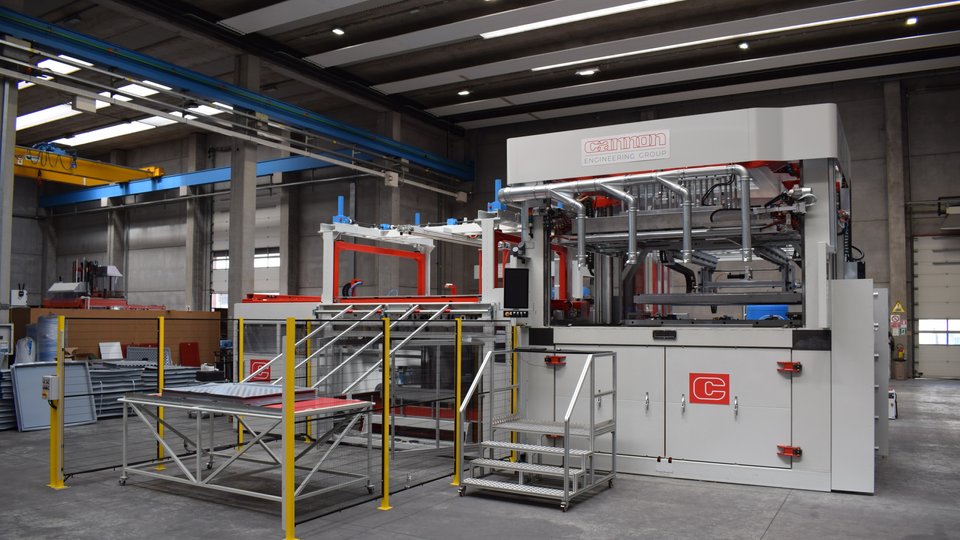
Linbrunner has installed an electric e-Forming twin-sheet thermoforming machine. Cannon's system provides a clamping force of 600 kN and a forming area of 2750 × 2200 × 600 mm while standing 4.8 m high.
The market requires thermoforming companies not only to manufacture high-quality parts, but also to remain flexible during frequent product changes, reduce operating costs and make efficient use of available factory space. Linbrunner faced these conditions. Founded in 1988 and based in Mengkofen, Germany, the family-owned company manufactures thermoformed parts for customers in various sectors. The diversity of the markets served means that production rarely runs in long, uninterrupted batches. Frequent tool changes and varying part dimensions require a production system that can be adapted quickly without reducing productivity. At the same time, rising energy costs and the factory's space constraints meant that installing larger equipment was not a straightforward solution. Linbrunner needed a machine that would increase production capabilities while fitting into the existing facility.
Compact design and larger forming area
The latest version of Cannon's e-Forming series is a twin-sheet thermoforming machine redesigned to address specific production constraints. One of the main challenges was the available building height. Many production facilities in Germany are between six and nine metres high, limiting the space available for generally large thermoforming equipment.
To address this issue, Cannon changed the architecture of the vertical drive system. The result is an all-electric thermoforming system which, according to the company, is the most compact solution of its kind available on the market. The machine provides a clamping force of 600 kN while standing 4.8 m high.
The design allowed Linbrunner to install a higher-capacity machine without modifying the building. The maximum forming area was increased to 2750 × 2200 × 600 mm. The previous machine, occupying the same space, offered an area of 2160 × 1260 × 400 mm.
Faster changeovers and compatibility with existing moulds
Linbrunner handles relatively small production batches, so operators change tools several times during the day. Reducing changeover time was one of the main design objectives. On the e-Forming machine, moulds can be changed externally, allowing tools to be prepared while production is continuing. An integrated roller conveyor, automatic locking system and optional mould preheating are intended to further reduce downtime and simplify operation.
The patented Triplo system uses an adjustment mechanism driven by three motors. It enables infinitely variable adjustment of part dimensions within the minimum and maximum parameters of the forming area. Settings can be saved and recalled, speeding up tool changes.
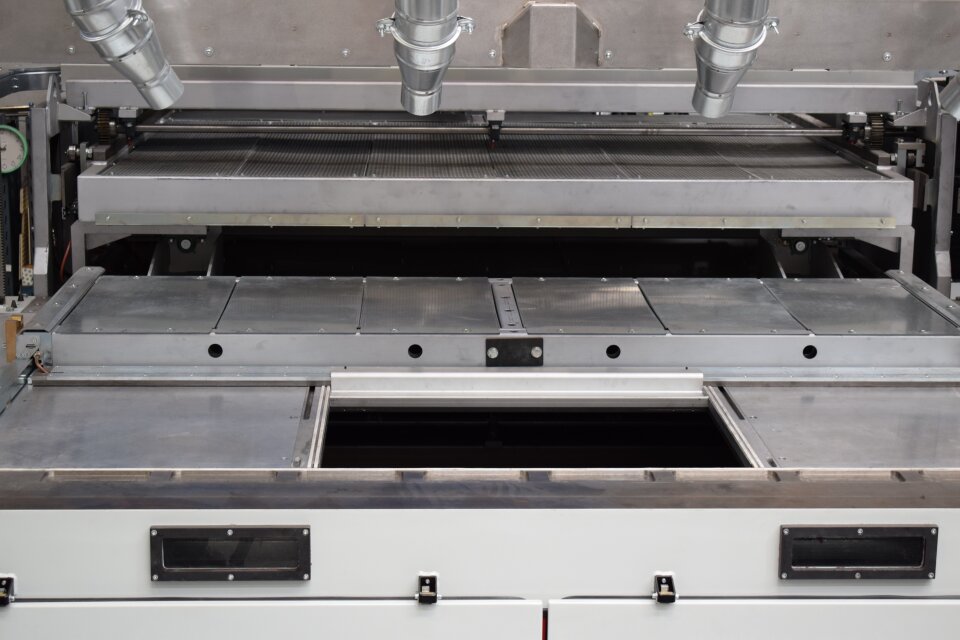
Compatibility with the tooling previously used by Linbrunner was also important. Cannon developed an adapter system that allows the existing moulds to remain in use. The machine can operate as either a twin-sheet or single-sheet system, providing additional flexibility without requiring separate equipment.
Energy management in the heating process
Heating is the most energy-intensive stage of thermoforming and therefore represents the main area for reducing operating costs. The e-Forming machine uses medium-wave infrared MW-IR halogen heaters and Cannon's Energy Management System.
The software automatically selects the heating strategy, switching between rapid-heating and energy-saving modes while following predefined temperature profiles. The heating banks and lamp layout have been redesigned so that the heaters are positioned closer to the plastic sheet. This is intended to improve heat-transfer efficiency and reduce energy consumption.
Automatic power map generation
The Easy Power Mapping function embeds the knowledge of experienced thermoforming technicians in the machine software. The system automatically generates the main recipe parameters, creating a power map for the heating elements based on the same part geometry used by the CAM system. As a result, less experienced operators can also achieve consistent forming quality without lengthy trial-and-error parameter selection.
Six independently controlled servo drives
The forming station uses newly developed electromechanical mould platens driven by six independently controlled servo motors. The control system continuously balances the forces applied across the mould. This is intended to ensure uniform clamping pressure even when working with asymmetrical tooling configurations.
The solution is combined with redesigned clamping frames, an adjustable cartridge, reinforced guide systems and precision motion control. According to the supplier, this configuration improves dimensional accuracy, process stability and consistent part quality throughout the production cycle.
A response to factory constraints
Linbrunner's investment was intended to address several practical issues simultaneously: limited factory space, rising energy costs, frequent changeovers and the need for flexible production. Redesigning the machine around these requirements made it possible to increase the forming area and retain the existing tooling without modifying the building. The new system is also expected to improve operating efficiency and prepare the company for further increases in production capacity while maintaining the required product quality.