MachinePoint and Poland: A key alliance in the growth of the european used machinery market
At a time when the European plastics industry is seeking to modernize, reduce costs, and move toward more sustainable models, used machinery has gained unprecedented prominence. Poland has emerged as one of the driving forces behind this transformation in Europe, with growing demand for used equipment and a notable capacity for exporting second-hand machinery.
In this context, MachinePoint has established itself as the trusted intermediary connecting the supply and demand of used machinery in Poland with the rest of the world. Thanks to its international network, comprehensive services, and local team, the company enables secure, efficient transactions that align with the new demands of the market.
The dynamism of Poland’s industrial ecosystem, combined with MachinePoint’s expertise, is driving a new phase in the used machinery trade, crucial for the sector’s competitiveness and sustainability.
Poland's used film machinery market diversifies: Which technologies are leading?
Poland’s used plastic film machinery market is showing increasing diversification, with extrusion, converting, and printing technologies taking center stage. This growth is driven by the expansion of flexible packaging, sustainability requirements, and the rise of e-commerce.
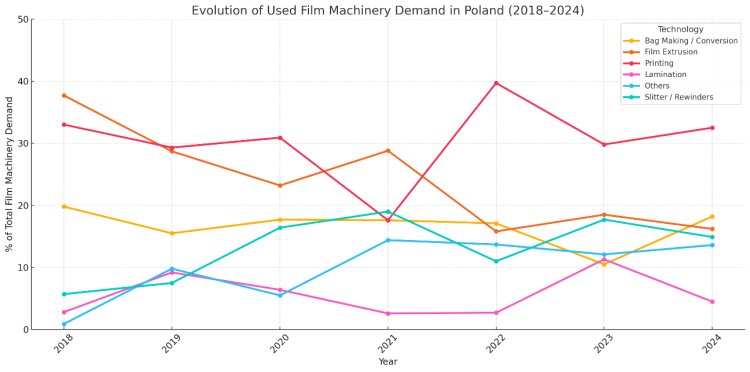
Among the most in-demand technologies are blown film extrusion lines, essential for producing bags, agricultural film, and flexible packaging. Film extrusion - covering technologies such as blown film and cast film - has seen its share of demand drop from 38% in 2018 to 16% in 2024. This does not indicate a loss of interest but rather reflects the growing variety of market needs.
At the same time, film printing machinery (including flexography, rotogravure, tape printing, etc.) has steadily gained ground, reaching 33% of demand in 2024. This growth signals a clear interest among Polish converters in customization and value-added technologies for flexible packaging. Also noteworthy is the stability of the converting and bag-making segment, which has maintained a steady share of around 18%, supported by high demand for formats such as pouch bags, industrial sacks, and bottom-sealed bags.
Although lamination has shown more volatile behavior, with peaks of interest in 2019 and 2023, it remains a relevant technology in strategies aimed at differentiation and technical performance improvement.
Poland’s used film machinery market shows a strong preference for well-established European brands. Manufacturers such as Windmöller & Hölscher, Macchi, Bandera, and Reifenhäuser demonstrate their leading position in blown film extrusion lines, while others like SML and Colines maintain a steady presence in cast film lines. Year-over-year trends indicate that these brands have sustained consistent demand despite the sector’s growing technological diversification, solidifying their status as reliable choices for Polish companies in the flexible packaging industry.
The role of used machinery in the circular economy
Today, sustainability and resource efficiency are top priorities, making used machinery a key element of the circular economy. MachinePoint has strongly embraced this model, enabling companies to optimize their production lines through the reuse of high-quality equipment.
In countries like Poland, this approach is being reinforced by public policies that offer subsidies to companies purchasing new machinery as part of their transition strategies toward circular models. This financial support is driving the sale of older equipment, creating a key opportunity for the used machinery market. It is precisely at this point that MachinePoint plays a strategic role, connecting the supply generated by these upgrades with companies looking for cost-effective and sustainable solutions.
One particularly relevant area in this process is plastic recycling, where MachinePoint offers a wide range of used equipment, from recycling lines to shredders and extruders, helping close the material life cycle and reduce the need for new raw materials.
Repelletizing lines remain at the core of recycling demand in Poland, although their market share has decreased from 55% in 2018 to 40% in 2024, as the market diversifies toward earlier stages in the recycling process.
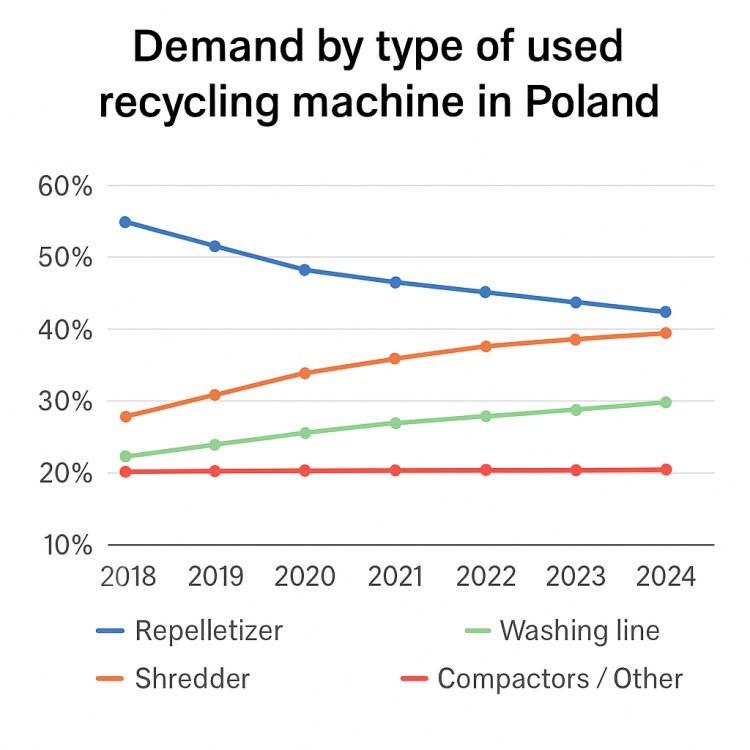
Shredders have gained ground, rising from 25% to 33%, confirming a growing interest in efficient reduction before extrusion or washing.
The most notable growth has been seen in washing lines, which have increased their share from 12% to 18%. This trend is closely linked to the recycling of film, big bags, and agricultural packaging, which require thorough cleaning beforehand.
Finally, compactors and auxiliary systems (such as agglomerators) have maintained a steady presence of around 8-9%, covering technical niches and specific solutions.
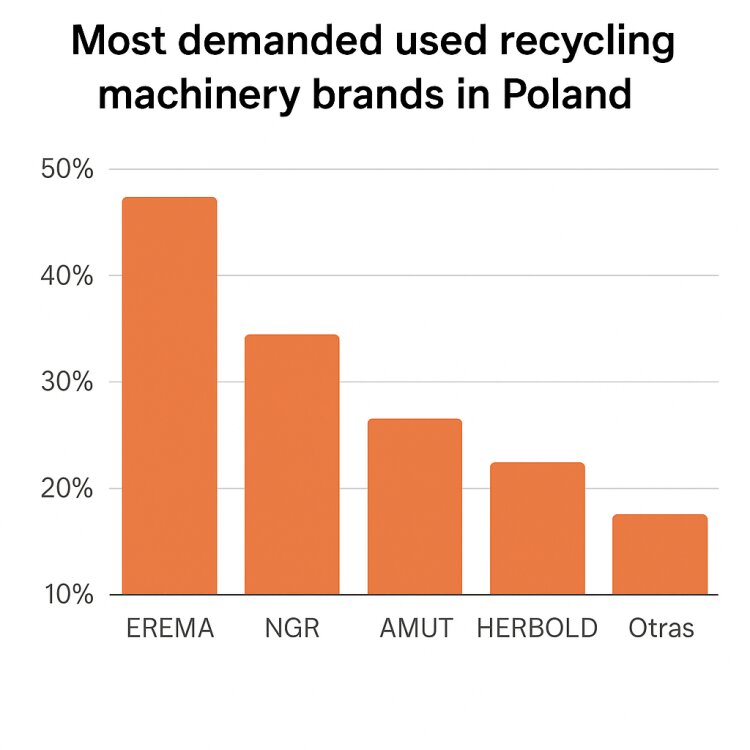
Some brands have firmly established themselves as undisputed leaders among buyers of recycling machinery. EREMA clearly leads the field, accounting for approximately 45% of the average total demand in recent years for recycling-specialized brands, thanks to its advanced extrusion technology and reliability in processing post-consumer materials. It is followed by NGR, with around 20% of inquiries, highly valued for its efficiency in high-capacity post-industrial applications.
The Italian brand Amut, with a 15% share, stands out for its complete lines integrating washing and repelletizing, especially for PET and film recycling. Herbold, holding 10% of the demand, has become synonymous with durability in shredding and washing systems.
Rounding out the landscape are brands like Starlinger, Linder, Polystar, and Plasmac, which together account for the remaining 10%, focusing on compact solutions, film recycling, and specialized applications such as big bags and light waste.
This distribution highlights a clear concentration around a few leading brands while also reflecting the growing technical diversification and specialization of the sector.
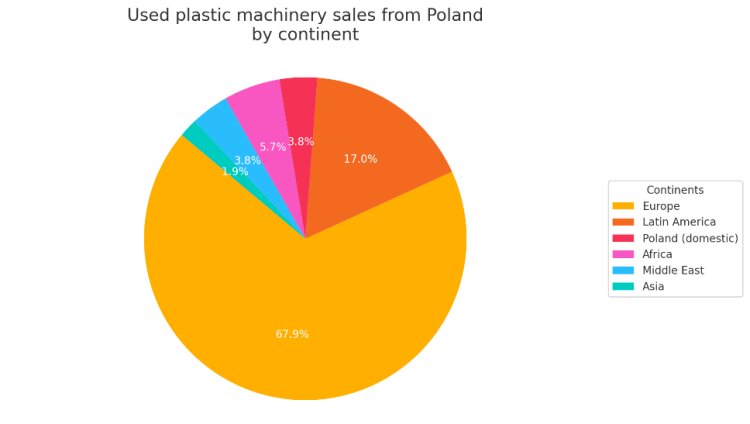
Between 2019 and 2024, export data for used plastic machinery managed from Poland reveals a distinctly international profile. According to MachinePoint records, over 66% of sales were directed to other European countries, solidifying the continent as the main destination for these transactions. Latin America ranked second with 16.7% of exports, followed by Africa (5.6%), the Middle East (3.7%), and Asia (1.9%). Notably, only 3.7% of the used machinery sold remained within the domestic market.
This remarkable export capacity not only reflects the competitiveness of the Polish industrial sector, but also underscores the pivotal role of players like MachinePoint, whose extensive experience and international network of buyers and sellers have enabled these machines to reach markets across the globe. Thanks to this global commercial infrastructure, many Polish companies are able to place their equipment in distant destinations efficiently and with full guarantees - further reinforcing the global nature of their operations.
Commitment to the polish market
Each year, the MachinePoint team takes part in the world’s leading trade fairs for the plastics industry, and Plastpol in Kielce is a key event on its calendar. Attending this fair allows MachinePoint to stay closely connected to the Polish industry, identify new trends, and reinforce its commitment to delivering solutions tailored to the needs of the local market.
Currently, MachinePoint offers an inventory of over 2,000 machines for sale, enabling us to meet a wide range of industrial needs. But our work goes far beyond buying and selling: we provide a comprehensive set of services that cover the entire transaction process, minimizing risks for our clients. Thanks to our ability to organize physical and video inspections, as well as our dismantling, transport, international logistics, and secure contract services, we make it easier to implement projects anywhere in the world.
At MachinePoint, we have witnessed the evolution of the sector in Poland firsthand. The machinery we manage from this country is not only diverse but also stands out for its high quality standards, reflecting a highly technical and increasingly sophisticated local industry. For our clients, this represents a clear opportunity to acquire high-performance equipment at more competitive prices than those of the new machinery market.
For more information check our website.
Read more: