South Korea's plastics and rubber industries at a crossroads
South Korea's plastics and rubber industries are moving from a volume-driven petrochemical model towards engineering plastics, advanced recycling and bio-based materials, supported by strict government policies, including recycled content mandates for PET bottles and eco-design rules.
South Korea's plastics and rubber industries are at a transformative crossroads in 2026, undergoing a fundamental restructuring from a traditional volume-centric petrochemical hub to a high-value ecosystem driven by sustainability. The sector is supported by strong demand from the automotive, electronics, packaging and industrial manufacturing sectors, and benefits from lightweight materials used in electric vehicles (EVs), consumer electronics and advanced packaging solutions. With a domestic market valuation of USD 14.25 billion, projected to reach USD 19.94 billion by 2034, the industry is growing not through volume expansion but through strategic shifts towards engineering plastics, advanced recycling technologies and bio-based materials. This transformation is accelerated by ambitious government policies, technological innovation and the need to address Korea's difficult environmental profile: within the Organisation for Economic Co-operation and Development (OECD), the country is the second-highest per capita plastic waste generator, at 103.9 kilograms per person per year.
The Korean government has set a framework targeting a 30% reduction in plastic waste by 2030 through comprehensive circular economy initiatives. These policies create guaranteed domestic demand for recycled materials and fundamentally reshape production economics through eco-design incentives and mandatory recycled content requirements. The industry has shown considerable adaptability: major petrochemical companies have voluntarily reduced naphtha-cracking capacity by 2.7 million to 3.7 million tonnes per year, while investing in specialty chemicals and advanced recycling infrastructure.
Market dynamics and economic context
The plastics market is growing at a compound annual growth rate (CAGR) of 3.80% between 2026 and 2034, while the recycled plastics segment is expanding faster, at a CAGR of 6.56% over 2025–2035. Engineering plastics, driven by electronics and automotive applications, are projected to reach USD 6.79 billion by 2029, growing at a CAGR of 7.09%. This growth reflects a fundamental market restructuring in which value creation comes from three main drivers:
- high-performance engineering plastics with premium pricing for electric vehicle and semiconductor applications;
- bio-based and recycled content materials benefiting from regulatory mandates and consumer preferences;
- specialised chemical recycling technologies enabling circular material flows that could not previously be achieved through mechanical processing alone.
The Korean petrochemical sector has carried out strategic capacity rationalisation in response to the global supply glut and stronger regional competition, particularly from Chinese manufacturers using economies of scale and Middle Eastern producers benefiting from lower feedstock costs. Ten major South Korean petrochemical companies collectively reduced production capacity, signalling the industry's shift from commodity resin production towards specialty chemicals and advanced materials, where technical specifications justify premium pricing. In addition, the government's decision to exclude thermal recycling (incineration) from official recycling statistics, although it initially lowers reported performance, creates a strong incentive for investment in material recycling technologies and infrastructure.
Sectoral transformation and application markets
Packaging
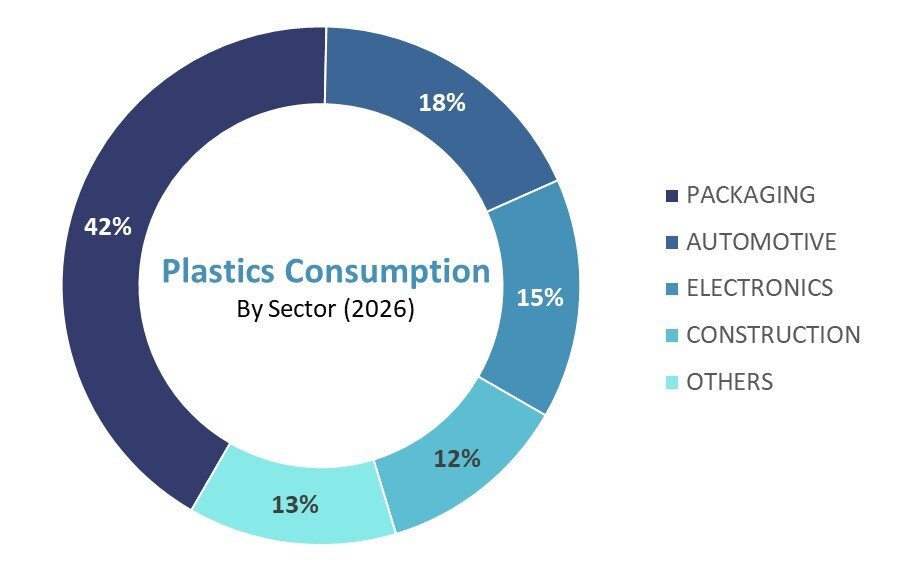
Accounting for 42% of total plastics consumption, the packaging sector is undergoing a fundamental transformation driven by the label-free mandate and circular economy requirements. Since 1 January 2026, the Ministry of Climate, Energy and Environment has prohibited plastic labels on all bottled water products. Essential product information must be permanently printed or engraved on bottles or caps, with supplementary consumer information accessible via QR codes. The initiative eliminates 2,270 tonnes of plastic waste per year and improves recycling efficiency by removing adhesive residue contamination that reduces material quality.
The regulation has increased demand for precision marking technologies, including UV and fibre laser coders capable of marking transparent PET without structural damage, as well as high-contrast, durable QR code inkjet printers for bottle caps. Suppliers offering modular units compatible with retrofitting on existing form-fill-seal production lines have gained a competitive advantage. Beyond the label-free mandate, the industry is moving towards mono-material designs to facilitate mechanical recycling, replacing multi-layer flexible packaging with single-polymer alternatives that maintain barrier properties through coextrusion and surface treatment rather than lamination of incompatible materials.
Automotive and mobility
The automotive sector accounts for 18% of plastics consumption, and demand is changing as a result of electric vehicle adoption. Korea's EV fleet is projected to reach 1 million units in 2026, creating unprecedented demand for specialised polymers. EV manufacturers prioritise weight reduction to maximise battery range, using transparent polypropylene compounds for sensor-integrated exterior panels and high-performance polymers for battery housings that require effective thermal management and flame resistance. Hyundai Motor's KRW 930 billion hydrogen fuel cell plant in Ulsan, scheduled for completion in 2027, will mass-produce polymer electrolyte membrane (PEM) electrolysers based on advanced fluoropolymers and specialised rubber seals able to withstand high-purity hydrogen environments under extreme conditions.
Electronics and semiconductors
The electronics and electrical sector represents 15% of consumption but generates disproportionately high value due to stringent material specifications. Korea's strong position in semiconductors and IoT devices has pushed the engineering plastics market towards USD 6.79 billion by 2029. Key applications include:
- high-purity polymers for wafer handling in semiconductor manufacturing;
- chemical-resistant materials for process equipment;
- ultra-clean room construction materials;
- high-frequency dielectric materials for 5G infrastructure;
- flame-retardant enclosures meeting UL 94 V-0 standards;
- thermally conductive but electrically insulating compounds for heat dissipation in AI servers and data centres.
Government policy and regulatory framework
The Korean government's Circular Economy Action Plan sets the most ambitious plastic waste reduction targets among developed economies. Two interconnected policy mechanisms drive the transformation of the industry.
The rPET mandate
Since 1 January 2026, beverage producers using more than 5,000 tonnes of PET per year must incorporate at least 10% recycled PET (rPET) in their bottles, rising to 30% by 2030. This baseline requirement creates guaranteed domestic demand for recycled materials and drives investment in collection, sorting and reprocessing infrastructure. Meeting food-grade rPET specifications requires decontamination processes equivalent to FDA and EU requirements, which has led Korean processors to invest in super-clean recycling technologies, including solvent-based decontamination and solid-state polymerisation to restore intrinsic viscosity to virgin-equivalent levels. The mandate has created price premiums for post-consumer PET: in early 2026, food-grade rPET was trading at 110–130% of virgin PET prices, although this gap is expected to normalise as production capacity expands in 2027–2028.
Korean eco-design framework
The government has introduced comprehensive eco-design criteria applying economic incentives and penalties based on recyclability assessments. Products considered difficult to recycle face Extended Producer Responsibility (EPR) fee surcharges of up to 30%. These include multi-material laminated packaging, black plastics that interfere with optical sorting, and products using problematic adhesives. Highly recyclable designs, by contrast, receive EPR fee reductions of up to 50%, with qualifying criteria including mono-material construction, minimal use of colourants, water-soluble adhesives and standardised formats compatible with automated sorting systems. The Korea Environment Corporation (K-eco) manages the assessment and certification process, evaluating products for material composition, difficulty of separation, compatibility with infrastructure and contamination potential.
Technology solutions and Industry 4.0 integration
Meeting strict recycled content mandates requires technological progress across the recycling value chain. Korean facilities are deploying AI-based optical sorting systems with 99.9% accuracy to separate food-contact materials from technical and contaminated streams. These systems use near-infrared (NIR) spectroscopy to identify polymer types based on molecular absorption signatures at sorting speeds above 3 metres per second, machine vision with deep learning to recognise bottle shape, colour and contamination patterns, and X-ray fluorescence (XRF) detection to identify bottles containing hazardous additives or heavy-metal-based colourants that require separate handling.
Chemical recycling
Conventional mechanical recycling is limited by quality degradation caused by chain scission and accumulated contamination, which restricts the share of recycled content in demanding applications. Chemical recycling technologies break polymers down into monomers or oligomers, enabling repeated recycling loops. Pyrolysis systems thermally decompose mixed plastic waste at 400–800°C in oxygen-free conditions, producing synthetic crude oil suitable for naphtha crackers and closing the loop for materials that would previously have been incinerated.
SK Chemicals is launching its Recycle Innovation Centre (RIC) pilot facility in Ulsan in 2026, focusing on glycolysis-based PET depolymerisation. The process chemically breaks PET polymer chains into bis(2-hydroxyethyl) terephthalate (BHET) monomer, which is then repurified and repolymerised to produce virgin-equivalent material suitable for food-contact applications. The Korea Institute of Machinery & Materials (KIMM) is demonstrating a plasma-based recycling technology capable of processing mixed plastics without pre-sorting. Plasma gasification converts polymers into synthesis gas (syngas), which can be used as feedstock for Fischer-Tropsch synthesis or methanol production, enabling the recovery of value from mixed waste streams that are difficult to recycle.
Smart manufacturing
Korean plastics manufacturers are adopting Industry 4.0 technologies to address labour shortages and optimise material use. Leading facilities use digital twins, virtual replicas of production lines, to simulate changes in material formulation and process parameters before physical implementation, reducing trial costs and material waste. Inline NIR spectroscopy monitors melt quality during extrusion and injection moulding, enabling immediate process corrections to maintain compliance with specifications. Collaborative robots (cobots) used for material loading, quality inspection and packaging operations help to address workforce constraints while improving ergonomics and safety.
Biodegradable Plastics Industry Promotion Act
In November 2025, the National Assembly introduced comprehensive legislation establishing a systematic framework for the development of the biodegradable plastics industry. The Biodegradable Plastics Industry Promotion Act is a strategic policy initiative intended to position Korea as a global leader in bio-based materials. The Act defines biodegradable plastics as polymers manufactured from biomass or petroleum-based materials that ultimately decompose into water and carbon dioxide or methane through microbial action under specific degradation conditions, including composting, natural soil and marine environments.
The Minister of Trade, Industry and Energy is to establish and implement a five-year Basic Plan covering policy direction and objectives, promotion of product development and use, technology development and dissemination, and training of a professional workforce. A Biodegradable Plastics Industry Promotion Committee will deliberate on the formulation of the Basic Plan, review of its implementation and changes to the system. Support mechanisms include government-funded technology development research, international cooperation initiatives, preferential procurement by public entities, quality mark certification administered by specialised agencies, tax incentives, pre-clearance customs release for research materials, and professional workforce development through designated universities and research institutions.
Strategic outlook and investment priorities
Several converging trends will sustain market growth until 2035. Mandatory recycled content requirements create guaranteed domestic demand for recycling infrastructure and technology, supporting the economics of investment in advanced sorting and chemical recycling facilities. The expansion of electric vehicles drives demand for lightweight engineering plastics, specialised battery materials and hydrogen infrastructure components, including fluoropolymer membranes and high-pressure seals. Korea's leading position in semiconductor manufacturing ensures continued demand for ultra-high-purity materials and specialised process equipment components. Korean recycling technologies and high-performance materials designed for circular economy requirements give domestic producers an advantage in European and North American markets that are implementing similar regulatory frameworks.
Strategic technology investment priorities include:
- advanced recycling technologies enabling repeated recycling loops and virgin-equivalent quality;
- bio-based polymers with performance characteristics matching petrochemical equivalents, supported by the framework of the Biodegradable Plastics Industry Promotion Act;
- smart manufacturing integration with digital systems, AI-based quality control and automation, addressing labour constraints while improving efficiency;
- specialty polymers for demanding applications, including semiconductor manufacturing, EV components and 5G infrastructure.
As a result of the ongoing transformation of South Korea's plastics and rubber industries, growing demand for advanced equipment, materials and technological solutions has made the country one of the largest sources of overseas visitors to Chinaplas. Participation in the trade fair and its concurrent events gives South Korean visitors opportunities to source advanced processing machinery, establish technology partnerships and open export channels for domestic recycling technologies. From a trade policy perspective, key priorities include using existing Free Trade Agreements (FTAs) to streamline equipment imports and material exports, securing technology licensing agreements for advanced recycling processes, and participating in international standardisation initiatives to ensure global recognition of Korea's eco-design standards.
Plastics consumption by sector (2026)