Circular plastics in Poland and Europe
The latest data from Plastics Europe’s The Circular Economy for Plastics: A European Analysis report shows that while the circular transition of the plastics system is picking up pace, there is still much to be done.
On the pathway to a circular plastics economy
The concept of a circular plastics economy is defined as “a sustainable model where plastics remain in circulation longer, their use is reduced, and they are reused and recycled at the end of their life span.” As noted in the report, this makes it possible to retain the value of plastic waste as a resource while reducing CO2 emissions and preventing plastics from ending up in landfill, being incinerated or polluting the environment, including the oceans. This year’s report discusses in detail the different recycling technologies and the types of plastics made from non-fossil-based feedstock, that is, bio-based plastics, bio-attributed plastics and plastics derived from carbon capture and utilisation.
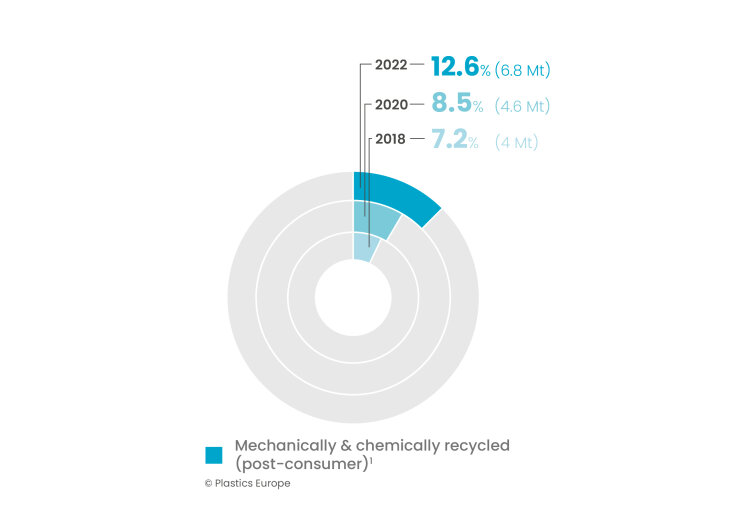
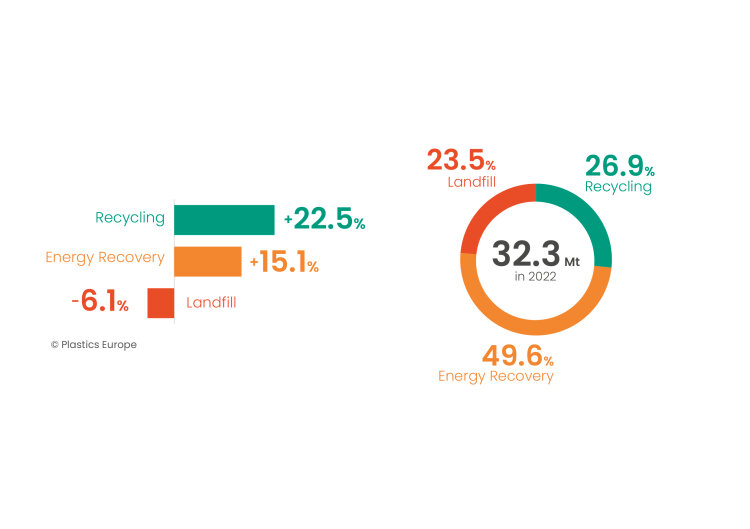
As previously noted, “circularity is the fastest, most affordable, effective and reliable method for reducing plastics waste and GHG emissions from the plastics system.” The Circular Economy for Plastics: A European Analysis shows that the circular transition of the plastics system accelerated considerably in 2018-2022. This is evidenced, for instance, by the 70% increase in the availability of post-consumer recycled plastics since 2018 (to 6.8 million tonnes in 2022) and by the fact that circular plastics now make up 13.5% (7.3 million tonnes) of all plastic resins converted into new products and components in Europe. As a result, Europe’s plastics system is now more than halfway towards achieving the intermediate goal set out in the Plastics Transition roadmap, which is to use 25 per cent of circular feedstock in new products by 2030. As regards recycled plastics, the recycling rate reached 26.9% (8.7 million tonnes) in 2022. This means that for the first time in history, more plastic waste is recycled than put into landfill, which is an important milestone on the path towards a circular plastics economy in Europe.
Recycling as the main source of circular feedstock
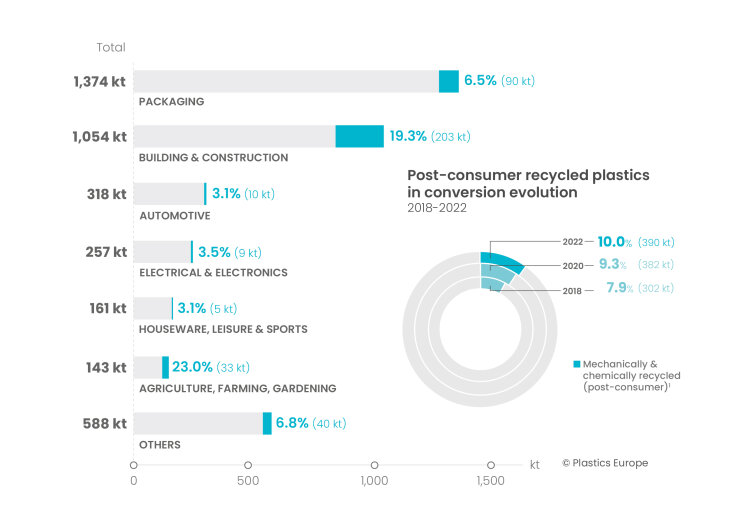
In 2022, European manufacturers relied on a variety of sources of feedstock to produce circular plastics. The main source was mechanical recycling, which accounted for 13.2 per cent of all feedstock, whereas the share of bio-based and chemically recycled plastics was only 1 per cent and 0.1 per cent, respectively. The use of circular plastics also varies between the different target sectors, with the highest demand coming from packaging, building/construction and agriculture. Against that background, other sectors such as automotive and electricals/electronics continue to lag behind.
The report also notes that in order to maximise recycling rates, it is necessary to significantly increase investment in sorting and recycling capacities, including those in chemical recycling. Innovative chemical recycling technologies are needed as a complement to mechanical recycling in order to tap the resource potential of plastic waste, especially the waste that is currently sent to landfill and incineration. Furthermore, improved Extended Producer Responsibility (EPR) schemes and other mandatory measures that incentivise mixed waste sorting also play and will continue to play an important role in increasing separate waste collection. Finally, fostering market demand for recycled plastics is another factor that may play a vital role in encouraging the necessary investment.
Challenges still remain
While many of the indicators show general progress towards circularity, the report also points to a number of challenges that require particular attention. For example, incineration with energy recovery increased by more than 15 per cent from 2018 (to 16 million tonnes in 2022), and approximately 25 per cent of plastic waste is still sent to landfill (7.6 million tonnes in 2022), even though a considerable portion of such waste could be recycled. The authors of the report emphasise that unless urgent steps are taken to increase the availability of circular feedstock, it will not be possible to sustain the current rate of progress and meet either European-level or industry-level circularity targets.
One of the challenges identified in the report is the growing competitiveness gap between Europe and the rest of the world. According to the authors, “Europe’s share of global plastics production decreased from 22% in 2006 (53,9 Mt) - when Plastics Europe began tracking global production data - to 14% in 2022 (58,8 Mt), with China, North America and the Middle East accounting for 32%, 17%, and 9% respectively.” As a result, Europe is becoming “increasingly dependent on imports which do not necessarily meet EU sustainability standards,” and the ability of European plastics producers (as well as many sectors that rely on plastics) to invest in circularity may be undermined. Hence, restoring the competitiveness of the European plastics sector is becoming vital to the EU’s economy.
Circular plastics in Poland
According to the available data, 2,365,000 tonnes of plastics were produced in 2022 in Poland, including 69.3 per cent from fossil-based feedstock, 19.2 per cent from post-consumer recycled plastics and 11.5 per cent from pre-consumer recycled plastics. Polish converters used 3,896,000 tonnes of plastics, of which 83.6 per cent came from fossil-based feedstock, 10 per cent from post-consumer recycled plastics, 6.2 per cent from pre-consumer recycled plastics and 0.2 per cent from bio-based feedstock. Overall, circular feedstock accounted for 10.2 per cent of all feedstock in new plastic products and components in Poland in 2022.
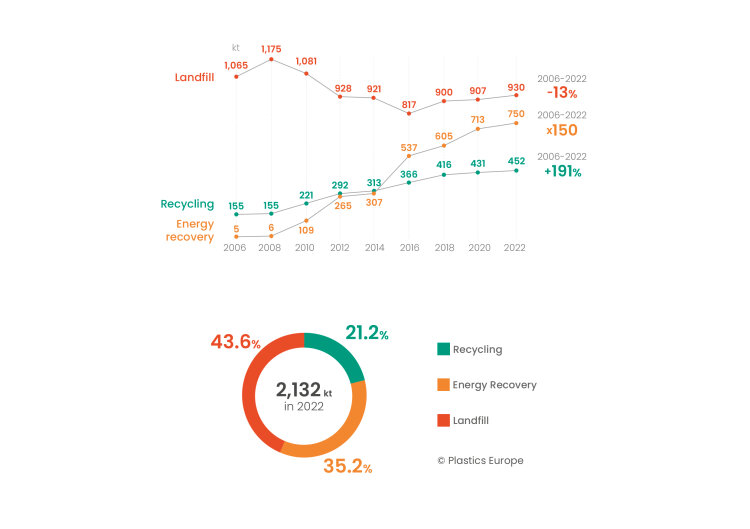
The recycling rate was 21.2 per cent, corresponding to 452,000 tonnes of plastic waste being recycled. While still below the European average, these figures point to a gradual improvement as the recycling rate grew 8.7 per cent compared to 2018. In line with the overall European trend, agriculture, building/construction and packaging are leading the market when it comes to the use of recycled plastics in Poland.
More to be done in the end-of-life phase
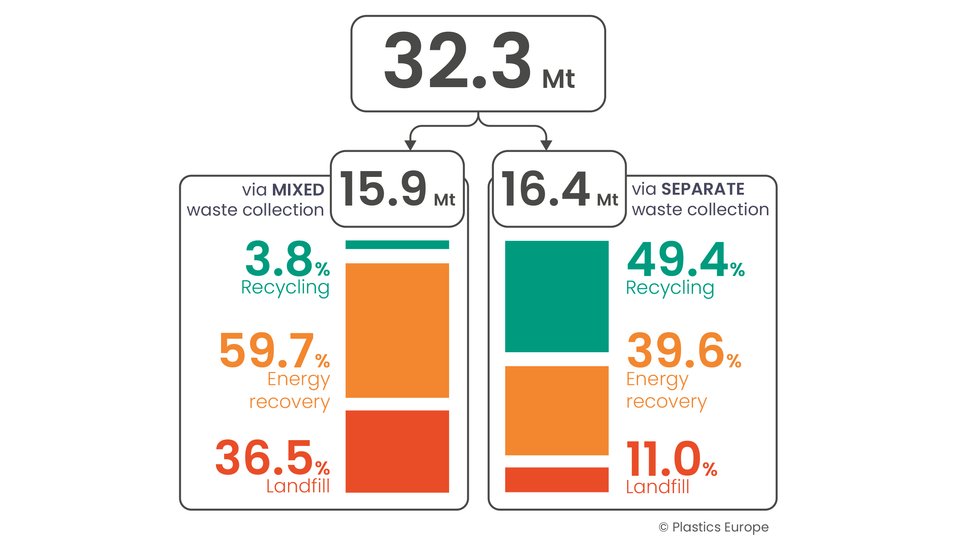
The report shows that the share of post-consumer plastic waste collected separately in Europe is, for the first time, slightly higher than the share of waste from mixed collection streams and stands at 50.7 per cent (16.4 million tonnes). In Poland, however, most plastic waste is still disposed of as part of mixed waste rather than through separate collection, the latter having a share of 43.1 per cent. This is a negative development that requires decisive remedial action, especially considering the fact that the recycling rate for separately collected plastic waste in Poland is as much as 15 times higher than for waste from mixed streams.
Too much waste is still being sent to incineration and landfill despite the adverse environmental impact of these processes and the loss of valuable material. While the share of incineration with energy recovery in Europe has increased by 15% since 2018, Poland has seen even more impressive growth at 24% in comparison with 2018. At the same time, landfilling of post-consumer plastic waste has been decreasing steadily (–6% since 2018). While this is a favourable trend, the report emphasises that the share of plastic waste sent to landfill is still too high (in 2022, the figures stood at 25 per cent for Europe and 43,6% for Poland). What is more, the trend is moving in the wrong direction as the quantity of post-consumer waste sent to landfill has in fact increased since 2016. Another unfavourable trend concerns separately collected waste, 11 per cent of which was still landfilled in Europe in 2022 despite the fact that the Landfill Directive imposes a ban on the landfilling of separately collected waste by 2030. In Poland, the share is even higher at 26%.
Circularity and the economic situation
Despite some progress towards circularity, economic statistics for Poland paint a mixed picture of the plastics industry. According to Eurostat data, overall industrial production in Poland fell 1.0 per cent in 2023 compared to the previous year; in the chemical industry (which includes polymer production), the drop was as large as 8 per cent. In the case of plastic and rubber products, there were some positive signs up to September 2023, but then production began decreasing from October onward. Seasonally adjusted indicators for the sector remained stagnant throughout most of 2023. Poland remains a net importer of plastics in primary forms and a net exporter of plastic products with a trade balance of -3,076,000 tonnes and 1,098,000 tonnes, respectively. Importantly, with Germany being Poland’s main trading partner in the import and export of both plastics and plastic and rubber products, the condition of Poland’s economy is directly dependent on that of its German counterpart, which is currently not showing any signs of significant recovery. Data from Poland’s Central Statistical Office also confirms the downward trend. The significant decreases in production volumes observed in Q1 and Q4 2023 across the manufacturing industry and in the rubber and plastic products sector continued in Q1 2024.
Country-level statistics from the Central Statistical Office indicate that the level of employment in the sector remains steady; another positive development is that capital expenditure in the industry is also increasing. While the chemicals and chemical products sector showed little overall growth in 2023, the rubber and plastic products sector grew considerably to PLN 7.4 billion (compared to PLN 6.1 billion in 2022).
Although industrial production in Poland fell 1.0 per cent in 2023 year on year, the plastics industry and its allied industries in the EU 27 - including the food and beverages, electricals and electronics, building and construction, and automotive sectors - recorded an increase in production. The fastest-growing sector was the automotive industry with an increase in production of 12.3 per cent compared to the previous year. The food and beverages sector and the electricals and electronics sector grew more slowly at 1.5 per cent and 1.4 per cent, respectively. “Looking at the big picture, the periodic upward and downward fluctuations in the industry contribute to economic uncertainty in Poland and leave Polish businesses in a limbo. If you combine this with the legislative pressure, the industry is faced with even greater challenges,” said Anna Kozera-Szałkowska.
Closer collaboration with policy-makers
Following the Plastics Transition roadmap, the authors of The Circular Economy for Plastics: A European Analysis point out how policy-makers could support the transition to a circular plastics system through appropriate policies and regulatory frameworks. One of the major enablers is public procurement, which can play a crucial role in promoting circularity - for instance by including circular plastic content as a criterion in public tenders. Furthermore, the authors point to the need to adopt a mass balance model (which is already used in sectors such as renewable energy, wood production or fair trade cocoa/chocolate) as a means of determining the content of chemically recycled plastics in new plastic products, and to introduce more ambitious recycled content targets for sensitive applications.
The report emphasises that collaboration between all actors within the European plastics system and policy-makers and regulators needs to be intensified. This is why the authors call upon the European Commission to urgently initiate a Clean Transition Dialogue with the plastics industry so as to identify the roadblocks and propose the solutions and investments that will enable the creation of a sustainable, net-zero circular plastics system in Europe.