KHS stretch blow molding technology
KHS combines NIR heating, the Double Gate concept and the new Airback 7 PRO compressed air recovery system to reduce energy and material consumption in PET bottle production. The KHS UltraLite 1.5-litre still water bottle weighs just 15.5 grams.
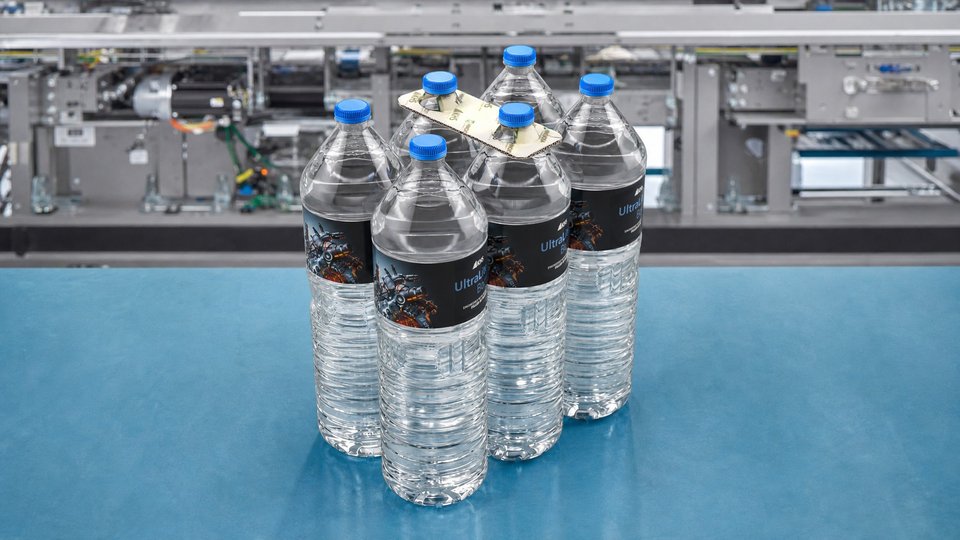
With its proven NIR heating technology and established Double Gate concept, KHS provides stable processes and efficient energy use in PET bottle production. Further savings potential comes from Airback 7 PRO: the latest generation of the KHS compressed air recovery system cuts the high-pressure air requirement during stretch blow moulding by up to 60% compared with systems without Airback. The lightweighting potential of these combined factors is illustrated by KHS UltraLite, a new 1.5-litre PET bottle for still water weighing just 15.5 grams.
"Our customers are extremely keen to lower their operating costs along the entire line and produce reliably over the long term. As their strategic partner, we support them from planning through operation to continuous optimization," says Arne Andersen, stretch blow molding product manager at KHS. With its lifetime solutions, KHS provides services covering a machine's full life cycle. Further technological developments enable existing lines to be adapted to new requirements.
For PET bottle production, KHS coordinates the stretch blow moulding process, machine technology and bottle design with one another. Targeted savings in energy and material consumption are given the same weight as bottle quality, line availability and productivity. "Only when we consider these factors as well can we unlock additional potential across the entire system," Andersen explains.
Double Gate for lower energy and space requirements
The Double Gate heating concept (DoGa) is designed to reduce customers' energy and space requirements. It is used on the InnoPET Blomax Series V stretch blow moulder and is therefore also included in combined KHS block systems. Based on near-infrared (NIR) heating technology, the preforms are transported through the heater in two parallel lanes for effective heating.
According to KHS, the compact Double Gate heating concept allows energy consumption to be reduced by up to 40% compared with similar single-lane stretch blow moulders. "Our technology has established itself as a benchmark in our customers' daily production operations. International users thereof include Coca-Cola Europacific Partners (CCEP) and Suntory PepsiCo Vietnam Beverage, for instance," states Andersen.
Latest Airback generation provides additional savings
With Airback 7 PRO, the latest generation of its compressed air recovery system, the Dortmund-based engineering company generates additional savings in the stretch blow moulding process. Before the bottle is demoulded, the high-pressure air is recovered and reused to stretch subsequent preforms. Additional compressed air only has to be supplied by the compressor for the final blow moulding stage. Compared with the previous model, the new generation has an extra recovery stage, increasing the possible reduction in compressed air consumption from a maximum of 40% to up to 60%.
"The lower compressed air requirement cuts the amount of energy required by the compressor and thus also operating costs. Accordingly, the smaller compressor size also potentially lowers the cost of investment," Andersen says. The first PET lines featuring this setup have been installed for several customers, and the consumption figures logged during production confirm the values given for the system. Airback 7 PRO will initially be installed on new KHS PET lines only. In the near future, however, the compressed air recovery module will also be available as a retrofit for modernising existing machinery.
KHS UltraLite with very low material consumption
With KHS UltraLite, a particularly light 1.5-litre bottle for still water, the systems supplier shows the potential of stretch blow moulding technology for reducing PET material consumption. The container weighs only 15.5 grams. The lower weight of the neck area and the specific design of the body and base geometries give it the necessary stability without additional nitrogen dosing. According to Andersen, the interaction between bottle design and system is key to its optimisation. With its container consultancy programme Bottles & Shapes, KHS supports customers throughout the entire PET bottle development process, from preform through design to final coordination with the production process.
"We've precisely aligned material distribution, the heating profile and blow molding pressure with our KHS process technology. Our new concept bottle shows which benchmark we can achieve in material consumption while retaining the container quality when packaging development and systems engineering dovetail with one another," says Felix Kösters, who is responsible for packaging development in the Bottles & Shapes programme.