New developments in the recycling of PET thermoforms in Europe
Report from the Petcore Europe Thermoforms Working Group and its public workshop
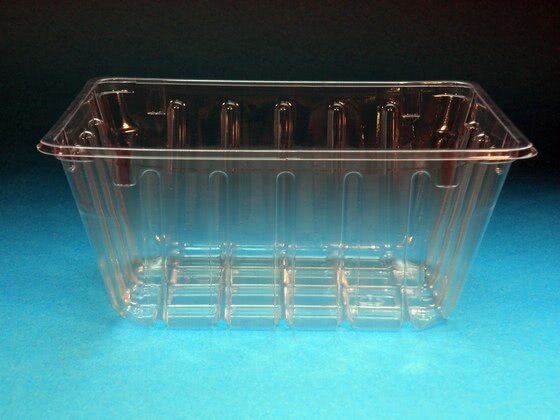
In this context, Petcore Europe has started its Thermoforms Working Group with the aim to increase and improve the recycling of PET trays into a third life. On 19 September 2017, the WG organised a public workshop in order to give the complete value chain an update on the activities and progress in the recycling developments of PET thermoforms. After an introduction and market overview, the workshop featured sessions on "Design-for-Recycling PET Thermoforms", "Collection, Sorting & Recycling" and "Potential applications & trial outcomes".
Market estimation: PET as the preferred solution for thermoforms
A market estimation - conducted by the Thermoforms Working Group and presented during the workshop - shows that PET is the preferred solution for monolayer, laminated (i.e. PET/PE for topweb sealing) and high gas-barrier (i.e. PET/PE/EVOH for modified atmosphere packaging) trays, while PS and PP are alternatives for open trays and clamshells. North European countries tend to have more mono-PET thermoforms than laminated and high gas-barrier PET ones, while it is the opposite for South Europe; however mono-PET is growing. Based on the market analysis, the following split applies:| Share | kTons | |
| Mono PET | 30 - 50% | 400 |
| Laminated PET | 25 - 35% | 300 |
| Barrier PET | 25 - 25% | 300 |
| Year | 2014 | 2015 | 2016 |
| 410 | 433 | 490 |
Design for Recycling Guidelines in PET thermoforms
Within the Petcore Europe WG, Design for Recycling Guidelines for PET thermoforms are currently being developed. The presentations of this session emphasised two main challenges that have to be considered in this context:1.Labels that are often too big and their glues are not suitable for easy removal in recycling plants. During the workshop a specific presentation demonstrated the potential improvement in recyclability given by new combinations of glue/labels on PET trays.
2.Soaker pads that are also glued with glues that are not suitable for easy removal in recycling plants. These pads could in any case be avoided by using a different design.
Collection, Sorting and Recycling
Since recycling targets go up, also collection targets follow. Even in countries where today PET thermoforms are not yet collected, this will happen in the future. A large test in France showed that recycling of monolayer PET trays together with bottles can work under certain conditions. The sorting requires software and devices that can distinguish between mono- and multilayer packaging and the recycling process is creating fines when the process is using high friction coefficient in washing/drying steps. Another approach is to sort all PET trays from bottles, eventually then sort monolayer from multilayer and develop outlets for the sorted fractions. Dedicated recycling lines for PET thermoforms are under development.
Development of applications for recycled PET thermoforms
The most obvious market for r-PET coming from thermoforms is to use them for the manufacture of new thermoforms. Several studies have shown that washing, extrusion and solid stating result in a good quality material for coloured applications. Retailers can increase the amount of deep coloured trays for vegetables and fruits and are invited to work with packaging producers on this solution. The material is also suitable to be used for agricultural trays.
Several tests have also shown that the use of PET thermoforms granulates can be used for monofilaments because the mechanical properties are very close to virgin PET. PET compounds for pellets and automotive applications are the next target and several connections within the industry have been established.
The workshop furthermore investigated the economics of a recycling stream of pure PET trays to produce material for compounding for injection molding applications and the final outcome looks quite promising.
Chemical Recycling
Chemical recycling is a promising technology for future recycling of “difficult to recycle” PET streams. Several start-up companies are in the stage of scaling up their technologies and tests have shown that recycling of PET/PE and PET multilayer trays will work. However, the important question is if industry will be able to develop these technologies to an industrial and economically feasible scale.
Source: Petcore Europe