Polyolefins congress highlights key industry issues
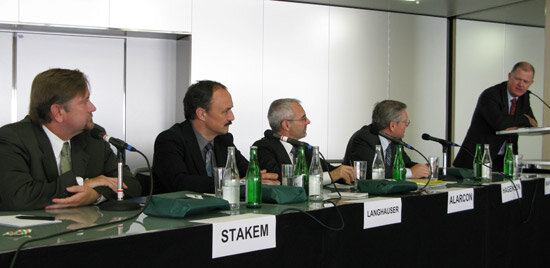
Key business and technology issues facing the polyethylene and polypropylene supply chains got a good airing at the PEPP 2009 global congress on polyolefins organized by Maack Business Services in Zurich in October. This annual meeting regularly attracts representatives from virtually all the world’s top polyolefin suppliers, and many of their customers.
Subjects coming under the spotlight this year included:
- the worsening polymer supply/demand imbalance;
- the increasing importance of supply logistics for bringing materials into Europe and North America from new mega-plants in the Middle East;
- the enduring importance of low density polyethylene in critical packaging applications;
- the advantages of comonomer flexibility for suppliers and users of linear-low density polyethylene;
- the role of additives in cost containment at polymer suppliers and processors.
In his scene-setting presentation, Konrad Scheidl, Executive V.P. and Partner at MBS, emphasized the global shift in PO production capacity. While 20 years ago, close to two-thirds of all global polyethylene capacity was in Western Europe and North America, by 2015 it will be just one-third, and the regions will be major net importers. The Middle East, China and Asia Pacific will have tripled their share to almost half, although China will still be a net importer. And all the while, total capacity will have almost quadrupled. Data for polypropylene are quite similar.
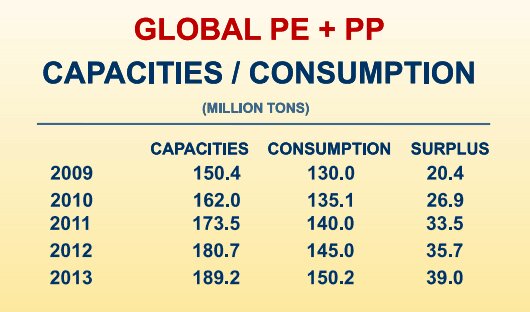
Global PE + PP capacity surplus through 2013 (Source MBS)
“Surplus factor” is much too high
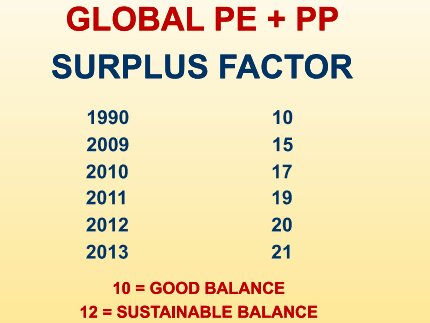
Scheidl demonstrated the dangers for producers through the use of the ‘surplus factor’ – nameplate capacity minus offtake, divided by nameplate capacity. A good surplus factor is 10, while 12 is sustainable, he said. And yet, overall, across PE and PP, it is almost 20 years since a 10 has achieved. The figure is already over 20, and could almost hit 40 by 2013.
Capacities totalling almost 50 million tpa are now at least 15 years old, and in some cases three times that, Scheidl noted. Their costs have been written off, and they could, theoretically, be shut down. “But sites die very slowly, if at all.”
Polyolefins surplus factor has not been sustainable for years (Source MBS)
Octene could supplant hexene as a comonomer
Peter Steylaerts, Linear Alfa-Olefins Regional Market Manager for Ineos Oligomers, gave an interesting presentation on current challenges in the polyethylene comonomer market. He indicated that with the current tightness in hexene that is due to last for many months, companies offering or using technologies that enable use of alternative monomers such as octene will be at an advantage. Demand for hexene is likely to out-strip supply until late 2011 at the earliest, Steylaerts said, whereas octene availability “is not an issue moving forward.”
Markus Gahleitner, IPR (intellectual property rights) Group Expert at Borealis, talked about the company’s Borstar PP for advanced packaging solutions. He cited two decisive elements: Borstar PP process technology and Sirius emulsion catalyst technology.“By combining a scientific and far-sighted approach to basic problems along the “chain of knowledge” from catalyst and process to modification and conversion with the intensive communications with customers and end users of our materials, it will be possible continue to expand the application range of polyolefins significantly,” Gahleitner said.
Logistics are increasingly important
As new polymer production centres emerge and expand, there is a growing need for improved logistics to move materials around plants, to and from shipping terminals and to customers. This year, PEPP devoted an entire session to the subject, with presentations from various players involved in the materials movement business.
Harald Wilms, Business Development VP at Zeppelin Silos & Systems, said that while the traditional model of polymer logistics has worked well within a single continent, where transport from the producer to the user could be done in virtually a single operation (mainly by truck in Europe, more by train in North America), extended distances between source and user soon require additional elements such as distribution centres, as well as specialist service providers. With intercontinental shipment, this is the norm.
Wilms outlined various storage and transport technologies available to close the link between the polyolefin producers and their clients in the downstream compounding and conversion industries. Discussing intercontinental shipment by bulk carrier, he said that with increasing capacities of polymer plants, their focus on few commodity grades per plant, and the export of these polymers to distant locations, new concepts may become economic in the future. “Any container ship can only be filled to a maximum of 2/3 with polymer containers,” he said. This problem can be overcome by using bulk carriers, similar to those known for bulk cargo shipments of grain or coal or minerals.
Toon Bruining, Group Supply Chain & Marketing Director at InterBulk Group, agreed that market developments are forcing the polymer industry to review existing supply chains. Over-capacity and volatile markets call for agile supply chains that are cost- and cash-efficient, he said. He also noted that multiple stock locations and divided responsibility for inventory management further increases stock levels.
Giant extrusion lines
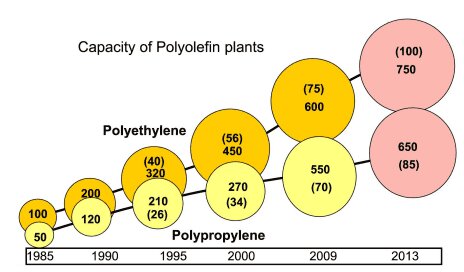
Klaus Kapfer, General Manager of Coperion’s polyolefins compounding systems business unit, discussed developments in extruder lines for latest mega-plants for PP and HDPE. He said that in the last 15 years of the last century, maximum operating capacities for single-train polyethylene plants more than quadrupled, while for polypropylene they were well over five times higher. With increased output has come increased reliability, as operating experience has grown.
It seems that the confidence of the plant developers has increased even more, because the growth rate, at least for polyethylene plants, has taken off in the first years of this century, with 600,000 tonne/yr plants six times bigger than the largest ones in operation in 1985. And by 2013, plants producing 750,000 tonnes/yr should be running.
PO plants continue to get bigger (Source Coperion).
Note: Numbers in bubbles are plant capacities in thousands of tonnes/yr and (in parentheses) tonnes/h.
In a session on high pressure technology for production of LDPE and copolymers, a Senior Technology Manager from LyondellBasell, Dieter Littmann, talked about the company’s Lupotech A autoclave technology. He noted that autoclave technology remains the best for making extrusion coating grades of LDPE. The company also offers Luptotech T tubular technology.
Littmann said the autoclave is a well established process with significant potential for further improvements, and because there are many similarities between Lupotech A and Lupotech T, recent Lupotech T advances are a solid basis for further Lupotech A developments.
“Novolen Technology: Flexible Approach to Satisfy Present and Future Market Requirements,” was the title of a presentation by Lummus Novolen Technology’s Director of Technology, Franz Langhauser. Novolen, a twin-reactor PP technology, is flexible in several ways, one of which being that reactors can be run in cascade or parallel according to requirements, enabling wide variations in output as well as polymer type. All sorts of co- and terpolymers are achievable, as well as very broad variations in molecular weight distribution.
Solving anti-oxidant issues
A session on additives included presentations on stabilizers, clarifiers and mineral modifiers. Klauss Keck-Antoine, Executive Officer, Global Application and Tech Services with Songwon Industrial, spoke about replacement of Trisnonylphenol Phosphite (TNPP) as a stabilizer in PE, and about if and where it is necessary and/or recommended. There are no restrictions on its use, but NP & derivates can potentially be formed from TNPP, and use of some of these is restricted.
Keck-Antoine showed that various phosphites can achieve better LLDPE quality than TNPP. He will give a follow-up presentation, illustrating a complete technical and commercial assessment of the issues, at the MBS conference Dubai Plast Pro 2010 next March.
Keck-Antoine’s views on TNPP were backed up by Jonathan Hill, Technology Director at Chemtura Manufacturing. Phosphites are by far the most effective class of secondary antioxidant hydroperoxide decomposers, he noted. Chemtura has introduced a new “next generation” liquid phosphite, Weston 705, which is structurally similar to an existing solid grade, Alkanox 240. Customer benefits include high performance and ease of use; improved durability and surface qualities of finished articles; improved processibility; and, last but not least, low cost.
PEPP, a unique event in the polyolefins supply chain calendar, is organized by Maack Business Services, which has been organizing conferences for the plastics industry for over 25 years. It is supported by chemicals intelligence company SRI Consulting, part of Access Intelligence. PEPP 2010 will be held in Zurich on June 14/15 2010.