The impact of optical sorting accuracy on the quality of polymer regranulate
If someone tried to trace their everyday life without plastic today, it would quickly prove to be an almost impossible task. Plastics have become so ubiquitous that it is difficult to notice how quickly everyday items turn into waste.
If someone tried to trace their everyday life without plastic today, it would quickly prove to be an almost impossible task. A bottle of water bought on the go, protective film on a parcel, a laptop keyboard, even spectacle lenses. All of these belong to the same, extremely diverse family of polymers. Plastics have become so ubiquitous that it is difficult to notice how quickly everyday objects turn into waste.
The problem arises when this mass of used polymers ends up where it shouldn't. At first glance, plastic waste seems homogeneous, because after all, ‘plastic is plastic’. In reality, we are dealing with a mosaic of materials with different chemical and physical properties that do not cooperate in the recycling process. PET mixes with PE, PP hides among PS, and added dyes or stabilisers further complicate the situation.
The problem of polymer waste diversity does not end with its collection and sorting. This is only the beginning of the journey. Every stream of plastic waste has the potential to be reborn as regranulate, a material that can get a second chance by becoming a bottle, a household appliance casing or a car part again. But the quality of this regranulate is not determined at the sorting stage.
Compromises in regranulate, or why purity is capital
In the plastics industry, the presence of unsuitable polymer in recycled granules acts as a defect in the structure: it reduces strength, impairs appearance and hinders further processing. Therefore, the purity and homogeneity of the feedstock is not only a technical issue, but also an economic and image issue. High-quality regranulate means not only stable mechanical parameters and the aesthetics of the final product. It also means the possibility of realistically replacing virgin raw materials, reducing oil consumption and reducing the carbon footprint. The better the regranulate, the fewer compromises the manufacturer has to make, and thus the greater the chance that recycling will become not an addition, but a full-fledged pillar of the circular economy.
Sorting accuracy as the silent architect of recycling – from waste to full-value raw material
If an error occurs at the beginning of the process, during segregation, the end result is a material of reduced value that is difficult to sell or use in demanding industries. Sorting accuracy therefore acts as a sieve that determines whether waste will be turned into a fully-fledged raw material or just a compromise mixture with limited possibilities.
Every additional percentage of ‘undesirable’ polymer in a batch of waste is a risk of producing defective regranulate. Even a small amount of polyethylene in the PET stream is enough to change its processing properties and reduce its quality. As a result, all the effort of collection, transport and washing is pointless if, at the end of the chain, we do not obtain material that meets market standards.
This is why sorting accuracy is not just a technological parameter. It is a key economic and environmental factor. The cleaner the input material, the higher the value of the output regranulate and the more realistic the vision of a circular economy becomes. In this context, optical sorting methods appear to be the answer to the challenges faced by recycling plants. They allow similar polymers to be distinguished, contaminants to be removed and material to be precisely directed to the appropriate streams, minimising losses.
Infrared in the service of recycling: from colour to plastic identity
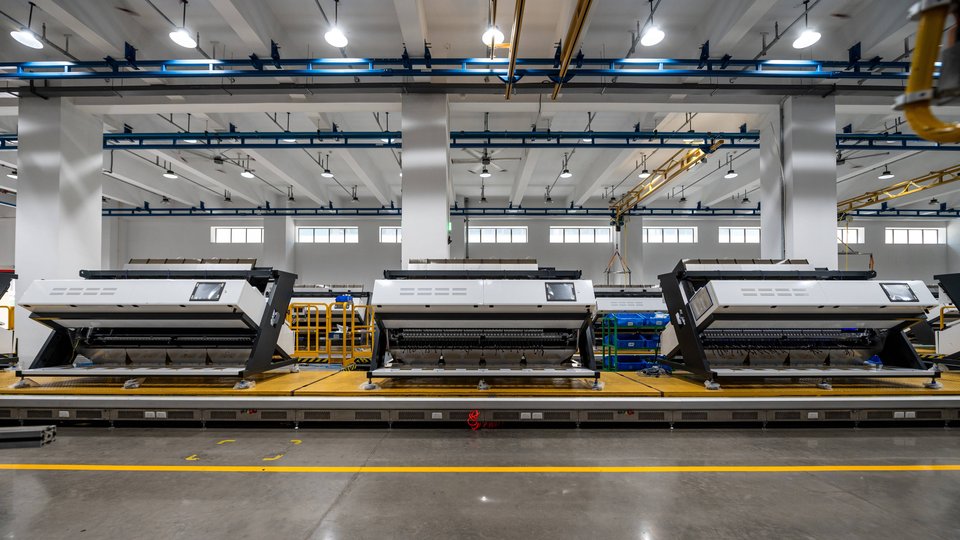
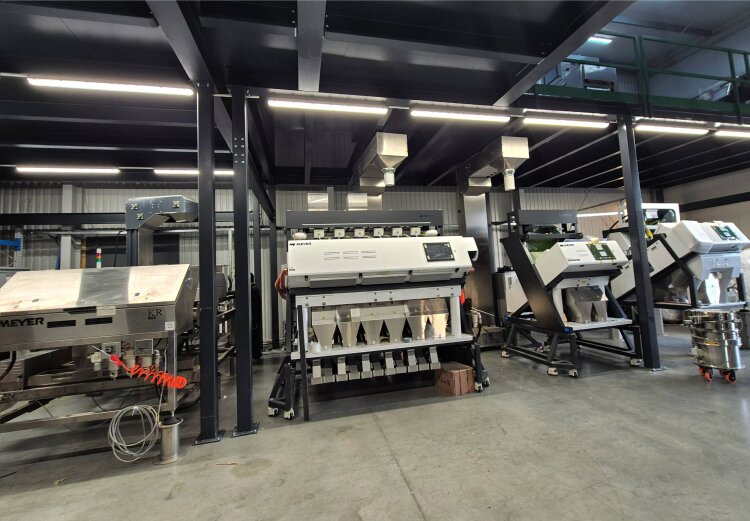
Optical sorting is, in a sense, the ‘artificial eye’ of recycling. Where humans see only colourful pieces of plastic, machines equipped with the latest technology can detect subtle differences in the structure of the material. Meyer sorters use near-infrared (NIR) technology, which allows them to ‘read’ the characteristic reflection signal for each type of polymer. PET, PE and PP, although similar at first glance, reveal their identity thanks to this invisible light signature.
In practice, the process looks like a quick show: polymers slide down a chute, a camera records the data, a computer analyses it, and a stream of compressed air ejects the fragment at the right moment. The whole process takes fractions of a second and is repeated hundreds of thousands of times per hour. This makes it possible to separate polymers that would otherwise form a chaotic mixture, difficult to reuse.
The impact of sorting quality on the regranulation process
Regranulate is a material whose true value lies not in tonnes or kilograms, but in purity. It determines whether a plastic granule will become a fully-fledged raw material or merely a substitute for a material that the industry does not really know what to do with. The road to quality begins at the selection stage. This is where it is decided whether the recovered polymers will retain their mechanical and chemical properties or be permanently contaminated by accidental admixtures.
A precisely organised waste stream offers the chance to obtain a material that can compete with virgin plastic without any complexes. However, a little chaos, a few unwanted polymers in the wrong place, and the end product becomes a compromise with limited applications and drastically reduced value.
This is where modern sorting machines, such as Meyer devices, which use near-infrared spectrum analysis, play a key role. They distinguish between polymers that look similar but have completely different properties. Thanks to this technology, there are no longer any stray PE or PP particles in the PET stream that could later ruin the regranulation process.
Mechanical properties
The strength and elasticity of regranulate are not abstract parameters from a table. They are the real consequences of every unwanted fragment of polymer that has found its way into the feedstock. A single foreign admixture acts as a weak link in the chain, weakening the entire structure. The result? A bottle that breaks more easily, film that loses its elasticity, or a connector in a system that cannot withstand loads.
Physicochemical properties
Melting point, viscosity and colour purity are the language in which the material tells its story. If even a small amount of PE creeps into PET, differences in melting points cause the mass to lose its homogeneity during processing. The granules do not flow as they should, the colour becomes dull or uneven, and the end product no longer looks like a full-fledged product.
Risk of degradation
Polymers do not forgive mistakes. They degrade chemically faster when contaminated and exposed to inappropriate conditions. Instead of a stable material, a raw material with poorer performance parameters is created, which loses quality with each subsequent processing. Therefore, accurate sorting is not just a preliminary stage, but the foundation on which the entire regranulation process rests. Without the support of precise optical systems, even the best production line is unable to provide material that meets market requirements.
From perception to perfection – the art of sorting
Precision in recycling begins where human vision ends. In Meyer optical sorters, it is no coincidence that distinguishing one polymer from another is done almost flawlessly. Behind it all are systems that combine physics, artificial intelligence and a touch of engineering finesse.
Maglev in action – when air directs the material
Meyer equipment is equipped with Maglev air ejectors that do not touch the material, yet are able to move it with almost surgical precision. Thanks to the levitation design, each air pulse is precisely targeted and immediate. The device reacts in milliseconds. The whole process looks like a well-coordinated dance: thousands of small elements detaching from the stream at the perfect moment, hitting the right channel. What is fascinating about this is not the speed itself, but the way in which the technology bypasses the physical limitations of classic mechanisms. The use of these ejectors allows for a level of precision that traditional springs or latches could only attempt to imitate.
Thinker and Master – Support systems and background data
Behind the scenes, there are also solutions that are not visible at first glance, such as Thinker and Master. The former collects and analyses data, while the latter enables remote operation and sends alerts before a minor problem turns into downtime. It is this intelligent layer of the system that means the operator does not need to be an expert in optics or mechatronics. The machine prompts, reacts and, to a large extent, monitors the quality of the process itself.
Meyer AI Deep Learning – machines that learn to see
Meyer machines no longer rely solely on cameras. They use deep learning systems. In practice, this means that they can recognise and classify fragments of materials based on a huge library of patterns, and can detect differences even at the level of a few pixels. In other words, they see what humans cannot see, and by analysing shape and colour, they are able to eliminate contaminants with a precision that seemed unattainable just a few years ago.
Preparation that determines success
It is worth remembering that even the most sophisticated algorithms and ejectors cannot cope with material that arrives on the conveyor belt in poor condition. That is why the preceding processes of shredding, washing and drying are no less important. Clean, properly fed input material is the foundation on which Meyer technology can show its full potential. Modern optical sorting is therefore not just about cameras. It is a coherent ecosystem, from material preparation, through artificial intelligence, to contactless Maglev ejectors. In this process, each element has one common goal: to obtain regranulate that is so clean that it can confidently replace the original raw material.
From precise sorting to perfect regranulate
n analysis of the impact of optical sorting accuracy clearly shows that precision at the segregation stage is the foundation of regranulate quality. Any inappropriate polymer in the waste stream affects the mechanical, physicochemical and aesthetic properties of the final material, limiting its use in demanding industrial processes.
Meyer sorters, using NIR technologies, intelligent AI support systems and precise Maglev ejectors, enable control at a level unattainable by traditional methods. The result is regranulate that becomes a fully-fledged raw material competitive with the primary material. The conclusions are clear: sorting accuracy is a key technological, economic and environmental investment, the effects of which are visible in the final products.
What does the future hold for recycling?
The future of optical sorting lies in even deeper integration with intelligent industrial systems. The development of machine learning algorithms, the ability to adapt to diverse waste streams and the full automation of monitoring processes open up new possibilities in both laboratories and production facilities.
Further research may enable even higher regranulate purity, better parameter repeatability and faster response to changing feed conditions. In this context, the Meyer Master 4.0 together with the KB plastics analyser can be seen as a preview of the future of sorting. This combination of intelligent material analysis, precise segregation and operator support systems represents a significant step towards modern, fully integrated sorting lines. Such solutions enable further technological development that sets the standard for future waste segregation systems, making them more intelligent, flexible and environmentally friendly.