Universal Robots and Inbolt – vision systems, robots and AI
Inbolt's AI-assisted 3D vision guidance software now runs directly on the CB7 Core controller of Universal Robots Gen 7 robots, without an external industrial PC or additional cabling.
At the SPS trade fair in Nuremberg, Inbolt and Universal Robots (UR), part of Teradyne Robotics, announced that Inbolt's AI-assisted 3D vision guidance software has been natively integrated with the UR Gen 7 robot platform. The new seventh-generation robot family is AI-ready from the factory and is intended to help manufacturers move artificial intelligence solutions from the laboratory to industrial applications. Inbolt is one of the first UR+ partners to run an AI-based application directly on the platform's CB7 Core controller following the Gen 7 launch in September.
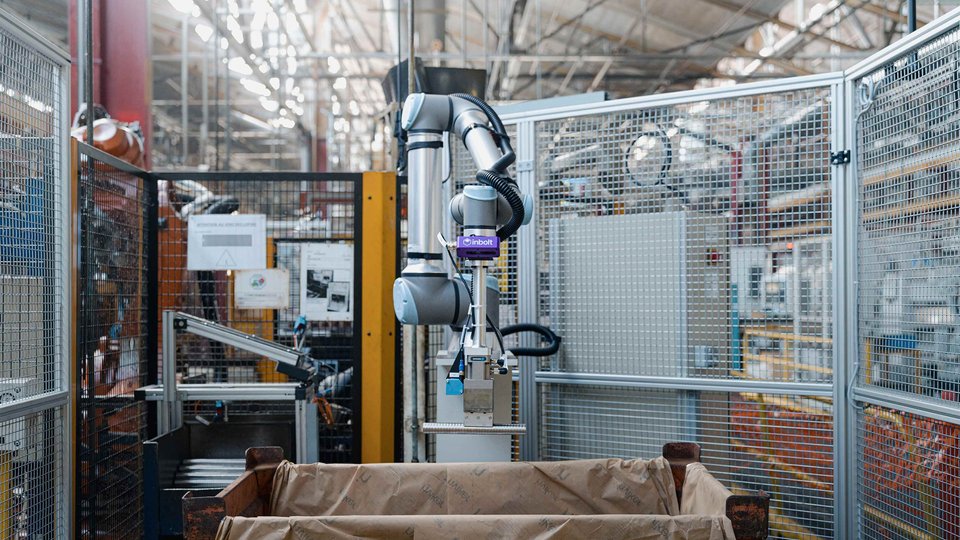
Inbolt Standard enables a UR robot to locate parts and adapt its taught motion path to the actual position of the part in every cycle, in tasks ranging from screwdriving and machine tending to rack loading and pallet unloading. A 3D camera mounted on the robot's "wrist" recognises the part on the basis of a CAD file, locates it and adjusts the taught robot motion to the actual part position in each work cycle. As a result, factories no longer need to build custom fixtures and jigs for every part at every workstation. Changing production to a new product becomes a software modification rather than a tooling changeover.
Vision guidance without a second system
With a licence that allows Inbolt Standard to run directly on the UR CB7 Core controller, the external industrial PC previously required to operate the vision system is no longer needed. This simplifies installation, deployment and maintenance of the system. In addition, the new Gen 7 tool flange is equipped with an Ethernet connector and a power connector, so the Inbolt camera is connected to the robot directly through the flange. This has eliminated the need to route external cables along the robot arm.
"Gen 7 is our platform for physical AI, giving partners the computing power, connectivity and tools they need to build AI-based applications and deploy them directly on robots," said Anders Billesø Beck, Vice President of AI Robotics Products at Universal Robots. "Inbolt Standard is an excellent example of what can be achieved in production in terms of ease of use and shorter integration time. Manufacturers that use UR as a standard across different plants can now introduce vision guidance as a standard option in every production cell."
Universal Robots and Inbolt have been working together since 2022, and vision-guided UR robot cells developed by the two companies are already in production use in Europe and North America. One example is an engine tightening station at Stellantis, where the Inbolt guidance system reduced the number of failed tightening operations by 91%, with image processing taking only half a second per engine.
From hardware to software
Inbolt Standard is used at stationary workstations where parts are presented in a repeatable orientation, either as single components or in multi-layer racks and trays. In the automotive industry, typical applications include screwdriving and bolt tightening, rack picking, machine tending and multi-layer pallet unloading.
The licence also extends the industrial application range of UR collaborative robots to low-repeatability electronics and data centre equipment, where cable trays, enclosures and server housings are rarely identical, from filling trays and racks to fastening and screwing subassemblies. A single program can switch between more than 80 part numbers, and operators can retrain the system when new parts are introduced.
"Inbolt and Universal Robots have been deploying vision-guided cobots together for years, and with the new Gen 7 series our products are more closely integrated than ever before," said Rudy Cohen, co-founder and CEO of Inbolt. "Because vision guidance now runs directly on the robot itself, a manufacturer deploying cobots at dozens of stations across multiple plants can configure them immediately in all production cells without having to design new fixtures for individual parts. In the coming months, we will make more Inbolt products available to UR customers."
How it works on Gen 7
Inbolt Studio, the software used for part teaching and production cell configuration, runs as a URCap within PolyScope X, while part localisation is performed on the CB7 Core controller processor. The Orbbec 3D camera is connected to the power connector and the 1 Gb Ethernet port in the g-Series tool flange, so its signal is routed through the robot.
Teaching takes place locally on the controller on the basis of the part CAD file and takes less than 10 minutes, without image datasets or labelling, and production data never leaves the plant. Inbolt commands appear in the PolyScope X program tree and are called in the same way as all URScript instructions.
Repeatability is 0.5 to 0.7 mm for stationary parts, and the camera's active infrared depth sensing works in bright, poorly lit and dark environments. Inbolt Standard runs natively on UR g-Series robots, namely UR10g-1750, UR17g-1300 and UR18g-950, with PolyScope X version 10.13 or later. It is also compatible with e-Series and UR Series robots equipped with the CB7 controller; on these robots the camera is connected with an external cable.
Availability and SPS 2026
Inbolt Standard will soon be available to order through Universal Robots and its distribution partners; it is also offered on the UR+ Marketplace.
Visitors to SPS 2026 (24–26 November in Nuremberg) will be able to see the Inbolt vision guidance system operating live on a Gen 7 industrial collaborative robot at the Teradyne Robotics stand (Hall 3C, Stand 111).
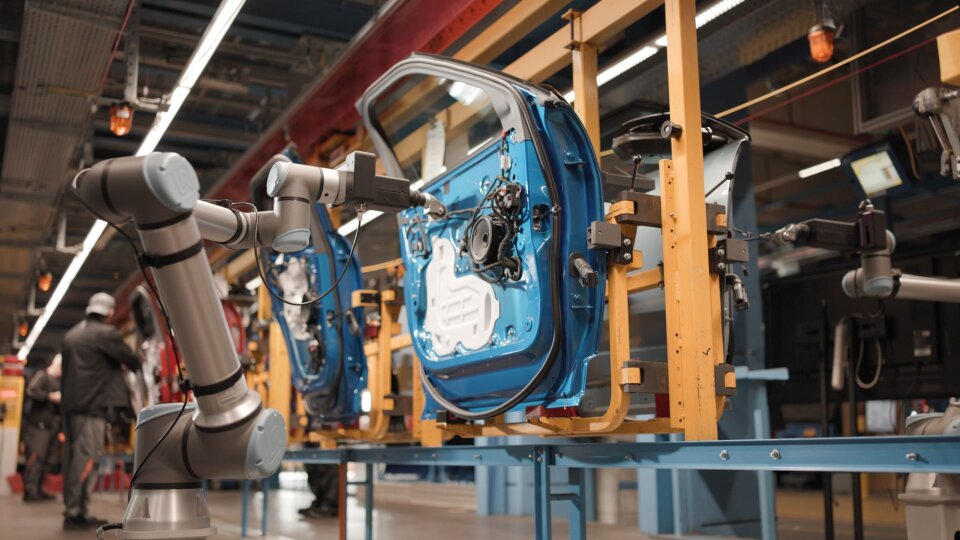
The Inbolt 3D vision system, integrated with Universal Robots cobots, automates water shield installation on an electric vehicle (EV) production line. Two cobots, positioned on either side of the line, track each vehicle in real time and continuously correct their motion path, without encoders or mechanical synchronisation