At PRSE 2026, Philipp Niehues of Coveris discusses how the company is responding to the growing demand for sustainable flexible packaging. He explains Coveris’ work on mono-material solutions, the use of PCR materials, solvent-based recycling technology and cooperation with chemical recycling partners. The conversation also highlights how Coveris helps customers close the loop by transforming their packaging waste into new packaging applications.
Vincent Kundrat from Meyer Europe talks at PRSE 2026 about the company’s optical sorting technologies for plastics recycling. Meyer Europe presents solutions for sorting 3D objects, bottles, plastic flakes, polymers and colours, supporting recyclers in improving material recovery and creating value from plastic waste. Kundrat highlights the importance of the fair as the recycling market begins to recover, as well as the role of R&D in developing new technologies in response to customer needs.
Thomas Dohse, representing the organizer of interpack 2026 in Düsseldorf, discusses the importance of the event for the global processing and packaging industry. He highlights the major transformation the sector is currently undergoing, driven by new regulations such as PPWR, the growing use of AI, new materials, reduced material consumption and the need for greater efficiency. Held every three years, interpack brings together around 2,800 exhibitors from 65 countries and visitors from more than 150 nations, presenting solutions for key industries including food, bakery, confectionery, pharmaceuticals, consumer goods and industrial products. The conversation also covers the event’s special areas and accompanying formats, such as components, the startup area, interpack live TV, the Safe Food conference and Women in Packaging.
Jelle Saint-Germain from Ad Rem discusses the company’s latest developments in recycling technology, with a strong focus on R&D and automated material analysis. At its test facility in Belgium, Ad Rem is working on new solutions for recovering plastics and metals from shredder residues. A key topic of the conversation is OWL, an automated analysis system combining FTIR and X-ray/XRF technology to identify both the type of plastic flakes and their elemental composition. The system can also analyse black plastics, which are difficult to detect with standard NIR methods, and helps recyclers identify substances such as bromine before extrusion, supporting compliance with regulatory limits and improving process control.
Davide Sighinolfi from Sidel S.p.A. talks at interpack 2026 in Düsseldorf about the company’s complete solutions for modern packaging lines, covering packaging design, line engineering, PET bottle blowing, packing and palletizing. He presents Sidel’s latest robotic innovations for packing and palletizing, designed to simplify operations, improve flexibility and increase overall line efficiency. The conversation also highlights the growing role of automation, data collection and predictive maintenance in helping producers optimize packaging operations across the beverage, food, home care and personal care markets.
Marcel Willberg from Lindner Washtech talks at PRSE 2026 in Amsterdam about the company’s solutions for film and rigid plastics recycling. Among the technologies presented are the compact, standardised Ready Wash lines, designed for basic applications and smaller capacities of up to around one tonne per hour. He also discusses more advanced washing systems, including solutions based on the Micromat series and hot-wash technology, which help remove contaminants before further material processing. Another key topic is the final approval obtained by a Lindner customer in Ireland for novel technology enabling the use of PCR material in food packaging applications.
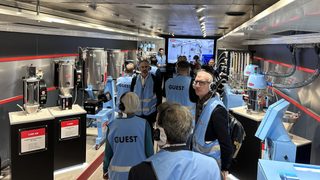
Ahead of PLAST 2026 in Milan, we joined an exclusive international press tour to explore the technologies that will define this edition of the show. Over three days, we spoke with key industry representatives:
00:36 Mario Maggini, Promaplast s.r.l., organizer of PLAST, on the international position of the exhibition and its importance for fast-growing markets such as Poland.
02:50 Massimo Santini, Costruzioni Meccaniche Luigi Bandera S.p.A. on energy-efficient extrusion, PCR upcycling and AI-based process control.
04:39 Mirco Panizzon, Moretto S.p.A. on advanced drying and gravimetric dosing systems reducing energy consumption and stabilizing production.
06:08 Lucio Strappazzon, BMB S.p.A. on high-performance hybrid machines and the growing specialization of thin-wall packaging technology.
Across extrusion, material preparation and injection moulding, one conclusion was clear: energy efficiency, digital control and high recycled content are no longer optional – they are essential. PLAST 2026 will bring these solutions together in Milan.
Thomas Dohse, Director of Interpack, speaks about the global significance of the event for the processing and packaging industry, the key challenges shaping the market, and the growing presence of Polish companies.
ENGEL officially opens its newly reconstructed office and technology centre in Poland. In this exclusive interview, CEO Stefan Engleder talks about the goals behind the investment, its benefits for customers, and the growing importance of the Polish market. He also shares insights into ENGEL’s future plans, innovation strategy, and how the company’s injection moulding machines are shaping the factories of tomorrow.
Lucio Strappazzon from BMB showcases the company’s latest innovations at K 2025 - including a full-electric machine with a 1.9 s cycle time, a new 450 HP platform for caps with a 96-cavity mold and a 2.7 s cycle, and a 550 t 2K system producing 6.7 L pails in 5.7 s. BMB focuses on thin-wall packaging, extreme speed and reliability - and the growing success in the Polish market proves how much customers value the performance and durability of these machines.
During Ecomondo 2025, Fabrizio Gasparin from TOMRA Recycling showcased the company’s latest sensor-based sorting and analysis technologies. He highlighted new AI-powered features that enhance TOMRA’s near-infrared (NIR) systems, enabling more precise material identification. The upgraded solution can now distinguish not only polymer types and colors but also food-grade and non-food-grade materials, such as HDPE, PET, and PP, allowing for higher purity in recycling streams. Gasparin also presented innovations in sorting paper and cardboard, achieving advanced deinking and material separation. Additionally, TOMRA is collaborating with PolyPerception, a startup developing real-time stream analyzers that provide valuable insights into plant performance and material quality—helping recyclers optimize efficiency and output.
During Ecomondo 2025, Oliver Cosani from TOMRA Collection spoke about the company’s role in advancing circular economy solutions through its three divisions – Collection, Recycling, and Food. He highlighted the TOMRA B5, a compact reverse vending machine designed for supermarkets and other public spaces, capable of collecting PET bottles, cans, and glass containers for both single-use and reuse. Cosani emphasized that TOMRA’s technologies help close the loop by ensuring that packaging materials are efficiently collected and reintroduced into the production cycle. He also noted that Ecomondo remains an important platform for meeting industry stakeholders and exploring developments in the recycling and sustainability sectors.