BASF presents new methylstyrene-acrylonitrile copolymers AMSAN
In the plastics segment, BASF intends to focus on specialties and products with a high potential for differentiation in the market. The target is to increase the sales share of these products by 2010 from roughly 25 to 40%. At The International Construction Fair Budma 2008 in Poznań, Poland, the company showed its new methylstyrene-acrylonitrile copolymers (AMSAN). AMSAN are the group of polymers which are highly compatible with PVC and have a high glass transition temperature.
Due to its ease of processing and toughness and not least on account
of its competitive price the material polyvinyl chloride (PVC) has captured a secure position in the building sector. Over half of the Western European PVC production, running to some 6 million metric tons, is used on building sites in the form of extruded window and door profiles, cable sheathing, floor coverings, pipes and conduits. Accordingly, PVC is one of the most important materials in this sector.
The potential of this material in this field has by far not yet been exhausted. One of the challenges constraining the wide use of PVC is the comparatively low heat resistance of this material. Most PVC products are recommended for operating temperatures of 60 to 65°C (peak temperatures of up to 80°C). At higher temperatures the material begins to soften.
This has negative effects on the dimensional stability of the material, in particular when the part in question is under mechanical load in use. In some circumstances this is already a problem in pipework carrying hot water or in dark coloured building panels (title picture) directly exposed to sunlight.
Increasing Heat Resistance
It is possible to increase the softening temperature of polyvinyl chloride by postproduction chlorination of the main polymer chain. Chlorinated PVC (CPVC) having a chlorine content of 66 %, for example (by comparison with 57 % in the normal material), is suitable for continuous working temperatures of 90°C (peaks of 110°C). However, the higher density (of about 1.6 compared with 1.4 g/cm3 in normal PVC), poor processability and the relatively high price are disadvantages. A solution to this problem is found in blends composed of PVC and polymers characterised in comparison with polyvinyl chloride by a relatively high glass transition temperature.
Corresponding mixtures should exhibit higher heat resistance than pure PVC. A useful guide value for the heat resistance of a polymeric material is obtained by measuring its Vicat B50 softening temperature.
It is determined by a practical test method. In plastics having a low degree of crystallinity the Vicat temperature is correlated with the glass transition temperature which can be predicted on the basis of a simple relationship among the proportions of the components of a blend (Gordon-Taylor relationship). In order to increase the heat resistance of PVC it is useful to mix this plastic with proportionate amounts of a polymer which is inherently characterised by a high glass transition temperature.
A-Methylstyrene-acrylonitrile copolymers (AMSAN) are polymers which are highly compatible with PVC and have a high glass transition temperature. Such a copolymer (Luran KR 2556) has been employed by BASF since as early as the 1970s for the production of heat-resistant ABS plastics (Terluran HH 106 and Terluran HH 112; the number after the abbreviation HH specifies the Vicat B50 softening temperature of the High Heat type in question).Depending on the level of heat resistance desired, AMSAN here replaces a proportion of the usual SAN component (Vicat temperature of SAN is approx. 107°C, that of AMSAN is approx. 120°C).
The idea of using AMSAN - or even SAN or ASA - in order to increase the heat resistance of PVC has already been discussed in the industry for a relatively long time. New studies conducted by the Süddeutsches Kunststoff-Zentrum (SKZ = South German Plastics Centre) and BASF are now helping to adapt the heat resistance of PVC to particularly demanding applications in cost-effective manner without the need to take the CPVC route.
Producing Mixtures Under MildmConditions
In order to be in a position to evaluate the effect that the AMSAN component of the mixture has on the mechanical properties of the polyvinyl chloride, care was taken to produce the blends under controlled mixing temperatures. In this way any possible decomposition of the polymer due to local overheating during the mixing process,which could diminish the mechanical properties of the blend, is minimised. This is ensured in optimum manner by the use of a planetary gear extruder.
The extruded strand is briefly cooled in a water bath, dried (Rieter SE/100) and pelletised (Rieter Primo 100). The PVC processed was an impact-modified, calcium-zinc stabilised PVC from Solvay whose mean melt temperature at the tip of the spindle was approx. 190°C. From the blends obtained in this way test specimens were produced which were subjected, inter alia, to the following tests: measurement of the Vicat softening temperature (ISO 306, method B50), measurement of thermal stability in accordance with DIN 53381-1 (test B) as well as measurement of impact resistance at room temperature (ISO 179- 1) and elongation at break (ISO 527-2).
Initial trials with proportions of AMSAN in the blend confirmed that the Vicat temperature of the blends can be raised by adding this copolymer. For every 10 % by weight of AMSAN added the Vicat temperature increased by approximately 4°C.
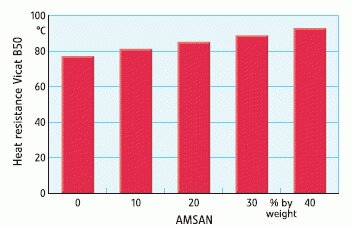
As expected this technically significant value is above those achievable by incorporating equivalent quantities of "classic" SAN copolymers as well as ASA varieties having correspondingly lower glass transition temperatures.
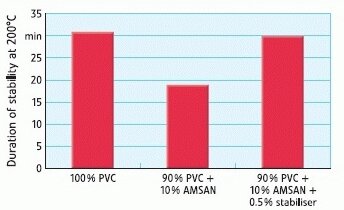
It is common to all the blends that they exhibit lower thermal stability than the starting polymer.While blends composed of PVC and Terluran HH 106 (ABS) or 112 and Luran S 778 T (ASA) are notable for slightly, with higher additions sometimes even dramatically, improved levels of impact resistance, the gain in Vicat temperature and hence in heat resistance as a result of AMSAN modification is simultaneously associated with certain losses in impact resistance.
The impact resistance of (PVC+AMSAN) blends, however, can be raised to the usual level by resorting to tried and tested methods of PVC formulation development.
Thus, the addition of 5 % by weight of an acrylate-based impact resistance modifier to a (PVC+AMSAN) blend (85:15 % by weight) is sufficient to achieve impact resistance values which were above those of the unmodified PVC used for producing the AMSAN blends (23.8 instead of 16 kJ/m2). As expected raising the proportion of modifier further increases the impact resistance levels and in all the blends studied the elongation at break values were also at a higher level.
Adapting Thermal Stability by Means of Stabilisers
On the other hand, the restoration of the thermal stability of (PVC+AMSAN) blends requires more detailed consideration of the degradation processes. The cause of the gradual decomposition of polyvinyl chloride at relatively high temperatures is the elimination of hydrogen chloride, which once started proceeds in accelerated fashion due to autocatalysis.
Initially this gives rise only to local discoloration of the plastic, but later adversely affects the mechanical properties of the entire product. A number of routes are available for stabilising PVC against this degradation process. Thus, the progress of the reaction can be slowed down by capturing the hydrogen chloride by means of suitable basic additives or by converting the first intermediate of the decomposition process - reactive allyl chloride - into products which pose no threat.
To this end the PVC processor can draw on a large number of tried and tested additives having correspondingly varied action mechanisms.
In order to test whether established additives are also suitable for retarding the accelerated degradation reaction in the presence of nitrite-containing polymers, trials were carried out on (PVC+ABS) blends at the Süddeutsches Kunststoff- Zentrum. Not only were the stabilizers which come into consideration studied, but also the quantities in which they need to be added. The stability of each blend was evaluated in a stream of nitrogen heated to 200°C (DIN 53381-1, test B). Even small quantities of a suitable stabilizer are capable of effectively retarding the thermal degradation of (PVC+ABS) blends.
These results are naturally transferable to (PVC+AMSAN) blends. In a direct trial the addition of 0.5 % by weight of this stabiliser was sufficient to raise the thermal stability of a mixture of polyvinyl chloride and an a-methylstyrene-acrylonitrile copolymer (90:10 % by weight; total nitrile content: about 3 %) to the level of the pure PVC.
This study demonstrates that a-methylstyrene- acrylonitrile copolymers such as Luran KR 2556 from the PlasticsPlus range of BASF`s Styrenic Plastics Division are suitable for effectively increasing the heat resistance of polyvinyl chloride.The possible rates of increase are about 4°C per 10 % by weight of added AMSAN.
Given a corresponding level of addition, (PVC+AMSAN) blends exhibit levels of impact resistance and thermal stability equivalent to those of pure polyvinyl chloride.
This should have great potential in applications which hitherto could not be fulfilled at all or could be fulfilled only inadequately because of the low heat resistance of PVC and on grounds of cost.
Specifically in the building sector great prospects are now opening up for the blend. In this field there will no doubt be news in future about some remarkable solutions.