BIC reaches 95% OEE with Engel's AI-based iQ process observer
At its shaver plant in Athens, BIC uses Engel's web-based iQ process observer to support five process engineers responsible for around 180 injection moulding machines. AI-generated recommendations have helped raise OEE from 91–92% to a consistent 95%.

At BIC's highly standardised shaver production facility in Athens, Greece, around 180 injection moulding machines are in use across five business units on a large campus. BIC is one of the world's leading manufacturers of stationery, lighters, brushes and shavers. The main challenge at the site is not machine availability, but the availability of engineering expertise. Just five process engineers are responsible for troubleshooting production issues and optimising the moulding process for all machines across the entire site. With Engel's web-based iQ process observer, BIC relies on a solution that specifically relieves limited resources: artificial intelligence analyses process data, detects deviations and provides concrete recommendations for process optimisation. This has enabled BIC to achieve a consistent 95% OEE (Overall Equipment Effectiveness).
Although BIC's production processes are highly standardised, ensuring process stability across all machines remains a demanding task. The large physical footprint of the production site in Athens makes manual monitoring even more difficult. "Our challenge is not operating the machines themselves," explains Yiannis Voultzatis, Molds and Injection Molding Process Industrialization Senior Manager, who is leading the project at BIC. "Our challenge is maintaining full process transparency and reacting quickly so our engineering expertise can be focused where it creates the greatest value." What is needed is an intelligent system that interprets process data and helps process engineers focus on where action is really needed.
From machine panel to decision-making tool
BIC started testing the first version of Engel's iQ process observer on a single machine as part of a proof of concept in 2019. The software, which at the time was installed on the injection moulding machine panel, was able to automatically analyse and interpret process data, thereby identifying deviations and gradual process drifts. However, its real value lay in the practical, AI-based suggestions for process optimisation and error reporting.
With the new web-based version of the system, BIC strategically repositioned the tool, not just as an operator interface at the machine, but as a decision-making tool for moulding process specialists. The application runs centrally in the office, offers a clear user interface and focuses on relevant deviations, prioritised recommendations and informed decisions. "Our process engineers need precisely this type of support – a system that guides them in a targeted way," emphasises Yiannis Voultzatis.
Process Notes: AI-generated recommendations
Since September 2024, BIC has been using the iQ process observer web to monitor around 30 machines in live operation. At the heart of the platform are the Process Notes: AI-generated recommendations automatically derived from the collected machine data. They continuously evaluate process behaviour, detect patterns, deviations and trends, and provide clear, understandable guidance. Voultzatis describes the function as follows: "Through the tool we receive intelligent recommendations. The machine is essentially telling us: 'Something isn't quite right here – please check.'"
Examples from day-to-day production demonstrate the system's practical benefits. For instance, it notifies users when decompression is ineffective because the set value exceeds the actual material cushion. It can also detect an unfavourable length-to-diameter (L/D) ratio that could affect process stability and notify the process engineers accordingly. The system likewise flags abnormal temperature behaviour, which may indicate defective heating zones; in one case, this led to the rapid identification of a mould hot runner issue. Especially in a machine fleet with control systems from different manufacturers, this automated analysis is an important source of support.
With only five process engineers responsible for a very large production campus, the greatest efficiency gain lies in avoiding unnecessary work and focusing resources where they are actually needed. Instead of manually checking dozens of machines, the process engineers can immediately see where urgent action is required. The AI-based prioritisation guides them directly to the relevant processes. "The real advantage isn't time tracking," confirms Voultzatis. "It's the fact that the system takes us straight to the right machines."
Results: OEE up from 91–92% to 95%
BIC measures success holistically using Overall Equipment Effectiveness (OEE). While OEE previously ranged between 91 and 92%, it has now consistently reached 95% for over a year, using iQ process observer web in combination with other Engel solutions such as authentig, iQ weight and iQ clamp control. Early detection of quality risks prevents scrap before it occurs. Reduced downtime and stabilised cycle times further contribute to increased efficiency. "All figures are based on machine data," emphasises Voultzatis. "This is not an estimate – it's measurable reality."
Next step: 2K injection moulding
Building on the results with one-component (1K) machines, BIC is currently testing the use of the iQ process observer in more complex two-component (2K) injection moulding processes. The goal is to monitor both components simultaneously, apply the same AI logic to new process parameters and close remaining transparency gaps. Initial results are promising, and a broader rollout is planned.
The AI-based iQ process observer provides in-depth analysis of machine behaviour and relieves scarce process expert resources by delivering prioritised, actionable insights. As a result, it makes large machine fleets manageable with limited resources. At BIC, it has helped process engineers to stop relying on intuition and make data-driven decisions, leading to faster response to process issues and helping to achieve a sustained OEE of 95% in a highly complex production environment.
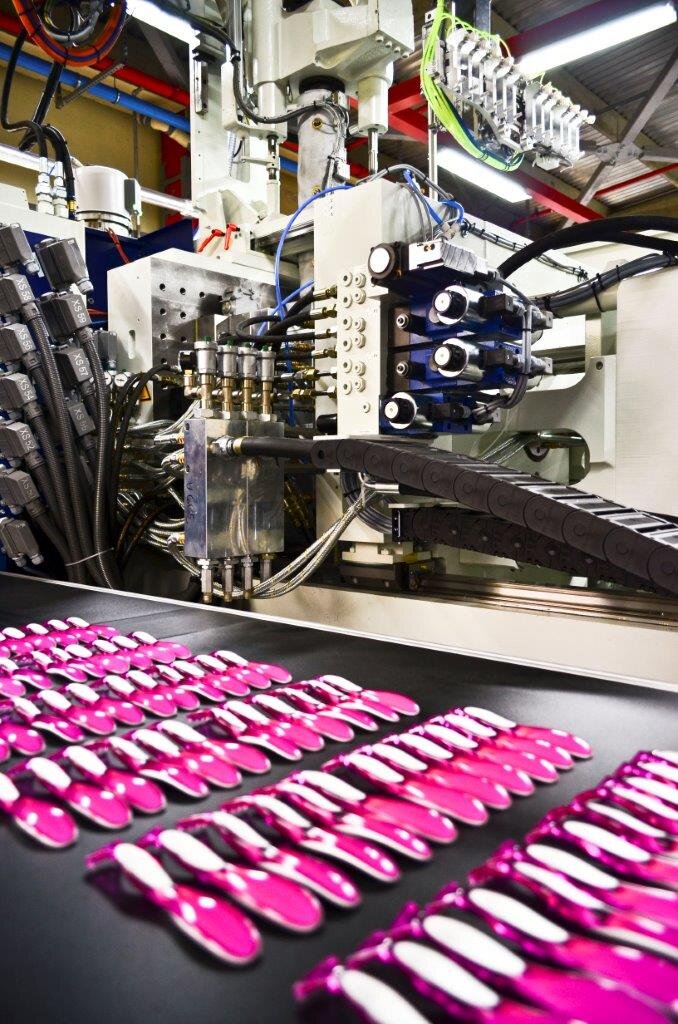
Shaver production at BIC in Athens: around 180 injection moulding machines are in use at the site. The web-based iQ process observer helps process engineers detect deviations early and respond where needed