Engel at FIP
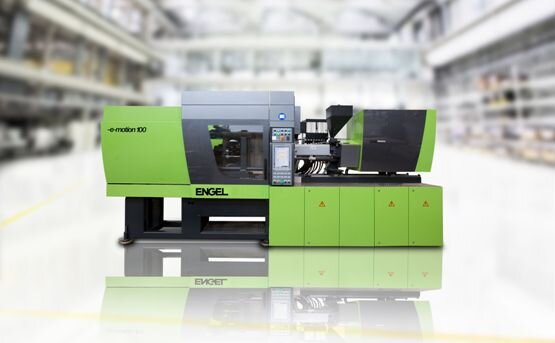
At FIP solution plastique from 24 to 27 May the focus of the ENGEL booth is efficiency.
The injection moulding machine builder and automation expert will be showing three exhibits that demonstrate how to improve efficiency in injection moulding while at the same time cutting costs. The keys to success: process integration, automation and fully electric drive technology.
Competitive pressure on injection moulders in western Europe is continuing to increase", says Philippe Sterna, Managing Director of ENGEL France, "this is reflected in growing demand for highly integrated and automated system solutions, which we provide from a single source in collaboration with brand-name partners."
The best example of this is the manufacturing of complex hollow parts, which will be demonstrated live at the trade fair booth on a compact, tie-bar-less ENGEL victory 1050H/500W/200 combi machine as a 3-component application. The Multitube mould system – ENGEL's partner here is mould maker Pernoud from Oyonnax/France – supports the production of hollow components with complex geometries in a single step. This is achieved by means of a multiple stage injection process that integrates picking & placing and over-moulding in a single cycle.
Sample parts – intake manifolds for 3 cylinder engines – will be produced at the fair. For this purpose, first threaded bushings are insert-placed into the mould and then over-moulded. The pre-moulded part for injection of the second component will be turned in the mould by a Stäubli six-arm robot before the third component, a TPE seal is applied.
To support multiple component injection moulding the victory machine is equipped with a piggyback unit and a third injection unit by Babyplast. The finished component is taken off by a multiple axis robot and deposited on an integrated conveyor belt. The robot control unit is fully integrated with the CC 200 control unit of the injection moulding machine. Because the robot works inside the extended safety guarding, the production cell only needs a small footprint.
The benefit of the plant's high degree of integration is that the hollow parts are produced in a single process step that removes the need for finishing, for example, a welding process. Compared with legacy gas injection technology, the Multitube concept also ensures enhanced quality of the interior surfaces and consistent wall thicknesses.
The second exhibit at the fair focuses on fully electrical drive technology. An ENGEL e-motion 440/100 T machine will be producing cough medicine beakers on a 16-cavity mould by Curtil, France. The machines in the ENGEL e-motion series combine maximum power and precision with minimal energy consumption on a tiny footprint.
All machine movements – from injection and plasticising, through to the mould and ejector movements – are executed by servoelectric drives. The result is optimum efficiency. During standstill times, cooling for example, the machine does not consume any power. Additionally, the energy that legacy systems lose on braking movements is recovered as electrical energy.
Thanks to the encapsulated toggle lever with recirculating oil lubrication system, friction in the toggle lever joints is extremely low; this means that the ENGEL e-motion requires comparatively little power for building up and reducing clamping force. This not only saves energy, but ensures particularly clean operation, thus making the machine an ideal candidate for clean room applications.
As a representative of the new linear robot generation by ENGEL, an ENGEL viper 6 will be making the journey to Lyon. The viper robots impress with excellent load bearing capacity, extremely accurate positioning and highly dynamic operation. This is mainly attributable to three of the new robot generation's features:
- vibration control reduces vibration for improved tracking and positioning accuracy, thus ensuring shorter cycle times,
- mass identification detects the weight in the gripper. If the weight exceeds a preset value, the robot slows down its movements, thus additionally extending its extremely long service life. If the weight is below the nominal value, the robot accelerates its movements, thus improving the productivity of the plant,
- efficiency control minimises robot wait times by allowing the robot to automatically adapt its sequences outside of the injection moulding machine to match the cycle time of the production plant. This function again ensures a long service life of the robot's mechanical systems and makes a major contribution towards energy efficiency.
Viper robots are not just deployed on ENGEL injection moulding machines, but also on third party machines. Five sizes with nominal load bearing capacities of between 6 and 60 kg are available.