Flow measurement and control combined with online-thermography
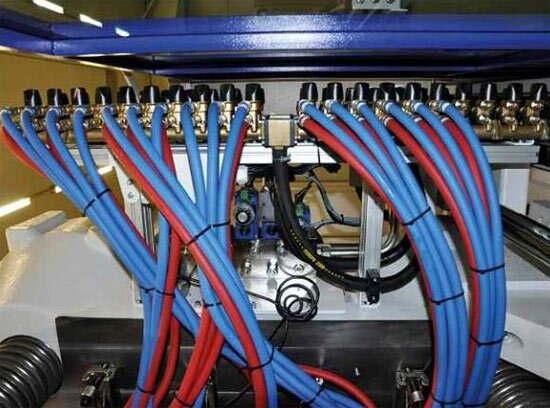
Multi-circuit flow control is more often used by processors looking for better process security and part quality.
The Wittmann Wfc unit (Water Flow Control) is combining a water flow regulator and flow measurement control meeting all requirements of single mold channel control. System changes are identified through collection of theprocess data, ensuring the reproducibility. Problems like blocked channels or buckled tubes that might occur after having changed the mold, are identified immediately.
Since the Battenfeld takeover, Wittmann and Wittmann Battenfeld are constantly generating synergy through the sharing of expert knowledge that can be used for the respective development and production work. Thereby the superior target remains to meet the growing demands of the market. Wittmann and Wittmann Battenfeld are working hand in hand developing integrated solutions that are including material handling, tempering, automation, and the injection molding process itself.
It is the main target of all development efforts to always make possible the best part quality. Therefore different up-to-date techniques are used.For example the so-called online thermography method is applied, developed by the Süddeutsches Kunststoffzentrum (South German Plastics Center, SKZ) in Würzburg; or the WFC unit (Water Flow Control).
At the K Show 2010, WFC has been presented in interaction with a Wittmann Battenfeld injection molding machine to the public.The accurate mold tempering is playing a crucial role in good injection molding, and thus the tempering process is attracting more and more attention. The deformation of the part – hence the quality of the parts – is influenced by the temperature distribution within the mold. When producing complex parts, a constant tempering of the different mold segments is indispensable to get a constantly high quality.
Online thermography is identifying variations in quality – for every single shot. The technology is visualizing both overstepping and under-running of temperature control tolerances. Online thermography is a quality management procedure of parts in hot condition, in which an infrared camera makes an optical recording of the molded part, thus documenting the surface temperature (respectively the temperature distribution). Directly after the demolding the part is rotated by the robot in front of the activated camera.
Afterwards the dataset is analyzed with the aid of special software. The outcome and possible deviations from the standard are displayed on a monitor.The calculation of the deviations is done on the basis of predefined mold segments. Via an interface these deviations are communicated to the WFC. The WFC unit is executing the necessary temperature changes without any delay in real-time. The significant advantage of this technique is the external temperature measuring that is done at the molded part. Thus complex adjustments or extensions at the mold itself are not necessary.
In com-parison to the common temperature measuring method that is using temperature sensors within the mold, thermographic measuring of the molded part is offering some special advantages:
- The here applied camera systems are working significantly more precise, and they are also much more robust than temperature sensors.
- The high resolution of an IR camera is allowing for exact registration of extensive areas and critical points (hot spots).
- If the rare case of any sort of disturbance should occur, the camera can be replaced very quickly and without having to dismount the mold.
The constant temperature control is allowing for optimized cycle times. The technology is advancing the start-up phase, and is leading to less scrap during the start-up phase.
The constant temperature distribution is leading to a lasting quality improvement. Variations in temperature that are not within the tolerance range are detected immediately. The costs that are linked to producing scrap are dropping to a minimum. The realization of the statistical process control gives for example the advantage that mold maintenance can be done early, so unscheduled repairs can be prevented as far as possible. Not least to mention that the thermal “fingerprint” is a comprehensively relevant process parameter.
At K Show 2010 the potential of online thermography has been demonstrated in conjunction with an EcoPower 240/750 injection molding machine. A Wittmann W821 robot was in charge of positioning the finished part – an ABS building block – in front of the camera. The robot was equipped with a rotational axis, permitting to take thermal “fingerprints” of five sides of the part.The analyzed thermographic records are needed for quality management documentation purposes. Beyond that, these values are consulted to control the mold tempering.
After having made the thermal pictures the robot is handling over the parts to a laser inscribing station.The handling system is playing a key role in this process. The heat images can only be done precisely when the positioning of the part is happening with repeated absolute precision. After that they are compared to the target state by software especially developed by the SKZ. The servo technology of the WIttmann robot that is controlled by the R8 software is ensuring that the robot’s movements are absolutely accurately repeated.
Again at this year’s K Show, a Wittmann Battenfeld large-scale MacroPower 1000/8800 Unilog B6 machine showed impressively the efficient interaction of Wittmann auxiliaries and Wittmann Battenfeld machine.The many visitors were in particular taken with the impressive large-scale Water Flow Control system with its 80 cooling circuits directly mounted on the machine. The installation presented to the public a special packaging application: The production of a stackable foldable box was executed – and this box also found great favor with the show visitors.