Four critical points to achieve high results in coding thinner flexible packaging
As flexible packaging becomes thinner and thinner, the challenge becomes greater and more difficult to consistently apply legible "date codes", Drew Weightman writes.
The article by Drew Weightman, Global Business Unit Manager at Videojet Technologies.
As flexible packaging becomes thinner and thinner to improve sustainability scores, the challenge becomes greater and more difficult to consistently apply legible "date codes". New technologies in materials and machinery have advanced the use of reduced substrates in most flexible packaging applications including form, fill and seal; thermoform and tray sealing; and pouch filling.
Despite material reductions, these formations provide the extended shelf required to protect brand freshness over a set period of time. To make sure brands communicate this "freshness" it's critical to have date codes on every package that consumers and retailers can easily read.
Here are four critical points that can help you efficiently overprint high-resolution codes automatically on today's downgauged flexible packaging:
1. Reduce risk of film perforation and material waste
So here's the top line: use Thermal Transfer Overprinting (TTO), a high-resolution digital printing system, instead of older analog printers such as hot stamps (a.k.a hot foil) or roller printers. Analog printers typically use metal stamps that are held in a heated block. These stamps need to be replaced every time a new job is required in order to change code data. Worn or broken stamps are a common occurrence and lead to poor print quality and perforation of the packaging film - resulting in high levels of waste and rework.
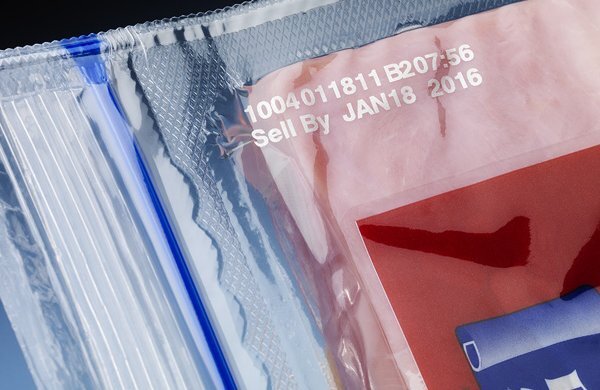
Stamping flexible packaging substrates, particularly downgauged constructions, to apply codes does not provide the user with the optimum coding performance. Digital TTO systems, which are a more forgiving technology, were developed specifically to transfer high-resolution codes directly onto flexible film packaging and labels. TTO uses a precision ceramic printhead, which transfer crisp legible codes from a thermal transfer ribbon directly onto the packaging films. This process transfers codes at 300 dpi (dots per inch/12 dots per mm) onto films just prior to sealing the package. TTO systems can be engineered to mount onto most flexible packaging systems so that codes can be applied efficiently and accurately on to packaging films.
2. Seek real-time coding systems that enhance output
TTO is a digital technology, which means it contains a real-time clock computer chip. It has the ability to print variable information including dates, lot codes, time and even graphics. This advanced technology allows information to be updated automatically so that it's not necessary to stop production lines when new codes are required. Real-time coding supports prudent traceability.
This differs significantly from analog printers, which use fixed metal stamps that need to be replaced every time a new package requires an updated code. Also since stamps are fixed - variable information such as real-time codes from one package to the next is not possible.
3. Select the right ribbon for each application
To gain excellent TTO code resolution for each package it's important to work with a coding partner that will assess your application needs and provide the appropriate ribbon type. Just like applications differ, so do ribbons. For instance, for fresh-made soups and other hot-fill applications (180-195oF) choose a special extreme temperature ribbon that will generate crisp, clean codes. Also depending upon line speeds, film or label type, or chemical resistance requirements, the right ribbon should be used to achieve maximum coding results and output. In addition, selecting the proper ribbon will enhance the life and performance of the system's printhead.
When it is time to replace the used ribbon, the TTO ribbons changeovers are fast due to simple cassette design.
4. Determine Marketing Value and Total Cost of Ownership
To make the best coding decision, it's imperative to consider marketing value as well as total cost of ownership. By selecting the right advanced TTO system, your brand will help ensure consumers that the product will meet their expectations if "purchased by the date clearly imprinted." Ensuring that clear, legible codes appear on every package help strengthen a brand's perception of "freshness" and "trust." When codes are smeared, unreadable or missing, those unfortunate brands often remain on retail shelves.
Also manufacturers should consider the importance that overprinted codes complement the high quality perception of your brand's pre-printed packaging. TTO coding can do just that by ensuring accurate placement of high quality codes on every package. By producing codes that include a mix of graphics, real-time content and bar codes, brands can support greater traceability and protection from counterfeiting.
When considering the impact TTO can make on a brand's competitive edge as well as reducing downtime and material waste, the best coding option for flexible packaging becomes quite clear.
Drew Weightman is a Global Business Unit Manager at Videojet Technologies. His primary responsibilities include business development of Thermal Transfer (TTO) and Thermal Ink jet (TIJ) technologies. Drew provides four years' experience in the product packaging and identification industry; prior to this he was a Vertical Account Manager and Danaher Business System Leader for Videojet.
Videojet Technologies is a world-leader in the product identification market, providing in-line printing, coding, and marking products, application specific fluids, and product life cycle services. Our goal is to partner with our customers in the consumer packaged goods, pharmaceutical, and industrial goods industries to improve their productivity, to protect and grow their brands, and to stay ahead of industry trends and regulations. With our customer application experts and technology leadership in continuous ink jet (CIJ), thermal ink jet (TIJ), laser marking, thermal transfer overprinting (TTO), case coding and labeling, and wide array printing, Videojet has more than 325,000 printers installed worldwide. Our customers rely on Videojet products to print on over ten billion products daily. Customer sales, application, service, and training support is provided by direct operations with over 3,000 team members in 26 countries worldwide. In addition, the Videojet distribution network includes more than 400 distributors and OEMs, serving 135 countries.