Hot runner solutions for demanding technical parts from HRSflow at Fakuma
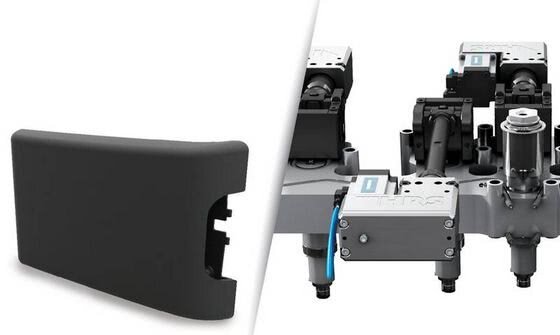
At Fakuma 2018, HRSflow will be demonstrating the universal application of its FLEXflow technology of servo-electric driven valve gate solutions based on examples of complex, high-quality parts. Produced with the help of advanced hot runner solutions, they will range from technical parts for the automotive industry to an extremely thin-walled laptop housing and an ultra-light tool box. In all cases, the ability to individually control the pressures and flow velocities at each gate makes the FLEXflow technology an optimal solution for large and small applications, even with thermoplastics that are very difficult to process. As a first step in the direction of IMM integration (according to Industry 4.0 requirements), the company will present the option of using the touchscreen of the respective injection molding machine to control the FLEXflow settings, which only recently became available.
Lightweight construction and Class A surfaces for the automotive industry
In cooperation with tool specialist GK Concept and injection molding machine manufacturer Yizumi, HRSflow has developed and optimized a hot runner system for the production of an engine cover, using the FLEXflow One technology. This servo-electric valve gate solution, which is programmed using an external Smart Interface and therefore requires no additional control unit, combines maximum precision with a broad process window and attractive cost efficiency. In the production of the large-sized component, an aluminum foil only 0.2 mm thick is first inserted into the mold and punched into shape during the closing process. Subsequently, the foil is thermoformed during overmolding with a glass fiber-reinforced polyamide using a FLEXflow hot runner system and physical foaming technology. During this back injection phase, in-mold graining (IMG) takes place, in which the fine texture of the mold is transferred both to the foil and to the polymer surface. The resulting part combines light weight with very high dimensional stability, low warpage and a premium surface without visible weld lines.
A FLEXflow five-nozzle hot runner system is used for the production of the automotive spoiler also shown on the exhibition stand. A polypropylene (PP) from A. Schulman, filled with 3M's hollow micro glass spheres, enables weight savings of up to 15% compared to the unfilled version. Thanks to FLEXflow technology, which ensures a more homogeneous pressure distribution in the cavity, the glass microsphere survival ratio is increased with even better distribution. The result is a lightweight component with no visible weld lines that meets the highest requirements for mechanical properties and surface quality.
Another lightweight automotive exhibit is a center armrest that is manufactured in a multi-stage process. Development partners in the realization of this project were the injection molding machine manufacturer KraussMaffei and the US toolmaker ProperTooling. The load-bearing structure is created from a thin-walled, fiber-reinforced organosheet, using the FiberForm process developed by KraussMaffei. First of all, this is over-molded with polypropylene (PP) and finally with a thermoplastic elastomer (TPV), whereby a soft, finely grained visual surface is formed. Injection molding is carried out with two FLEXflow hot runner systems with two (first phase) or three (second phase) hot runner nozzles. The servo-electrically driven, individually controlled valve pins ensure optimum cavity filling and enhance process reliability and cost effectiveness.
Thin-walled, heavy-duty housings
Other typical fields of application for the FLEXflow hot runner technology are lightweight yet stable injection-molded plastic housings. At Fakuma 2018, HRSflow will be showing examples from the fields of electrics and electronics as well as general industry.
A project that has been developed together with the heating and cooling specialist Roctool, KraussMaffei and the toolmaker Flex is a cover, only 1.5 mm thick, for a 14" laptop. It is produced using a high-glass fiber-reinforced polycarbonate (up to 50% by weight) injected in cascade molding, combining a FLEXflow five-nozzle hot runner system with Roctool’s induction heating and cooling technology. The above technologies ensure highest standards in terms of functionality and appearance. In a single shot, this results in a visible surface with high-gloss and matt areas with a cost-efficient cycle time of around 50 seconds.
A second example of an innovative housing shown at Fakuma is a toolbox made of microcellular foam, which is characterized by its low weight. Its production is based on the FoamPro foaming process from development partner Yizumi, and a FLEXflow triple-nozzle hot runner system from HRSflow with back-injection. The finished part is characterized by a high-quality, finely structured surface.
System integration insight
In order to make the FLEXflow utilisation smarter and the machine operator's workplace easier, HRSflow has taken a first step in the direction of system integration, which will ultimately lead to full integration of the FLEXflow technology into the world of Industry 4.0. Since June 2018, it has been possible to visualize, via VNC (Virtual Net Computing), the display of the control unit of the hot runner system on the touchscreen of the associated injection molding machine and thus be completely autonomous in terms of settings and functionalities. As a result, the use of a second screen can be dispensed with, optimizing the workplace ergonomically and offering a smarter user interface.
The FLEXflow family: simple, safe and clean
The integrated servo-electric needle drive - the common feature of FLEXflow and FLEXflow One - opens up a variety of options for setting process parameters. Thus, the individual needles of a hot runner system can be independently controlled with respect to their position (stroke), speed and acceleration. This allows users to control the pressures and flow rates during the entire tool filling process in a particularly precise, simple and flexible manner, thus optimizing the quality of their injection molded parts. The results are improved Class A surfaces and minimized warpage, and the technology also ensures low maintenance and user friendliness.
Quelle: HRSflow