How PVC furniture edge bands are made
The quality of PVC furniture edge bands depends on material homogeneity, extrusion precision, dimensional stability and surface finish. Sławomir Trela of Maag Polska describes the successive process stages, from raw material preparation to primer application.
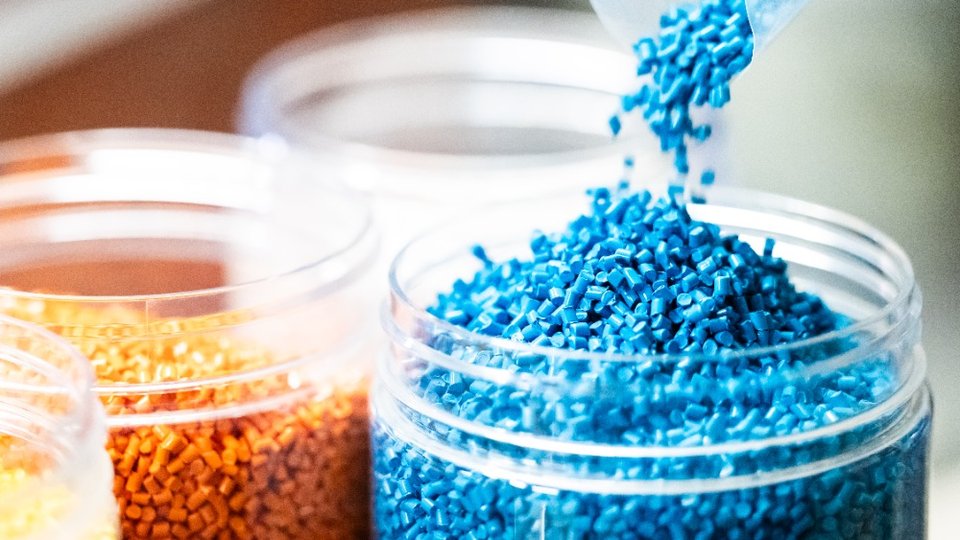
Material homogeneity, extrusion precision, dimensional stability and surface finish quality are the factors that determine the properties of PVC furniture edge bands. To obtain products that meet the requirements of today's furniture industry, production requires strict control of each technological stage. A furniture edge band is the result of a multi-stage conversion process. Its quality is determined as early as raw material preparation, while the subsequent technological operations define the surface appearance and the properties needed for the later edge banding of the board.
"The extruder is fed with PVC granulate or so-called dry blend, which is a non-granulated mixture of polyvinyl chloride with additives. Depending on the technology used by the manufacturer, the raw material can be delivered in bags and big bags, or stored in silos and conveyed pneumatically through pipelines. Production using granulate means cleaner material handling, while dry blend is the cheaper solution," says Sławomir Trela of Maag Polska, adding: "The mixture contains components responsible for the processing and performance properties of the material, including stabilisers, plasticisers, impact modifiers, fillers and pigments. Colouring is also carried out before feeding into the extruder or at the batch preparation stage. Colourants can be in solid or liquid form, and their dosing depends on the technological solution adopted. A properly prepared compound is the basis for obtaining an edge band with the required colour and properties."
In single- or twin-screw extruders, the material is plasticised to form a homogeneous melt. At this stage, the actual forming of the edge band begins.
Two production routes: film or direct extrusion
Today's PVC edge bands can be produced in two basic technological variants: from wide film or by direct extrusion of one or more material streams. The choice depends, among other things, on the product range and the length of the production run.
"The first method involves extruding film through a wide die, followed by calendering and air cooling. Calendering levels the surface and gives it the appropriate texture. Depending on the design, it can reproduce natural wood pores, stone, pearlescent surfaces or other materials. The film prepared in this way is wound onto a large roll and transported to the next station, where the decorative print is applied and a primer is applied to the underside of the material. After these operations, the roll goes to the cutting station, where the film is slit into edge bands of specified widths. The finished rolls are then packed and sent to the warehouse," explains the expert from Maag Polska.
The second method involves direct extrusion of the edge band through a die that gives it its final cross-section. After leaving the die, the material passes through calender rolls, which stabilise its surface and allow the texture to be reproduced. It then enters the calibration unit, where its dimensions are set precisely. After cooling and drying, the edge band passes through in-line printing and primer application stations, after which it is wound onto rolls and transported to the warehouse.
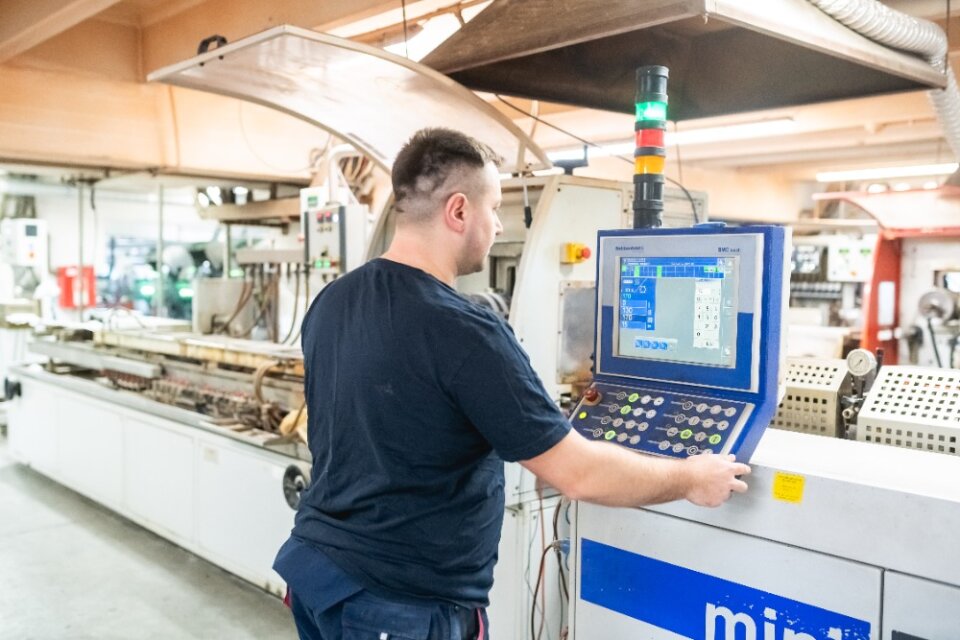
Decor, printing and primer
The final appearance of the edge band is shaped not only by mass colouring and the texture applied during calendering, but also by surface decoration technologies. The solutions used in the industry have evolved from traditional solvent-based inks to UV-curing systems. UV inks polymerise in a very short time, which makes it possible to increase production speed and achieve more repeatable surface properties. Modern lines allow precise reproduction of wood, stone and other material decors.
"Preparing the underside of the edge band for bonding is also an important stage. The primer forms an intermediate layer between the plastic and the adhesive, improving adhesion especially on smooth, low surface energy substrates, typical of PVC, ABS and PP, among others. This is important when using hot-melt adhesives, including EVA-based ones, as well as PO and PUR adhesives. After application, the primer is dried in a tunnel with warm air circulation," explains the expert from Maag Polska.
In the case of solvent-based primers, the drying process involves emissions of volatile organic compounds (VOCs). Production installations are therefore subject to industrial emissions requirements. Emission reduction solutions include thermal or catalytic oxidation of the organic compounds generated during drying.
Process precision and the quality of the finished edge band
Modern PVC edge band production combines materials science, precision extrusion, calibration, printing technologies, automation and process parameter control. The quality of the finished product depends on the interaction of many factors: from the compound formulation and die design, through cooling conditions and dimensional stabilisation, to decor quality and surface preparation for bonding.
This is how Maag Polska edge bands are produced. The company is a manufacturer of furniture edge bands using its own extrusion technology. Its range includes standard sizes matched to the decors and board thicknesses offered by leading European manufacturers.
Read more: