PET is the world`s favourite in the beverage industry
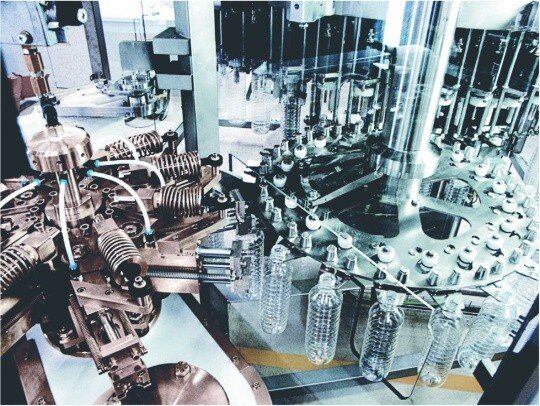
Bottling lines in the beverage industry fill entire buildings. Faults in individual units can therefore affect the efficiency of the overall line. Manufacturers of bottling and packaging lines know the challenges and now offer space-saving solutions which also operate more cost efficiently.
The market share of bottled mineral water in the western industrialised countries is growing steadily despite the good quality of drinking water available directly from the tap. Beer consumption is stagnating even in the major beer-drinking nations such as the Czech Republic, Germany, the UK and the Benelux countries. At the same time, however, new markets with great potential and huge growth rates like China, India and the CIS states are opening up for the manufacturers of bottling systems.
Both mineral water and beer are very demanding products which are increasingly being packaged in PET bottles in large areas of the world. According to the London-based market research company Euromonitor, production of PET containers will rise by seven percent a year to reach 350 billion bottles per year in 2009 (2006: 288 billion). That makes it all the more important to produce PET containers as cost-efficiently as possible.
Ahead of interpack 2008 (Düsseldorf, 24 to 30 April 2008), leading equipment manufacturers have integrated stretch blow moulding machines with filling lines in response to the wish of many bottlers to further expand their capacities using as little space as possible. PET bottles have become a huge success in the field of disposable containers. Another trend in PET bottles is to reduce weight and thereby save material.
Cutting out the middle man
An integrated system to blow and fill PET bottles is a cost-effective solution. Directly linking the stretch blow moulding machine with the filler offers numerous advantages. Although a bottle conveyor can serve as a buffer and support cooling of the bottles, transport problems and interruptions are often caused by jammed bottles, especially in complex conveying systems with numerous curves and/or height differences.
Frequently, this makes it necessary to halt production of the stretch blow moulding machine, thus compromising its efficiency and lowering the output of the entire line. An integrated system eliminates this source of problems. Here, the stretch blow moulding machine and the filler are the only factors determining the system`s overall efficiency. In case of irregularities, the filler communicates directly with the connected blow moulder.
The control system immediately decouples the two machines and empties the stretch blow moulding unit. Preforms which have already been loaded run through the heating system and finished bottles are ejected on a conveyor belt.
Bottles for carbonated beverages, which leave the stretch blow moulding machine at a temperature of about 75 degrees Celsius, have to be cooled down to roughly 55 degrees Celsius. In integrated systems, a rinser can be included to reduce the temperature with an internal rinse. Even without a rinser, the desired result can be achieved by using a specially adapted base cooling system in the bottle transfer zone.
Even lighter bottles
Lightweighting is another trend to which preform and equipment manufacturers are turning their attention. By reducing material thickness, especially at the carrier ring, considerable cost savings can be achieved, for example, in material purchasing. Another concept is based on using the flexibility and shape memory of the plastic (memory effect).
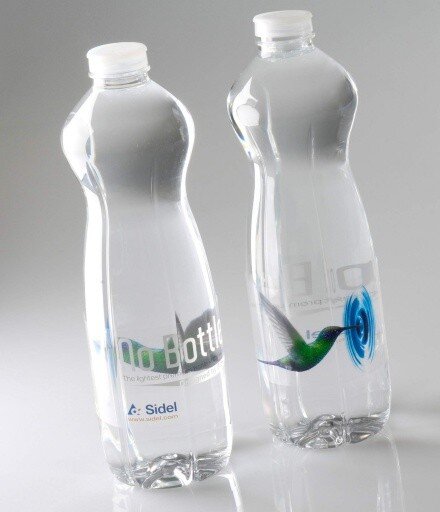
The 500 ml PET bottle weighs only 9.9 grams. As a result of the flexibility and the memory effect, a bottle regains its original shape after pressing together. When bottle weight is reduced, stiffening is normally provided by means of ribs which make the bottle brittle and limit the weight savings. Thanks to the flexibility, ribs are no longer needed. Despite the lower weight of the bottle, shape can be chosen freely, the bottle is easy to grip and is less noisy when compressed. Thanks to its shape memory, the bottle easily withstands stresses during conveying, packaging and transport.
Deep drawn containers
Up to now, blow moulding has been the only way to produce moulds for small bottles for dairy products such as yoghurt drinks from the growing functional food segment. Usually, the bottles are bought in and processed on suitable fill and seal lines. Blow mould machine manufacturers have adapted their machines to the requirements of this segment and many examples of the new machine generation will be on display at interpack 2008 in Düsseldorf. For example, 65 ml containers can be produced at a rate of around 4,600 units per hour using a 12-cavity die. Multiple extruders are used for multilayer, for example, in order to extrude a middle barrier layer. Additional features include systems for rapid blow mould changes and integrated leak testing.
One new development is a thermoforming process allowing these containers to be deep drawn in-line. The thermoforming process provides an absolutely uniform wall thickness distribution despite low starting surface area and high drawing depths. To the naked eye, there is no difference between a blown and thermoformed bottle. In addition, thermoformed bottles are only half the weight of a blown bottle yet still offer the stability required by the market. The machine design is based on experience with FFS lines and cup moulding machines. The machine is suitable for direct linking with existing fill and seal machines in dairies. The line works at 25 cycles per minute and 20 bottles per cycle. This represents a total output of approximately 30,000 bottles per hour and is thus equal to the output of a conventional standard fill and seal system.
In the free zone between the moulding and stamping station, the bottles can be sleeved as required. In the case of subsequent decoration, so-called roll-fed labels can be used instead of sleeves. They cost less but require the bottles to be arranged in a line and cannot be used for waisted bottles owing to the low shrinkage values.
Another advantage of the thermoformed bottle is the external edge. It ensures a smooth sealing surface for the cap. Blown bottles have their edges formed internally, which makes them rather unstable and can result in problems during sealing.
Flexible for multipacks
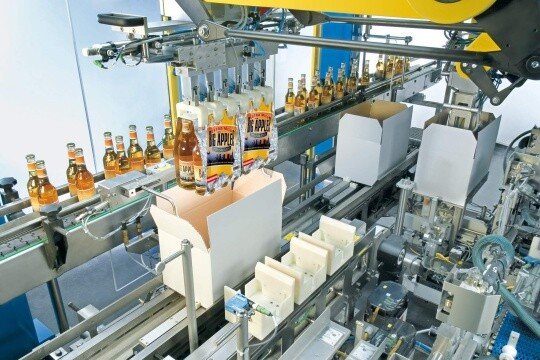
Whether it`s yoghurt drinks, soft drinks or beer - the bottles are usually sold not individually but in multipacks. Since the introduction of deposits on disposable bottles, returnable packs have become very popular for non-alcoholic drinks and beer. Six-packs are not only easier to carry, they also allow bottlers to offer cases containing different drinks.
A compact top-loading packaging machine can process bottle packs, carrier packs, folding boxes, wraparounds and sleeves. The number of units per pack can be selected at will. If the system is equipped with a scanner system, mixed cartons containing several flavours can be prepared at any time. Switching from a six-unit sleeve to a 20-bottle folding box takes less than five minutes. Due to the compact design of the multipacker, the system offers a high degree of flexibility and efficiency. All drives and movements are CNC-controlled. A touchscreen provides a complete overview of central data and machine functions and allows simple operation.
Interpack 2008 from 24 to 30 April in Düsseldorf will offer innovative solutions and comprehensive services for all areas of packaging and for the confectionary industry. With manufacturers displaying numerous new products, the beverage industry in particular has plenty to look forward to.