Plastics and the material basis of modern systems
A reading of Vaclav Smil’s How the World Really Works highlights the dependence of modern societies on cement, steel, ammonia and plastics, and the systemic limits of rapid material substitution.
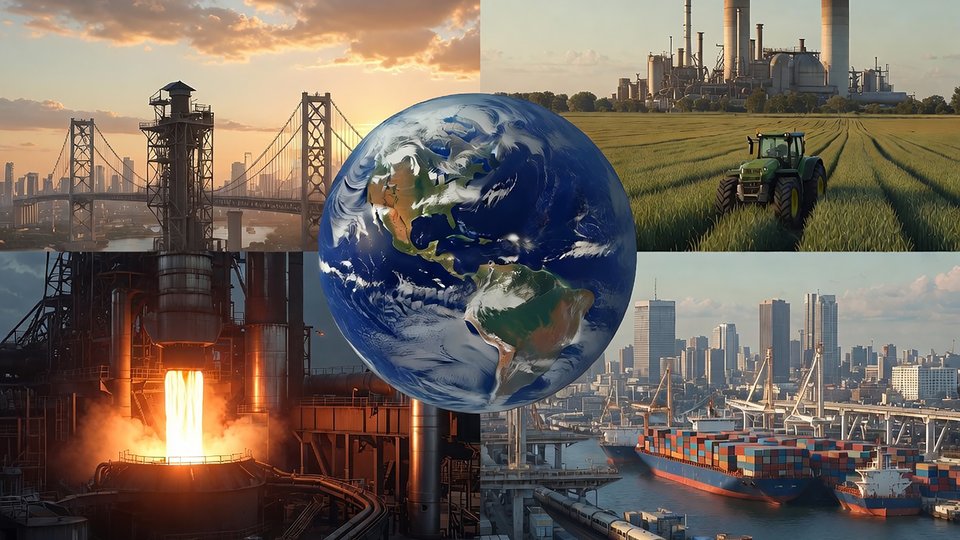
Discussions about the future often focus on political targets, consumption patterns or technological visions, while the physical foundations of modern societies receive less attention. The Canadian environmental scientist Vaclav Smil addresses this issue in his book "How the World Really Works", in which he describes how deeply contemporary civilization depends on four basic materials: cement, steel, ammonia and plastics. These materials are not isolated inputs. They are embedded in tightly interconnected systems that support infrastructure, agriculture, energy supply and global value chains. Because of this level of integration, changes in their production, use or replacement cannot be implemented quickly without wider consequences. Smil’s argument is relevant for the plastics sector because it places the material not only in the context of waste and resource use, but also in the broader structure of industrial efficiency and systemic dependency.
The material foundation of industrial societies
Modern economies are increasingly described as digital, but their operation remains materially organized. According to Smil, cement, steel, ammonia and plastics form the basis of advanced industrial societies. Cement enables buildings, transport infrastructure and energy facilities. Steel is essential for machinery, construction and power generation. Ammonia supports agricultural productivity through fertilizers. Plastics contribute to packaging, mobility, electronics, medical applications and numerous technical systems.
A central point in Smil’s analysis is that these materials can only be replaced to a limited extent. Their production routes, applications and supporting infrastructures are closely linked. In practice, this can be seen in the energy transition itself: wind turbines require steel structures, cement foundations and plastic-based rotors and components. Substitution or transformation of these core materials is possible, but it requires long time horizons and does not fit easily into short-term political target frameworks.
Geopolitical crises show how sensitive these systems are. Disruptions affecting oil and gas supplies, including events such as a blocked Strait of Hormuz, can drive up energy prices and change the operating conditions of entire industries. Plastics production is directly exposed to such effects, both through feedstock links and through the energy intensity of polymer and chemical value chains.
Plastics in a systemic context
Plastics are at the centre of many future-oriented debates, mainly because of the waste volumes associated with their use. At the same time, they are deeply integrated into systems that make resources usable in an efficient way. Plastics reduce weight, protect goods, extend shelf life, enable lightweight components and support applications that would otherwise require significantly more material or energy.
The decisive issue is therefore the context in which the material is used. In complex systems, individual components can rarely be assessed in isolation. Materials and technologies operate within large networks of interdependencies. These systems do not follow a simple linear logic. They grow through their connections. Mathematically, the number of possible connections in a system can be described as n times (n minus 1) divided by 2. With 10 components there are 45 possible connections; with 100 components there are already 4,950. This illustrates the quadratic growth of dependencies. Each additional component increases the number of interactions disproportionately.
For plastics, this means that substitution affects more than the material itself. Replacing a polymer in a given application may alter energy demand, transport weight, product protection, storage losses, processing requirements or the performance of related components. A local intervention can therefore create effects elsewhere in the system. This is one of Smil’s key messages: efficiency is central, meaning the ability to achieve as much as possible with the smallest possible input. Plastics can contribute to this objective when they are used intelligently and integrated into functioning cycles.
Ambition, feasibility and long-term change
"How the World Really Works" underlines that many public debates underestimate the complexity of material systems. Industrial production, infrastructure and supply chains remain stable because of extensive mutual dependencies. The stronger the interconnection, the lower the direct controllability of individual interventions. This does not mean that transformation is impossible, but it indicates that deep restructuring requires time, investment and a precise understanding of systemic effects.
At the same time, global demand is rising. Population growth and higher living standards increase pressure on resources, production systems and logistics. The future is therefore likely to involve greater structural complexity, not less. The central conflict lies between political objectives and physical feasibility. Short-term restructuring of existing infrastructures and investments can also create new dependencies, while attempts at rapid redirection in highly networked systems may trigger unintended shifts in stability.
The practical implication is to focus on more efficient material use, lower losses and closed cycles, rather than only on rapid substitution or reduction targets. In the case of plastics, this points toward design for recyclability, efficient applications, improved waste management and integration into circular systems. Smil’s work is frequently cited because it describes the material constraints under which modern societies operate. Its value lies in providing a factual perspective for discussions that often underestimate physical reality. For plastics, the key question is not only whether less material can be used, but how the material can be applied more effectively within the systems on which modern society depends.
Read more: