Robotized cells for manufacturing automotive parts
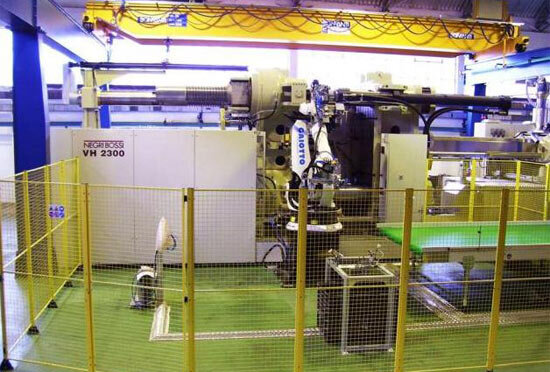
The companies of the Plastic Division in the Sacmi Group have combined their efforts and know-how in order to better integrate the production processes: from press-cycles up to finished products, i.e. creating a well integrated manufacturing system.
Roboplast combines a wide variety of expertises: the injection moulding presses of Negri Bossi as well as the automated coating systems of Gaiotto. Sacmi is the process leader that provides well organized, technical and commercial links to plants, machines, state-of-the-art technology and second-to-none service.
Among the services implemented, the Sacmi Group has developed a highly versatile manufacturing cell for processing plastic components of the motor scooter body.
These parts, which are manufactured in a modern plant where they undergo the forming, on-board machining, washing, painting and final assembly processes in single process areas with robotized manufacturing cells and presses so that the different parts (e.g. cover plates, bodies, etc) of a motor scooter can be easily formed, handled ad machined.
The requirements of the clients in general and the single products cannot fit into price list criteria or standardized principles. For these reasons, even the implemented solutions cannot be considered like this. As the production batches tend to decrease and product complexity to increase, it is not possible to create manufacturing areas dedicated to single specialized products; the machining cells should be as flexible and convertible as possible, thereby minimizing product changeover and process time.
Like the press, with the die-set changer and different raw materials, a number of products can be press-formed with downstream automated systems so that new requirements can be met with little adaptation and conversion work.
In this context, the manufacturing cell has been developed and perfected up to final inspection. A wide variety of products using different manufacturing methods can be carried with a number of production processes, forming operations and reduced batches. The projects are therefore developed taking certain manufacturing limitations into account:
- Allows for the processing of ABS or PP components
- Inserts can be fitted in
- Work-pieces are unloaded w/ support
- Certain components need flame-hardening
- Feed-heads are cut of
- Certain parts need de-burring
- Certain parts should be sand-papered so as to prepare them for the painting process.
The manufacturing cell is not only capable of performing these operations but according to the cycle time available, it could also be implemented for other procedures in the near future. If different products are to be manufactured, a flexible, open, easily programmable and a highly productive system can be provided.
To reduce down-time and the number of tool changes, a lot of engineering time has been dedicated to decide on the tools to leave on the robot wrist or on the floor. The vast experience gained over the years outside the plastic field has helped our designers to make a robot hand capable of de-moulding the pieces with grippers and suction cups, cutting feed-heads, sand-papering and de-burring the work-pieces.
The tools that perform the missing operations can be fixed to the outside.
Description of the process
1. The work pieces are picked up from the Negri Bossi press with the aid of an anthropomorphic robot provided with multi-function gripper.
2. The work-pieces are placed on a work bench, thus making preparations for the subsequent painting process)
3. Feed-heads are cut off (6 points of cutting)
4. The inner edges are de-burred and the cut feed-head points are thoroughly finished.
5. Surface finish at the die-set closing point done with air driven tools and Scotch Brite ultra-fine tape
6. The plastic work-pieces are picked up and flame-hardened: this process serves to remove plastic filament and burrs.
6. The work-pieces are put onto conveyor belts.
As explained above, the points of forceof the Sacmi Group, as highlighted in the implemented solutions, are based on the team involved in the operations, who possesses the expertise required and the consolidated experience gained in a number of fields, such as automated robotics.
This technical achievement have led Gaiotto to avoid the development of machines dedicated to particular tasks and opted for standard systems such as anthropomorphic robots to perform specific activities. This has notably increased the reliability of the manufacturing cells. Production stoppages should be avoided as much as possible and only technologically advanced machines assure long dependable service over time.
A natural step to complete the solutions obviously means that systems capable of painting the press-formed parts near the press and the handling system are to be developed. Working on the die-set and cleaning the production area, changes can be worked out, maintaining the proposed characteristics.
When machining operations that could contaminate the work-piece are performed (de-burring or other), the robot on board the press will not unload the products onto the conveyor belt or into containers.
The work-pieces will be loaded onto dedicated carriers which, thanks to an advanced handling system, enter the painting area where a further dedicated robot provides adequate surface treatment as required in the specifications. Avoiding intermediate storage, low value added handling (along with the quality and operative impact involved), use automatic machining cells that allow the manufactured work-pieces to be kept under control along with the operating costs.
Today, only Sacmi possess the required expertise and organization to carry out the proposed projects.