Selecting a technology for flat-top plastic cap production
A comparison of continuous compression and injection moulding for high-volume flat-top cap production, covering productivity, product quality, flexibility, energy use, circularity and maintenance.
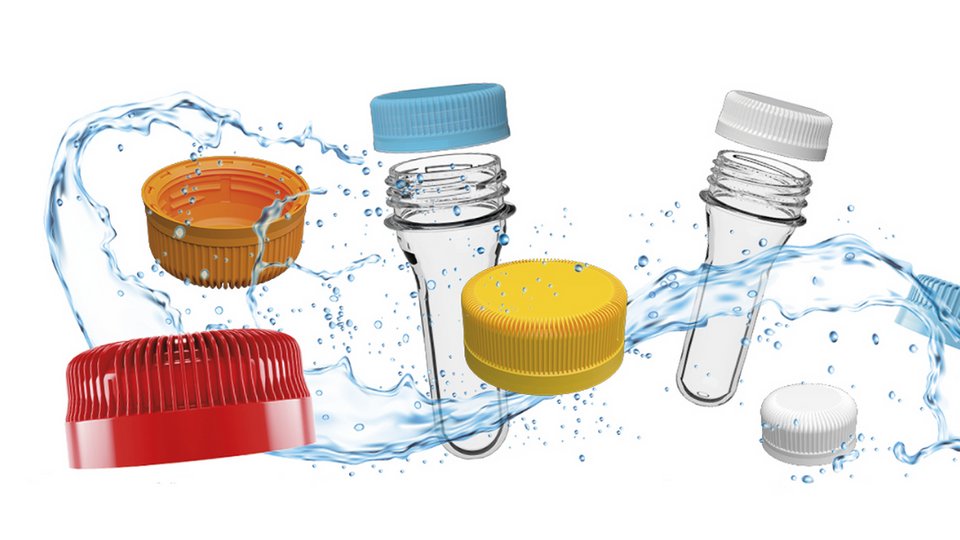
Selecting a technology for flat-top plastic cap production requires assessment of process performance, product requirements and long-term operating conditions. Continuous compression moulding and injection moulding are both established processes, but their characteristics differ in ways that affect cycle time, dimensional consistency, line flexibility, energy consumption and maintenance. The comparison is particularly relevant to high-volume production of small articles such as beverage caps, other closures and coffee capsules. Flat-top bottle closures are the main focus because they are widely used in the beverage market. The purpose is not merely to list generic strengths and limitations, but to identify factors that may help manufacturers choose a process suited to caps and capsules. These conclusions should not automatically be extended to every moulded plastic product, as continuous rotary compression is a specialised technology, while injection moulding serves a much broader range of applications.
How the technologies work
Continuous compression moulding
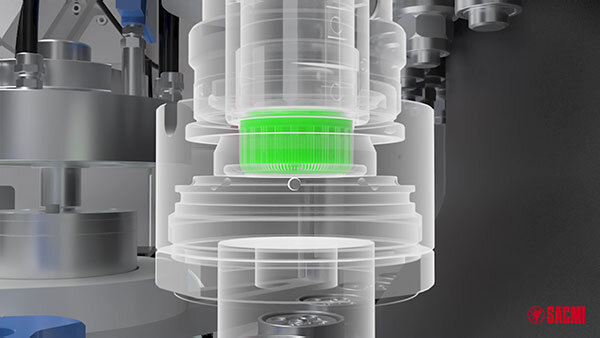
Continuous compression moulding is suited to large-scale production of relatively small, symmetrical products such as caps and closures. The cycle starts with melting and metering the polymer. The melt leaves a single nozzle, and a rotating device collects a precise dose and places it in an open mould positioned around the circumference of a rotating carousel. The mould closes and applies high pressure, shaping the molten material.
The product cools in the closed mould while the carousel rotates. After each mould opens, the products are transferred to an outlet belt in an oriented and spaced arrangement, ready for downstream operations. This feature is important in cap production because inspection equipment can operate without a separate feeder for orientation and alignment.
The process is specialised. Bulky parts with through-holes or pronounced undercuts are not typical applications. Small products, including caps and coffee capsules with relatively complex geometries, are better suited to rotary compression moulding machines.
Injection moulding
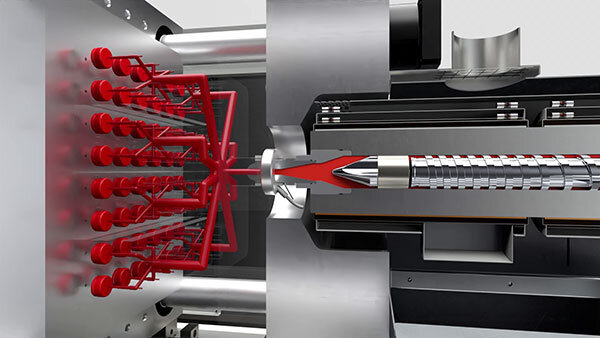
Injection moulding is a widely used plastics processing method. Resin is melted to a temperature at which it can flow under high pressure through narrow channels, each supplying a mould cavity. The material is injected into a closed mould, where it cools and assumes the required shape. When the mould opens, the caps are ejected, fall under gravity and are collected.
The technology can process a broad range of products and materials and is adaptable to numerous applications. Its widespread use has also created an extensive base of mould manufacturers. This versatility, however, does not mean that injection moulding is necessarily the preferred option for every product.
Productivity, stability and flexibility
Cycle time and material flow
For the same product, the source states that compression moulding has a shorter cycle time than injection moulding. This is attributed mainly to the lower melt temperature and to simultaneous introduction of material into the mould and removal of the finished product.
The compression process uses a relatively simple extrusion unit and does not require a hot runner. Melt exits through one nozzle whose diameter is stated to be about ten times greater than the terminal channels of a hot-runner system. In injection moulding, the polymer must be pumped at high pressure through narrow hot-runner channels. A higher melt temperature is needed to reduce viscosity and support this flow.
Process stability
Both processes can be stable and robust when their parameters are correctly adjusted. According to the source, compression moulding provides better dimensional consistency and tighter tolerances for caps. Products also leave the mould at a lower temperature, which can reduce shrinkage and application-related problems.
Compression moulding can process materials with lower melt flow and higher molecular weight. Such materials can provide improved mechanical properties, subject to resin selection and product requirements.
Production changes and tamper-evident bands
Cap manufacturers may need to convert lines between different closure designs. The source argues that forming a tamper-evident band in the mould restricts this flexibility and increases process and maintenance complexity. Cutting the band in a separate slitting operation permits the use of a simpler mould and allows the slit pattern to be changed by replacing the blade.
For the tethered-band designs discussed in the source, slitting does not require angular alignment between the cap and mandrel. Inspection can also be simpler because a slit band has solid walls without open spaces. In-mould bands contain openings that transmit more light and may reduce image quality during optical inspection.
Product quality considerations
Injection gate and inspection
Compression-moulded caps have no injection gate. In an injection-moulded closure, the gate area contains crystallised material with characteristics different from the remainder of the cap. The source identifies this area as a potential weak point where defects such as micro-holes may occur.
Quality control of thin-wall injection-moulded caps may therefore include a micro-hole detector or spark tester. Such equipment is described as unnecessary on compression lines. Injection-moulded caps leave the press in random positions, so an inline vision system generally requires a feeder to orient and align them. Continuous compression equipment delivers caps already oriented and spaced on the discharge belt, where a vision system can be installed directly.
Mechanical properties and mould alignment
The simpler extrusion unit, absence of hot runners and lower processing temperature expose the polymer to less thermal and mechanical stress. The source associates these conditions with improved mechanical properties for both high-density polyethylene and polypropylene caps, reduced dimensional variability and the ability to process higher-molecular-weight polymers.
Thin-wall closure production also depends on mould alignment. In compression moulding, each core and cavity pair is centred separately by tapered guiding surfaces and a floating stripper ring. Mechanical engagement and local coaxial alignment occur before complete mould closure, independently at each station.
In a high-cavitation injection system, the mould is a large horizontal assembly that can weigh several tonnes. The source notes that elastic deflection in its central region may affect the relative position of the two halves and cavity-to-cavity consistency. This effect becomes more relevant as mould size and cavity count increase. Rotary compression stations are vertical, individual mould sets weigh only a few kilograms, and alignment is local to each core-cavity pair.
Energy use and lightweighting
Sacmi reports that its analysis of case studies involving current compression and injection lines found specific energy consumption, measured in kWh per kilogram of resin, to be at least 25% lower for compression lines. In some cases, the reported reduction reached 38%. With product and resin held constant, consumption on a compression line was described as slightly more than two-thirds of that on an injection line.
Weight reduction requires coordinated work on the process, machine and mould, regardless of the selected technology. Both processes can produce progressively lighter caps, and cap weight alone does not clearly favour either one. The source nevertheless states that compression moulding can use higher-viscosity materials that may enable additional lightweighting options.
In injection moulding, resin enters only after the mould is fully closed and must flow through narrow gaps during filling. In compression moulding, the resin is shaped as the mould closes, so it flows through wider gaps during much of the filling stage. According to the source, this can allow compression moulding to produce lower wall thicknesses in some applications.
Thin-wall closures
The lightweighting trend in beverage closures began around 15 years ago with the first 26 mm and 29 mm neck finishes. Sacmi attributes the suitability of rotary compression for thin-wall closures to short cycles, a broad material processing window, compatibility with higher-viscosity resins offering improved environmental stress-cracking resistance, and the absence of an injection gate in the cap top.
Circularity and contamination control
Lower processing temperatures and short residence times can limit polymer degradation in compression moulding. Sacmi reports that, in its tests, the same plastic material was reprocessed as many as 45 times without a significant change in viscosity. The use of higher-viscosity materials with favourable mechanical properties may also help retain performance over repeated recycling loops, supporting cap-to-cap recycling.
Regarding dust and potential contamination, the source states that applying good manufacturing practices prevents a risk of microplastics or contamination in caps produced by either moulding technology or by stand-alone slitting. Sacmi sampled products from the market and reports that it found no difference between caps with moulded bands and those with slit bands produced by compression or injection moulding.
Economic factors and maintenance
Return on investment depends on several variables, including factors beyond the moulding process itself. On a typical injection line for flat-top caps, the mould is reported to account for a larger share of total cost than on a compression line with equivalent output. This becomes important when production must be adapted to changing market requirements.
A cap line commonly operates for close to ten years, during which product requirements and regulations may change substantially, as illustrated by the introduction of tethered caps. The source links the adaptability of compression lines to lower mould investment and the flexibility of downstream slitting.
Maintenance costs vary according to whether a company uses breakdown, preventive or predictive maintenance and according to the period covered by the assessment. Digital services are available for both technologies to support operation, reduce downtime and improve line availability. Consequently, it is not sufficient to state that one process always requires more maintenance without considering the production setting and maintenance strategy.
A structural difference is the hot runner, which is present in injection systems and absent from rotary compression cap equipment. According to the source, a hot runner generally needs a major overhaul after three to four years of intensive use. A replacement unit can partly protect machine availability, but the operation affects total cost of ownership because it requires specialised labour, spare parts and lead time. On a compression machine, individual male and female mould stacks can be replaced while the remaining stations continue to operate, supporting availability during mould maintenance.
Summary of the comparison
For flat-top caps and capsules, the principal characteristics identified in the source are:
| Technology | Advantages | Limitations |
|---|---|---|
| Injection moulding | Versatility for other applications; broad base of mould manufacturers | Higher energy consumption; longer cooling time; injection gate |
| Continuous compression moulding | Shorter cycle; lower energy consumption; dimensional consistency | Specialised technology; limited number of equipment suppliers |
The final selection depends on production volume, closure design, resin properties, required flexibility and the intended application. Injection moulding offers broad versatility, while continuous compression moulding is specialised for high-volume manufacture of small closures and is associated in the source with lower energy demand and consistent product quality. Technology choice remains only one part of a long-term investment decision, which should also account for mould costs, downstream operations, maintenance strategy and the line's ability to accommodate future product and regulatory changes.
Read more: