Siemens and P&G scale AI quality inspection
Siemens and Procter & Gamble are expanding an AI-based inspection system across P&G's manufacturing operations. The companies report 10 to 20 percent lower scrap rates, depending on the product, and commissioning five to ten times faster than with traditional vision systems.
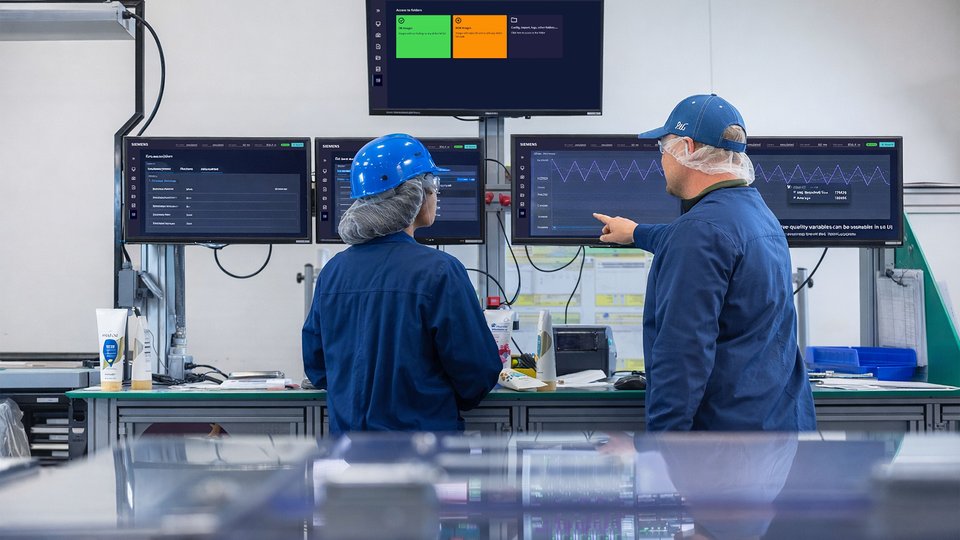
Siemens and Procter & Gamble (P&G) are expanding the deployment of an AI-based quality inspection solution across P&G's manufacturing operations worldwide. The Visual Inspection Cockpit (VIC) analyzes live camera images and inspects every product in real time at full production-line speed. The system is intended for high-speed consumer goods manufacturing, including applications involving delicate, textured materials that naturally shift, stretch or wrinkle during processing. Such variability can pose difficulties for conventional rule-based vision systems, which often require extensive reconfiguration when materials, packaging designs or production environments change. By applying industrial AI, VIC is designed to adapt to these variations while maintaining inspection performance across a broad range of products. According to the companies, the solution has reduced scrap rates by 10 to 20 percent, depending on the product, while supporting more consistent product quality.
Industrial Edge infrastructure and deep learning models
Developed jointly by Siemens and P&G, the solution combines P&G's deep learning models with the Siemens Industrial Edge computing platform, industrial PCs equipped with Nvidia GPUs, and AI hardware and software. Siemens provides the industrial computing infrastructure, software scaling capabilities and support for long-term system operation across production sites.
"Our Industrial AI and Industrial Edge capabilities deliver what high-speed production demands: full inspection accuracy for thousands of products per minute, scalable from a single line to a global footprint. This collaboration demonstrates what we mean when we say we're making industrial AI real," said Rainer Brehm, COO for automation and CTO at Siemens Digital Industries.
Paul Thomas, Director of Machine Vision and Applied AI at Procter & Gamble, said: "We engineered this solution to solve a myriad of industry challenges traditional vision systems couldn't touch: accurate characterization of overlapping components, the subtlety of low-contrast defects, the complexity of highly decorated products and packaging, tight time coordination, real-time PLC integration with single product reject at high production rates with continuous inspection."
Model configuration at plant level
Unlike conventional rule-based systems, the AI-based approach can process a wide range of product variations without frequent reprogramming. VIC includes the Visual Inspection Engineering Tool, which allows plant engineers to configure, train and update inspection models directly, without dedicated data science resources. This is intended to make quality control easier to maintain in complex production environments.
Inspection results are processed close to the production equipment on Siemens Industrial Edge and integrated directly into manufacturing operations. The system can automatically initiate actions, including alerts or the removal of defective products from the line. Quality data can also be collected and analyzed over time to identify trends and support continuous improvement.
Reusable application supports rollout across plants
VIC forms part of Siemens' machine vision and industrial AI portfolio, which also includes the Industrial AI Suite. The solutions are supplied as standardized applications on the Industrial Edge platform, providing a common framework for deploying AI systems at scale, whether an AI model is developed by a customer or owned by Siemens.
As VIC is delivered as a reusable Industrial Edge application, the companies report that new deployments can be commissioned five to ten times faster than traditional bespoke vision systems. Established infrastructure, DevOps processes and integration patterns enable P&G to replicate the solution across plants, products and inspection scenarios with limited additional overhead. Inspection data is also fed into P&G's broader digital manufacturing ecosystem, providing real-time information on process stability and opportunities for continuous improvement.