Aimplas studies bacterial cellulose for facial masks
Aimplas is investigating bacterial cellulose hydrogels as carriers for active ingredients in facial masks. The biodegradable material could also be used in burn dressings, ulcer treatment, controlled-release systems and tissue regeneration.
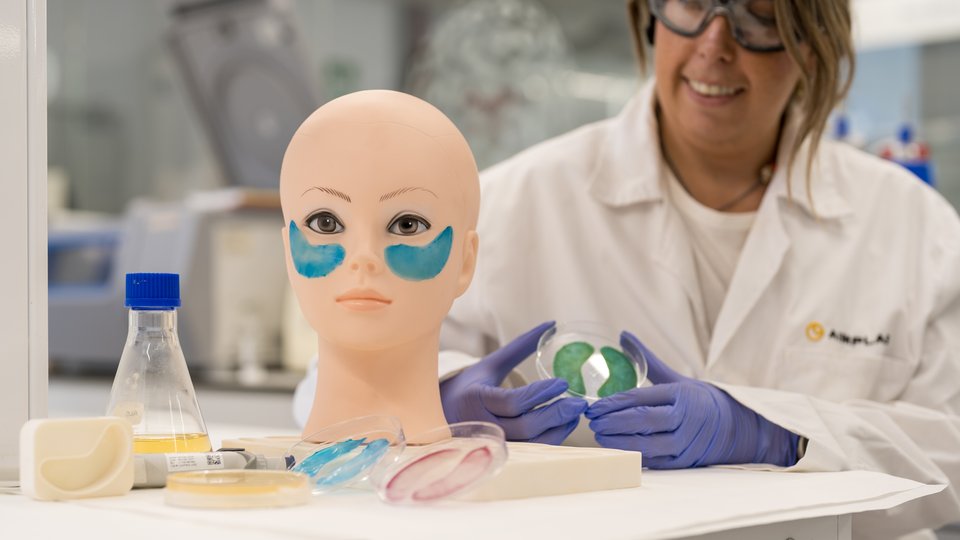
Aimplas, the Plastics Technology Centre, is investigating the potential of bacterial cellulose to develop facial masks that act as carriers for active ingredients intended for skin care after sun exposure. Heat, sun exposure and prolonged use of air conditioning can contribute to skin dehydration during the months following summer. The research therefore focuses on facial masks based on bio-based and renewable hydrogels. Bacterial cellulose is a 100% natural biopolymer produced by certain bacteria. In addition to cosmetic applications, the biodegradable material may offer opportunities in healthcare, including burn dressings, ulcer treatment and skin regeneration.
Bacterial cellulose is mainly synthesised by bacteria of the Komagataeibacter genus, which are commonly found in fermentation processes associated with products such as vinegar, kombucha and nata de coco. During growth, these microorganisms generate a three-dimensional network of intertwined nanofibrils. This network forms a flexible and durable material capable of retaining large amounts of water.
The resulting structure allows bacterial cellulose to adapt closely to the face, creating a "second skin" effect. This makes it a suitable support for active ingredients used in cosmetic applications.
According to María José de Manuel, Biotechnology Researcher at Aimplas, "Bacterial cellulose has very interesting properties for the development of more sustainable, high-performance cosmetic products. Its extraordinary water-retention capacity, together with its flexibility and ability to adapt to the skin, make it an ideal material for facial masks and as a support for incorporating cosmetic active ingredients."
Its flexible structure and high water-retention capacity are key characteristics for cosmetic applications. As a biodegradable material that contains no synthetic fibres, bacterial cellulose may also provide an alternative to many conventional products.
Potential healthcare applications
The possible uses of bacterial cellulose extend beyond cosmetics. Its biocompatibility, high water-absorption capacity and nanoporous structure give the material potential in healthcare applications associated with skin care and recovery.
It can be used to develop dressings and patches for burns, wounds and ulcers, as well as supports incorporating active compounds for controlled release. Its properties may also support tissue regeneration applications and the development of new biomaterials for the healthcare sector.
"The versatility of bacterial cellulose makes it possible to develop innovative solutions for both skin care and biomedical applications. It is a natural, biodegradable material with very interesting properties for the development of sustainable, high-value-added products," highlighted María José de Manuel.
Bio-based production and material purity
Cellulose is the most abundant organic polymer on the planet and is traditionally obtained from plant sources. Bacterial cellulose provides a bio-based alternative that can be produced through fermentation processes while requiring fewer forestry resources.
The material also offers a high degree of purity because it contains neither lignin nor hemicellulose. These components occur in plant cellulose and require additional processing for their removal. Other characteristics of bacterial cellulose include biodegradability, flexibility, transparency and a high capacity to absorb and retain water.
According to Aimplas, these properties make bacterial cellulose a promising material for new solutions in cosmetics, medicine and biotechnology. The centre's work forms part of its research into advanced biomaterials intended to support the development of functional products with a lower environmental impact for sectors including cosmetics and healthcare.