Formnext Awards 2026 finalists announced
The Formnext Awards 2026 finalists represent developments in additive manufacturing across education, design, production technologies, recycling and carbon data. Public online voting will remain open until 19 November 2026 at 12:00.
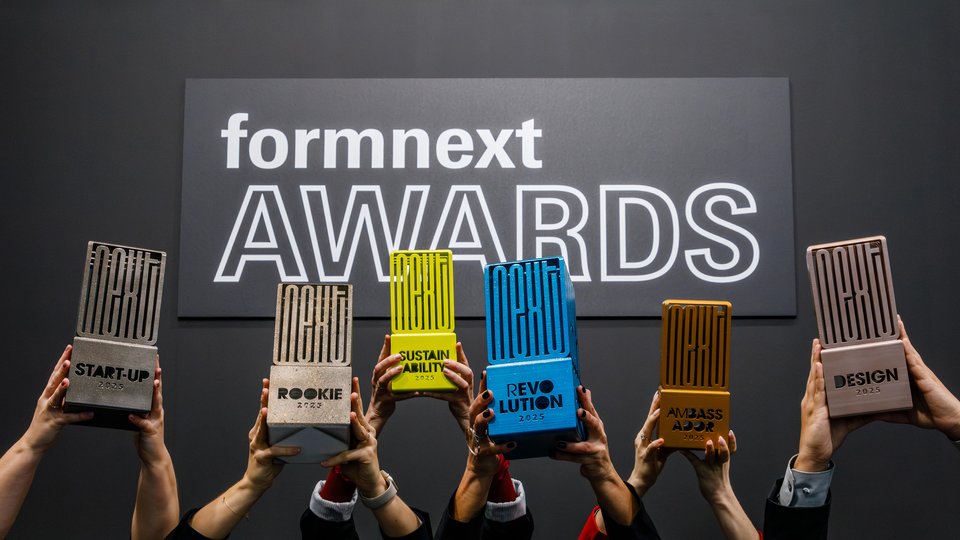
The finalists for the Formnext Awards 2026 have been selected in six categories. Their projects cover specialised additive manufacturing technologies, applications in textiles, aerospace, medicine and dentistry, as well as recycling, industrial sustainability and AM education. The finalists will present their exhibits online before Formnext and at a dedicated showcase during the exhibition. The winners will be announced at the awards ceremony on 19 November 2026. Public online voting is open, and its result will count as one additional jury vote.
The selected projects illustrate the range of current additive manufacturing developments. They include technologies created by emerging AM companies, applications developed by universities and medical institutions, and concepts intended to reduce the environmental impact of industrial production. Visitors can see all finalists at the Formnext Awards Showcase in Hall 11.0, stand F60. The awards ceremony will begin at 16:10 on 19 November at the Industry & Application Stage in Hall 11.0, stand D72. Voting in all categories will close at 12:00 on the same day.
AMbassador Award
The AMbassador Award recognises individuals and organisations that support the industry and its users through training, education or personal advocacy for additive manufacturing.
Dr Michael Kraemer from the AM Center at TU Darmstadt is a finalist for his work in educating future AM specialists. Between 50 and 60 students complete the centre's programmes each year. The activities also cover more than 20 student projects and 10 doctoral theses over a three-year period. Further training is provided to apprentices in cooperation with IHK Rhein-Main and to industry professionals.
Professor Leroy Gardner and the Steel Structures Research Group at Imperial College London are developing the use of metal AM in construction. Their activities combine experimental research, structural optimisation, design development, robotic metal 3D printing and full-scale testing. Their work includes the world's first 3D-printed steel bridge, developed with MX3D, and a hybrid steel truss incorporating additively manufactured nodes.
Mechanical engineer Luan Saldanha of Aditiva Brasil created the Additive Manufacturing Map of Brazil to increase the visibility and connections of the country's AM ecosystem. He also publishes the Panorama MA newsletter, operates the Manufatura Digital industry news platform and produces educational AM content for YouTube and Instagram.
Design Award
The Design Award finalists include a 3D-printed garment, a patient-specific titanium implant and a single-piece rocket engine.
During her Master's degree in Industrial Design at the Technion, Israel Institute of Technology, Maya Kaplan developed the Computational Bra. The 3D-printed garment demonstrates how computationally designed textile structures can combine elasticity, support and compression in one product. These functions are integrated directly into the textile, which is produced from TPU on a desktop FDM 3D printer.
The Levin Center at Tel Aviv Sourasky University Medical Center developed a monolithic titanium implant conforming to the patient's anatomy and successfully used it in surgery. Combined with point-of-care 3D surgical planning, the implant is produced from medical-grade Ti-6Al-4V titanium. Its applications include the treatment of bone cancer in children and adolescents.
Indian space technology start-up Agnikul Cosmos developed a single-piece, semi-cryogenic rocket engine 3D-printed in Inconel. The engine was designed for additive manufacturing from the outset and was successfully deployed in the Agnibaan SOrTeD Mission 2024.
(R)Evolution Award
The (R)Evolution Award covers products, technologies and services designed to provide measurable value to users. This year's finalists address dental production, filament drying and micrometre-scale 3D printing.
Fyous developed the GHOST machine for manufacturing aligners and retainers. Its PolyMorphic Moulding technology temporarily creates moulds using thousands of precisely actuated pins.
Malta-based Thought3D developed the Drywise inline filament dryer to improve tensile strength and performance in materials including nylon. Rather than drying a complete filament spool, the system dries only the section immediately before extrusion.
Boston Micro Fabrication developed the microArch S150 desktop printer for micrometre-scale production. Based on Projection Micro Stereolithography technology, the printer provides an optical resolution of 25 μm. Potential applications include microfluidic channels, fibre-optic parts and electronic components.
Rookie Award
The Rookie Award is intended for people with promising business concepts who have either not yet established a company or did so within the previous year. The finalists are working on battery recycling, copper feedstock and a metal AM process derived from aerospace applications.
The cAIclone engineering initiative, whose company formation is in preparation, is developing AI-optimised, 3D-printed hydrocyclones for separating fine particles in the 1–50 µm range. The Munich-based team is initially targeting battery recycling.
FlexCycle Solutions produces copper powder for additive manufacturing and powder metallurgy from electronic industry waste. The entirely mechanical process creates particles with a spherical, rough morphology intended to improve laser absorption in laser powder bed fusion applications.
Spaceform is developing Vacuum Atomised Suspension Printing, a metal additive manufacturing architecture. In the process, a metal powder suspension is vacuum-dried before laser processing to form a stable and cohesive powder layer. Initial applications include radio-frequency components, thermal management and precision fluidics.
Start-up Award
The Start-up Award recognises young AM companies with sustainable business models and market-ready products. The finalists focus on new additive manufacturing and hybrid production concepts.
Aumatis uses additive manufacturing in its AX-150 system to automate a traditional process used in industry and jewellery production. A 3D-printed polymer model is embedded in a proprietary investment compound, burned out and subsequently cast under vacuum.
Swiss start-up sallea develops 3D-printed soluble cores and tooling for producing lightweight parts with complex geometries. Initial applications include thermoset carbon-fibre-reinforced polymer components for motorsport and sporting goods.
Hydra Manufacturing develops hybrid production technologies for difficult-to-process materials, including advanced ceramics and cemented carbides. Its system combines paste extrusion, green-state machining and in-process inspection in one machine. The range of processable materials includes silicon carbide and hard metals.
Berlin-based additiveStream4D also uses a hybrid approach. Its retrofit technologies enable standard metal laser powder bed fusion systems to manufacture precisely on existing geometries. Potential applications include advanced cutting tools and the repair of high-value parts such as turbomachinery components.
QH Build is developing simulation software intended to improve the efficiency of additive manufacturing. In one wire laser additive manufacturing application, implementation was completed 72% faster and the cost per part was reduced by 64%. The system combines industrial robotics, multiphysics simulation and a controller-aware digital twin to reduce trial-and-error in metal directed energy deposition.
Sustainability Award
The Sustainability Award, supported by Renishaw, evaluates AM products and applications across their complete product life cycle. The finalists are FlexCycle Solutions, BMF GmbH and Baker Hughes.
FlexCycle Solutions was selected for its mechanical production of copper powder for additive manufacturing and powder metallurgy from manufacturing waste streams. The company is also a finalist for the Rookie Award.
BMF GmbH, Bernstein Mechanische Fertigung, supplies customers with a 3D printer alongside its blasting systems, allowing plastic spare parts to be produced on demand. The required design files are provided through the cloud-based Digitalsource spare parts catalogue.
Baker Hughes developed the Manufacturing Carbon Platform to support manufacturing decisions based on carbon data. The platform provides information on the environmental impact of additive production processes from quotation to delivery.
Awards ceremony and online voting
The winners in each category will receive cash and non-cash prizes, as well as trophies designed by SutoSuto and produced by FKM Additive Manufacturing. All finalists are presented on the Formnext Awards website. The public can vote online until 12:00 on 19 November 2026, and the winners will be announced later that day.