Artificial intelligence is not just data
As a pioneer in the industry, Arburg is working hard and with a practical focus to find ways of using digitalisation to further increase production efficiency in plastics processing.
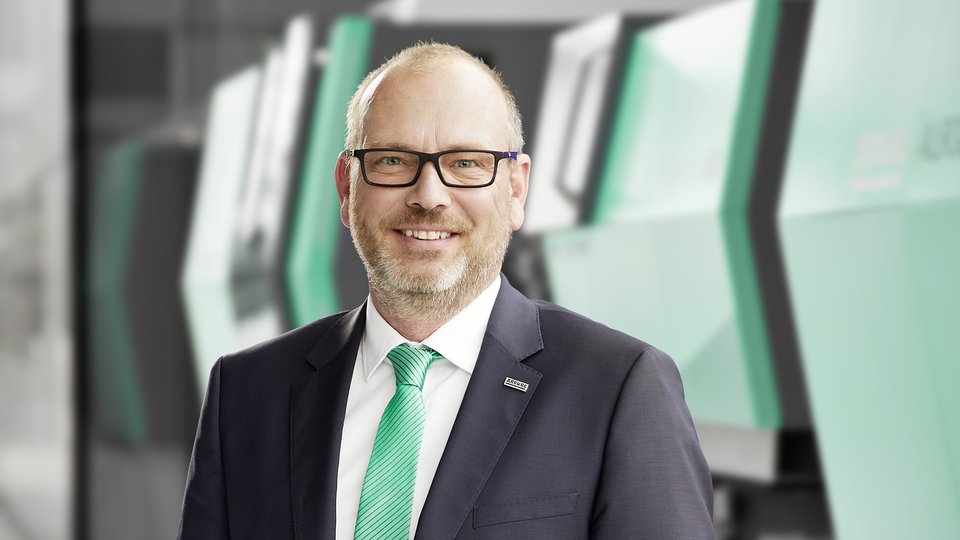
As part of our "Future of Injection Molding" series, we talk to Guido Frohnhaus, Managing Director Technology & Engineering at ARBURG
The rapid development of digital technologies has thrown the door wide open to the 'Industry 4.0' era. What impact does digitalisation have on the injection moulding machine industry and how has it changed the approach to injection moulding processes?
As a pioneer in the industry, Arburg is working hard and with a practical focus to find ways of using digitalisation to further increase production efficiency in plastics processing. With high-quality technology, a 'smart' control system and digital products and services, even difficult processes can be optimised and kept stable. What was previously associated with considerable time, staffing and control outlay is now becoming increasingly simple, efficient and reliable in terms of processes. This is precisely what plastics processors expect from us machine manufacturers - to use digitalisation and automation to make everyday work in injection moulding easier and more profitable.
There is a demand for extensively interlinked 'smart' injection moulding machines that know the parts they are producing, monitor their processes, control them adaptively, and actively support the operator in every situation. This also includes assistant-supported operation and seamless documentation. The data collected provides a great deal of information about the manufacturing process and enables users to organise their own sequences more quickly and with greater added value, and also to inform customers about the status and quality of individual orders, for example.
The Arburg host computer system, or 'ALS', our own MES specially developed for injection moulding, makes this possible. Besides Allrounders, injection moulding machines from other manufacturers and metalworking machines and peripheral devices, for example, can also be connected with this tool.
Last but not least, digitalisation is essential for a functioning circular economy and hence for the sustainable and resource-efficient use of plastic as a recyclable material. Arburg is involved in this area as part of "R-Cycle", for example, a cross-industry initiative for plastics recycling. This has been nominated for the German Innovation Award for Climate and Environment (IKU) 2022 in the category "Use of digital transition for climate and environmentally friendly innovations". The aim is to use a digital product passport to automatically record properties relevant to recycling during production so that recyclable packaging can be identified and separated by type in waste sorting plants and then used to produce high-quality recyclates.
But these are still the beginnings of advanced digitalisation and, generally speaking, the level of maturity in terms of the digitalisation of injection moulding processes still varies widely.
Mechanical engineering is following the same development path as the automotive industry - software and 'smart' technologies are also becoming increasingly important in plastics processing. But we are only at the beginning of a new era here. Together with our customers and partners, we are embarking on a journey towards digital transformation. However, because digitisation has progressed differently in different countries, industries, and companies, we want to meet everyone exactly where they are at the moment. Our aim is to be at our customers' sides to offer advice and assistance, and in so doing create 'connectivity', so to speak, between them, our machines and Arburg.
Well, let's talk about which doors digitalisation opens – which specific opportunities it makes available (compared to the past).
Smaller quantities, faster product changeovers, increased flexibility and quality requirements combined with seamless documentation and a lack of skilled workers – these are current challenges that need to be solved. This can only be achieved with the help of automated and digital sequences. Modern machines will continue to be high-quality, durable, capable of integration and efficient. But they also have flexible assistance and control modules that form the basis for a 0-ppm strategy.
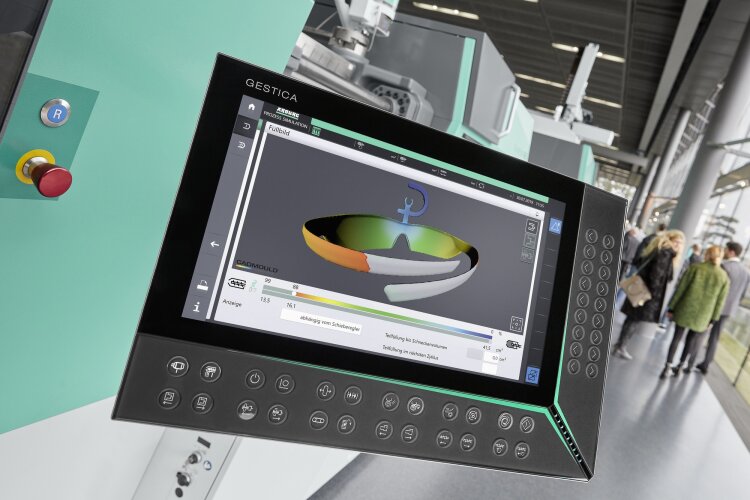
With the Gestica control system, the use of two physically separate host computers - one for operation and visualisation and the other for controlling and regulating the processes in real time - opens up possibilities that were previously only available to a limited extent with one controller. Good examples of this are 3D views and assistance functions. I am sure that with our Gestica we are taking injection moulding to a new level. It will be a whole new experience for digitalisation and for our customers' control concepts. As the 'brain' and seal of quality of the machine, the Gestica offers an enormous amount of flexibility, especially with frequent mould and product changeovers, or when users want to optimise their processes and keep them stable. They can use it to make excellent process analyses and optimise sequences and cycle time.
One example of an 'intelligent' assistance function, thanks to which the machine 'knows' the part it is producing, is the axw Control FillAssist - a valuable tool for setting up a mould to speed up the process and make it more reliable at the same time. The function works by animating the filling level of the part in relation to the current position of the screw as a 3D graphic in real time. So you can run filling simulations directly on the machine, even while it is working. Three other control systems – the ScrewPilot, PressurePilot, and ReferencePilot – enable adaptively regulated injection. These are control strategies that build on each other for central quality requirements such as constant shot weights and uniform mould filling, irrespective of viscosity fluctuations.
Thanks to aXw Control MeltAssist, the Gestica identifies the built-in cylinder module via a chip and uses this data to automatically calculate and monitor parameters such as plasticising utilisation and dwell times. In addition, the running performance and plasticising load are stored. This enables performance-based or predictive maintenance, efficient service, and saves valuable working time in everyday production.
All assistance functions have one thing in common: they contain the expert knowledge and experience of experienced operators in a stored and retrievable form, making operation very simple; no special software knowledge is required. This is particularly advantageous when operating and service staff change frequently, and to compensate for the different levels of know-how worldwide.
As injection molding processes become more digitalised, the amount of data increases. Data contains a lot of information but this is often not recognisable at first glance. How does using this information support processes optimisation?
Data is the driver of digitalisation and, so to speak, the gold of the future - even of the present. But for most tasks, it is not 'big' data that is needed, but 'smart' data. For example, in order to achieve the goal: 'machine knows part' by bringing simulation and reality together, a large amount of process data must be collected and evaluated and conclusions drawn with a great deal of expertise. This is something that we are working hard on.
The machine technology's real-time network system, a 'smart' control system, and data analyses form the basis for reliable process monitoring. With appropriate sensors, the conditions of parts susceptible to wear can be recorded (condition monitoring) and predictive maintenance enabled. This minimises the amount of maintenance required and at the same time ensures long, stable, and fault-free run times. In this way, batch to batch variations in the material or wear in hydraulic valves or vacuum generators, for example, can be detected and predicted. The control system informs the operator in good time as soon as the parts susceptible to wear need to be replaced. Another example is the load-dependent, automated lubrication of toggles on electrical machines depending on the application and parameter settings during ongoing production.
Generally, there are two options for data analysis. In an 'on-cloud' solution, the collected data is transmitted to a higher-level central system in the cloud, where it is analysed and later communicated back to the machine. This requires an elaborate IT infrastructure. Arburg, on the other hand, relies on an 'on-device' solution, i.e. the data is analysed and evaluated directly in the Gestica operating unit, where data models trained by us are located, so Arburg's process knowledge is also directly incorporated. The control of the machine itself remains unaffected. In our view, higher-level systems are more suitable for topics such as production planning and long-term analyses.
At Arburg, more than 90 per cent of all sequences are already digital today - from setting up the machines to the mobile planning of service technician assignments. Interlinking along the entire value chain makes production-relevant information actively available at any time and any place. Thanks to meticulous data maintenance, there has long been a digital twin for every machine. The data stored for a machine is also made accessible to customers via the customer portal. Every customer is assigned their own virtual room in arburgXworld, to which only they have the 'key'.
Online support, remote service, augmented reality - the functions are now already widely used. What are your achievements in this area?
We see ourselves not only as a machine supplier, but rather as a technology partner, efficiency driver, and pioneer in the plastics industry when it comes to digitalisation. Our machines, automation and proprietary IT solutions form a flexible production system. The ultimate goal is to make the complex controllable. We equip our Allrounders with an IIoT gateway so that they can be interlinked in a standardised way with the arburgXworld customer portal or the Arburg Remote Service, for example.
We have combined our digital products and services intelligently and clearly in the arburgXworld tool. With our customer portal of the same name and its many apps, we map the entire world of our customer's company, so to speak, and make it easier to get started in Arburg's digital world - across the entire injection moulding value chain. The portal offers real added value and many features to make everyday work even more efficient – all available in a basic version that is totally free of charge and therefore also risk-free. The Shop and MachineCenter are particularly in demand. In the Shop, customers can very conveniently order spare parts at any time and at attractive conditions. With its central access to production-relevant information and documents, the MachineCenter offers transparency about the company's own machine fleet and simplifies planning. The VirtualControl function, on the other hand, is the digital control twin, so to speak. The machine setter can use a PC or tablet to create and change injection moulding programmes from home, optimise sequences, and carry out troubleshooting - even across locations. Data can subsequently be transferred directly to the machine via the ARBURG host computer system (ALS), for example, or on a compact flash card.
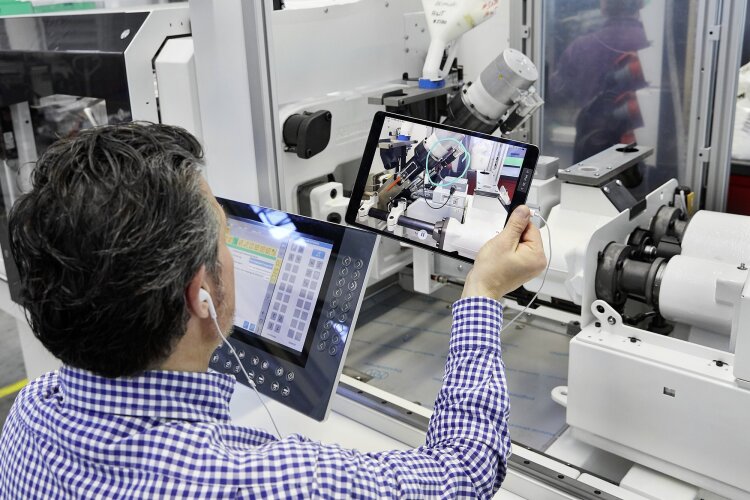
The SelfService app is another modern tool. This is where the service technicians' knowledge database is stored. In the event of a machine fault, there are instructions for self-help - which avoids time-consuming and costly on-site service visits. In future, the Gestica control system will also provide 'first aid' by using 3D animations to show the operator exactly where the malfunction is located and then assisting with troubleshooting via the operating instructions.
Many customers are avoiding business trips and site visits due to the coronavirus pandemic. For this reason, we now also offer the option of remote machine acceptance. During the process, our sales experts go through the requirements specification together with the customer. On completion, they receive a detailed report including additional documentation in the form of images. The approach saves time and money and is an exciting option for the future. Just like our online support via the Arburg Remote Service, or 'ARS'. This allows hotline staff to connect directly to the machine's control system via a protected and encrypted data connection. The machine operator actively enables VPN access via software switch. This secure online support enables customers to quickly and easily use the extensive skills of our service experts to analyse as well as optimise their processes.
We are also seeing the rapid development of AI. This is particularly noticeable in the social sphere, although we often see side-effects of this development as well. But let's stay with our business. What is the role of AI for injection moulding processes?
It is not enough to simply collect data. You also have to have the process expertise and domain knowledge. Arburg started thinking about neural networks for process optimisation more than 20 years ago. The advantage is that we can base our AI ideas on the Gestica control system we developed ourselves, the Arburg host computer system, and our own arburgXworld customer portal.
Particularly in the areas of AI and machine learning, we still see great potential for machine operation. In future, an injection moulding machine must also be able to automatically process 'difficult' materials such as recyclates in a way that produces quality parts without putting more strain on the operator. One issue for the future is to ensure that the machine not only keeps itself stable, but also optimises itself. A typical case of application is that, in the event of a malfunction, for example, the control system records the actions of the operators, compares them with each other, and uses them to determine the best course of action to provide targeted support if there is another malfunction. So the system learns continuously by means of 'machine learning' and gets better and better over time. Another example is the automatic programming of robotic systems. In future, the operator will only have to enter the desired start and end positions – the control system will take care of the rest by automatically determining the optimum operational sequence.
The big challenge in injection moulding is that AI models are highly dependent on the respective process, material, and equipment. Arburg is working on developing original models for various process types, materials, and machine equipment and making these available to our customers. They can then refine their model 'at the edge' – for example in the laboratory – and make a rollout, e.g. via our arburgXworld customer portal or our host computer system ALS, for machines distributed at different locations worldwide. From an extract of optimised models from different customers, we could then create the next generation of an original model.
Another very practical potential field of application for AI is the improvement of spare parts management by means of 'intelligent' image processing. The plastics processor could photograph an oil filter in need of replacement, for example. If the picture were linked to arburgXworld, the processor could automatically receive an order suggestion, plus other products that go with the spare part - in a way that would be familiar from Amazon.
Finally, I would ask you to play the role of a visionary. What will the injection moulding technology sector look like in 20 to 30 years?
My vision is that, thanks to their smart assistance functions, 'intelligent' machines will make injection moulding as easy and convenient as autonomous driving makes it to get from A to B. There could also be fewer types of plastic in the future. Instead, a few basic materials will be modified directly on the injection moulding machine as required. In order to modify these materials with appropriate additives for achieving the desired properties, one can imagine progress towards the smallest, most complex extrusion-injection moulding combinations with compounder functionality. This is also of interest as regards the topic of the circular economy in the short to medium term. In the future, I would also like to be able to 'cultivate' modern plastics that break down into biologically harmless components through simple chemical or physical effects when they are disposed of.
There will probably be a smooth transition between additive manufacturing and injection moulding in the future. Freeformers and other 3D printers will produce ever higher quality plastic parts ever faster and injection moulding production will become increasingly flexible. Looking into my glass ball for Arburg, I see even more standardised clamping units that will be coupled with various 'injection modules' in a very versatile way in the future. So-called 'memory' metals are conceivable for demoulding. However, the central question is how in general we are going to deal with the issues of circular economy, energy, carbon emissions, and resources in the coming decades. That depends very much on whether we humans want to remain on this Earth. If so, then we must also do everything we can to preserve it.
Read more: