Barmag to present integrated fiber technologies in Shanghai
At ITMA Asia 2026, Barmag will present technologies for filament yarns, staple fibers and nonwovens. The portfolio covers spinning, winding, texturing, automation, digital process control and polyester recycling.
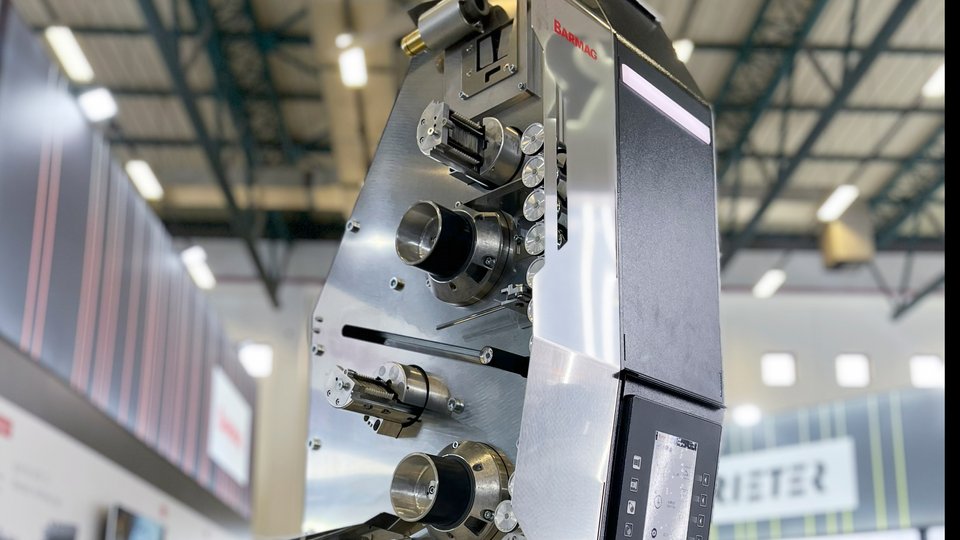
Barmag will present a portfolio of technologies for man-made fiber production at ITMA Asia 2026, taking place from 20 to 24 November 2026 at the NECC in Shanghai. At booth D45 in Hall 6.1, the company will show spinning concepts, smart factory platforms and systems for filament yarns, staple fibers and nonwovens. The presentation addresses rising energy costs, sustainability requirements, labor shortages and the growing need for production flexibility. Barmag describes the portfolio as the basis of "A New Era" in textile production. Its central development is POY 2.0, a spinning concept created through a reassessment of the full partially oriented yarn process chain, from spinning and quenching to winding, combined with digital process control. Rather than optimizing individual components separately, the development focuses on their interaction across the process.
The concept is intended to improve yarn quality, productivity, labor efficiency and resource use simultaneously. At its core is the WINGS POY 2.0 winder, which includes a fully automatic string-up function. According to Barmag, this reduces start-up times, waste generation and the need for operator intervention. The automation of this previously labor-intensive operation is also intended to help spinning mills respond to shortages of skilled personnel.
"For decades, productivity improvements in spinning were often measured in percentages. With POY 2.0, we set out to rethink the entire process from the ground up," said André Wissenberg, Head of Marketing, Corporate Communications and Public Affairs at Barmag. "The result is a solution that simultaneously addresses the industry's most pressing challenges: efficiency, quality, sustainability, and workforce availability. This is not a machine upgrade. It is a new production philosophy."
Changes across the POY process chain
The POY 2.0 concept extends beyond winding. The DIO Spin Pack Generation 2 is designed to improve rheological performance and filament homogeneity. Its more compact design reduces filter sand consumption by approximately one-third and component weight by more than 30 percent. A redesigned spinning beam has smaller surface areas, which Barmag says can deliver energy savings of up to 10 percent.
The EvoQuench 2.0 system is intended to simplify process adjustments and optimize filament quenching. Improved accessibility shortens setup times, reduces operator effort and helps limit off-quality production during product changes. Together, these developments are designed to reduce resource consumption and stabilize yarn quality.
"Our customers are no longer looking at individual machine specifications," Wissenberg explained. "They are evaluating total operational performance. Energy efficiency, waste reduction, ease of operation and reproducible quality all directly influence profitability. Our solution POY 2.0 was designed around exactly these priorities."
Digital process control with atmos.io
The digital layer of POY 2.0 is based on the atmos.io platform, Barmag's concept for an intelligent yarn factory. Machines are equipped with a digital core that captures, analyzes and distributes process data. The platform connects production information and assigns each bobbin a digital identity extending from polymer processing to warehouse storage.
This structure is intended to give production managers greater transparency across operations, support early detection of quality deviations and enable prompt adjustment of process parameters. Its app-based architecture allows manufacturers to select required functions and integrate them into existing infrastructure.
"The future competition among yarn manufacturers will not be decided by who owns the most machines," said Wissenberg. "It will be decided by who can transform production data into actionable intelligence. atmos.io is enabling exactly that transformation."
Barmag identifies lower waste rates, more stable quality, reduced operator workload and higher productivity as the principal benefits. The platform is also positioned as a component of manufacturers' Industry 4.0 strategies.
Flexible winding and lower-energy texturing
To address shorter fashion cycles, broader product portfolios and the need for rapid changeovers, Barmag has developed WINGS FDY FLEX. The winding concept offers a broad production window and supports product changes across different yarn types, including recycled polyester materials. It is intended to allow producers to react more quickly to changes in demand while maintaining production efficiency.
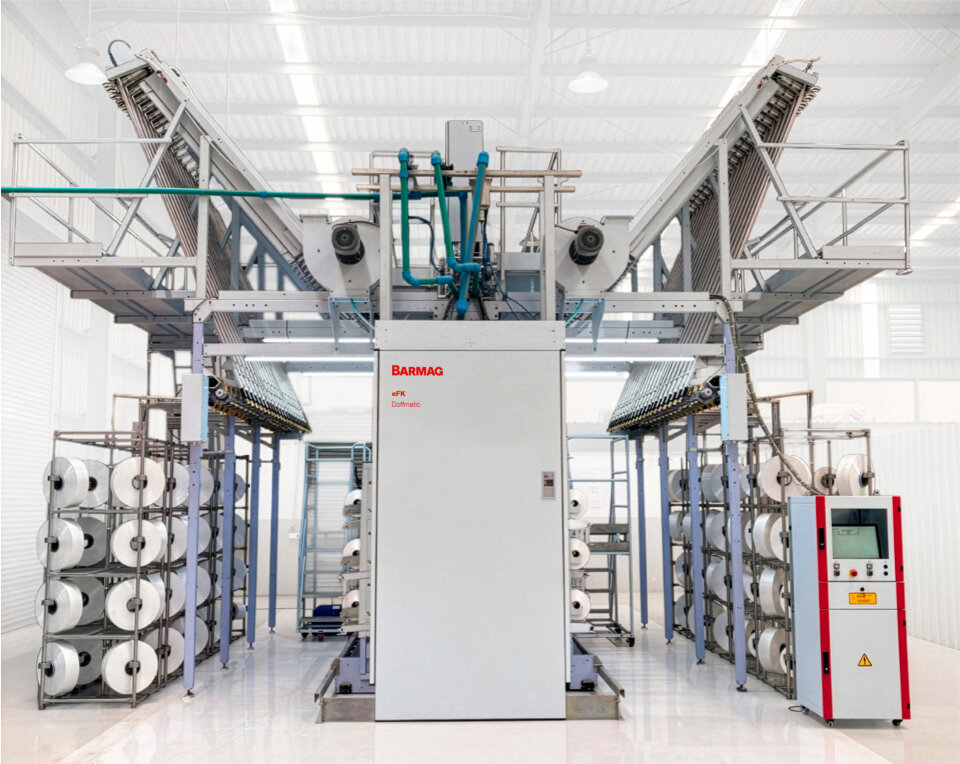
For texturing, Barmag will present the eFK EvoSmart, which combines optimized process control with the EvoHeater system and Smart Godet technology. According to the company, the machine can reduce specific energy consumption by up to 25 percent per kilogram of yarn.
Replaceable heater inserts eliminate complex cleaning procedures, while optimized airflow systems double service intervals and reduce maintenance effort by up to 50 percent. These changes are intended to improve machine availability, lower operating costs and maintain consistent yarn quality.
In June 2026, Barmag partnered with India's Hitech Automation Solutions to integrate the Doffmatic system into existing eFK equipment. Because the solution can be retrofitted, it provides a route to greater automation for manufacturers that do not plan to invest in fully automated lines.
Automation and efficiency in staple fiber production
Barmag's Neumag product line includes the EvoSteam process for staple fiber production. It is designed to lower energy consumption while improving fiber quality. Supporting systems, including EvoDuct and EvE-2, optimize airflow management and monomer extraction to increase process stability and improve the uniformity of fiber properties.
Neumag is also introducing robotic spin pack cleaning. The system is intended to provide consistent cleaning quality, extend service intervals, reduce labor requirements and improve process reliability.
"Automation is not about replacing people," said Wissenberg. "It is about allowing skilled operators to focus on higher-value activities while ensuring greater process consistency and operational excellence."
Carpet yarn and nonwoven technologies
For carpet yarn production, Neumag is introducing BICO BCF technology. The resulting yarn structure is designed to improve carpet bulk and recovery while reducing face fiber consumption by approximately 20 percent. This makes it possible to produce a lighter carpet with lower raw material requirements.
FiberGuard BCF is a sensor-based monitoring system that continuously measures yarn tension between twisting and winding. Its software adjusts production parameters automatically when deviations occur, with the aim of reducing waste and improving efficiency. FiberGuard can be retrofitted to existing BCF installations.
In nonwovens, Neumag's patented hycuTEC technology uses osmosis-treated water to provide meltblown materials with electrostatic charging efficiencies of up to 99.99 percent. The technology is intended for demanding filtration applications, as well as growing hygiene and technical textile markets.
Polyester waste recycling
The first stage of man-made fiber spinning from polyester, polypropylene or nylon is the conversion of polymer into a homogeneous, high-quality melt. Barmag Huitong Engineering's homogenization technology supports the thermomechanical recycling of post-industrial polyester waste, including bottle flakes and film material, and is intended to provide a basis for high-quality recycled PET products.
Targeted viscosity increases enable the production of defined intermediates for pellets, melt or fibers used in direct spinning. According to Barmag, the process gives users greater control over polymer quality, reduces dependence on external raw material suppliers, increases the value obtained from recycled material and supports more sustainable production.
Integrated technologies for textile production
The portfolio presented by Barmag and Neumag combines machinery, software, automation, energy efficiency and resource management. It is intended to help textile manufacturers address production costs, sustainability targets, labor availability and changing customer requirements without replacing entire production systems.
"The industry stands at a turning point. The producers who will lead tomorrow are those who embrace innovation today. Our goal is to give customers the technologies, intelligence, and confidence they need to succeed in a rapidly changing world. It's definitely 'A New Era. Powered by Innovation,'" Wissenberg concluded.