Central European Polymer Market outlook
From 2018, the market was characterised by low prices and cheap import. We had survived the first wave of the epidemic, the demand suddenly started. However, polymer deliveries were delayed due to a lack of containers. All this generated an actual shortage.
From 2018, the market was characterised by low prices and cheap import from outside Europe. When it became clear in October 2020 that we had survived the first wave of the epidemic, the demand suddenly started. However, polymer deliveries were delayed due to a lack of containers. All this generated a sense of scarcity, stronger demand and eventually an actual shortage.
September presented the players of the polymer market of Central Europe with a difficult task. Their operation is now determined by 3 extremely uncertain, week-to-week (according to some opinions, day-to-day) variable factors:
- General demand - the state of the economy, the growth of demand
- Energy prices.
- Polymer market demand and prices
The question is rightly raised: with such uncertainty, what can be expected in the short and medium term in the Central European polymer market? Below, we present "only" the expectations related to polymer prices, naturally touching on the other two topics as well.
To understand the current situation and expectations, let's first look back into the past. At the beginning of 2020, the Central European polymer market had no idea what the future held. From 2018, the market was characterized by continuously falling prices and widely available cheap imports from outside Europe. Many of us thought that Europe should specialize in the field of polymers, should not participate in the price competition. The prices, which were constantly decreasing to a small extent, fell to the bottom during the first COVID lockdowns due to the extremely negative outlook. After the lockdowns, prices did rise, but the price level remained low. Due to the wide supply, the actors of the entire value chain reduced their stocks by October 2020. The low inventory level took its toll and indirectly led to the extremely sharp price increase from November 2020. When it became clear in October 2020 that we had survived the first wave of the epidemic, that there would still be Christmas, the demand suddenly started.
In fact, there was unusually strong demand, due to the fact that the imported products (plastic products and packaging materials) coming from the Far East were delayed due to a lack of containers and ship space. Imported polymers were also late. All of this generated a sense of scarcity, stronger demand and finally an actual shortage. The basic experience of 2021 in the polymer market was the shortage. The first half of 2022 was characterized by strong, but not real, demand. It was not real, as the players in the plastic value chain learned from the shortage phenomena in 2021 and put the main focus on safe supply in 2022.
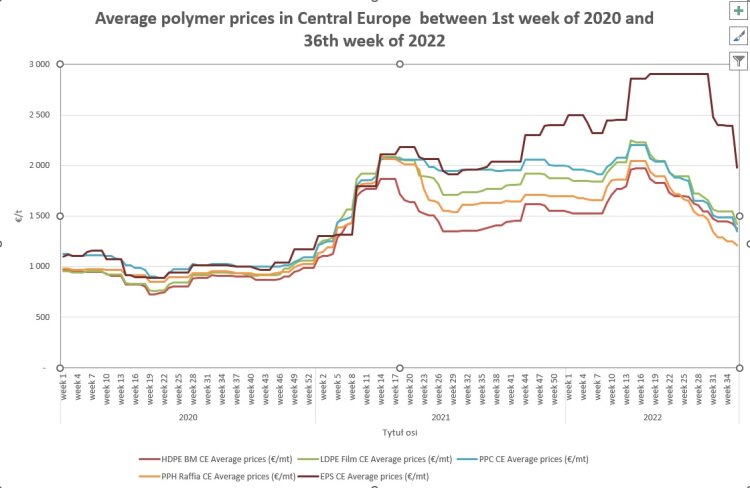
Therefore, many tried to secure their 2022 supply with contracts. Larger plastic converters even tried to secure themselves with price formulas. Those who did not sign a contract built the safety inventory. As a result, by May 2022, a kind of overkill and overstocking has developed in the entire value chain, from plastic converters to packaging material users. In the meantime, due to the Russian-Ukrainian war and inflation starting in the second half of 2021 and continuously increasing, consumer demand became uncertain.
By May 2022, it became apparent that polymer and plastic product inventories were too high. Inventory reductions started in May, and polymer prices started to decrease at the same time. A 'high price' period has ended. Prices began to fall rapidly, while the demand for polymers fell significantly. This is so for two reasons. One is the actual drop in demand, and the other is that everyone is trying to use up their now expensive stocks. That's why they don't buy, even the necessary amount only in small quantities. Now, as this article is being written - at the end of September - market participants are waiting for polymer prices to bottom out. They haven't reached it yet. If it is reached, a slight increase in demand and a normalization of the polymer stock level can be expected. This will lead to a short-term, quick 2-3 week mild recovery in demand.
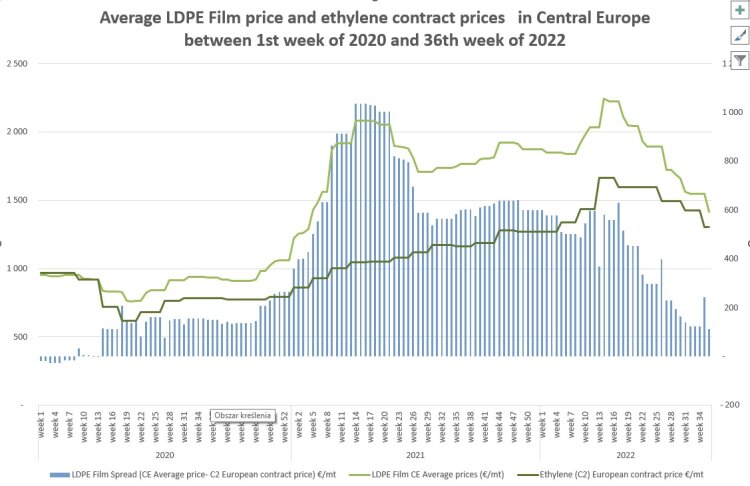
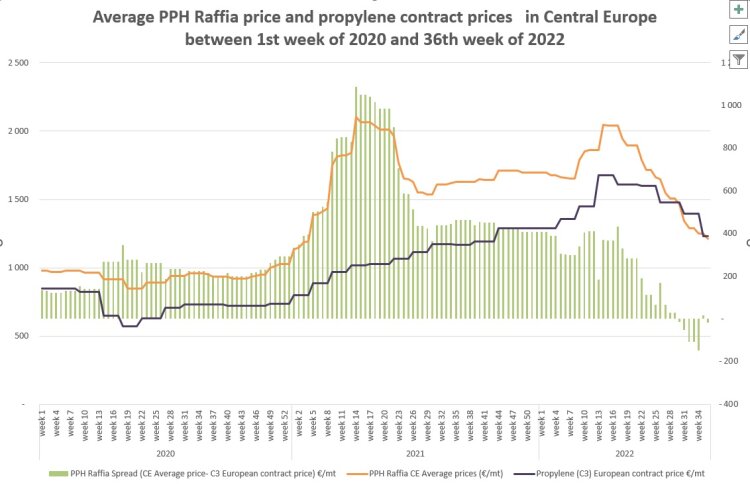
But where can the bottom of the prices be? How low can polymer manufacturers go? In some cases, not for long. The difference between the contracted monomer prices and the polymer prices, the 'spread' in the case of polyethylene, is dangerously close to a negative value, and is already negative in the case of some HDPE grades. In the case of polypropylene, most homopolymers are sold with a negative spread. What's wrong with that, since we also saw this in the first quarter of 2020? The problem is the high energy price.
Polymer production is also an energy-intensive process. As early as in the last quarter of 2021, when the first sharp price increase occurred in the price of natural gas and electricity. Some polymer manufacturers tried to cover their rising costs by introducing an energy surcharge. At that time, due to the good demand, they were able to have this accepted with their customers in most cases. Now the energy prices are much higher, but due to the weak demand, it is almost impossible to enforce the additional costs. This means that the "cash margin" of most polymer producers has turned negative, with the exception of integrated producers and those who can purchase monomer below the contract prices.
Due to the negative cash margin, some of the polymer manufacturers start to reduce the capacity of their factories and reduce their production. This can already be felt, but for now there are few complete shutdowns in Central Europe, however, by mid-to-late October, some of the non-integrated, small-capacity producers will be forced to shut down. Unless prices and demand start to rise. There is a chance for that too, since there will be Christmas this year as well. This is likely to bring a revival in demand. Now, when the players in the plastic value chain have low stocks of polymer and plastic products, last-minute purchasing decisions can lead to a sudden but short-lived price increase this year.
However, the problems will remain with us next year as well. A lot of companies are likely to extend the winter shutdown period; they stop two weeks earlier than usual in early December; and it is expected that they will start production two weeks later than usual, at the end of January. Of course, those who have sufficient financial reserves. The biggest challenge in 2023 will be energy supply and prices. Since most electricity contracts expire at the end of the year, the new contracts - if there are any - will have shorter periods and higher prices. Consequently, electricity prices will be more volatile. This will be the beginning of a new era in the plastics industry. It is no longer only the polymer price change that must be passed on, but also changing energy prices. Plastics converters need to acquire new skills. one must learn to clearly and openly communicate price changes resulting from cost changes to their customers. It is possible that they will have to reveal their cards. The survival and operation of the plastic value chain is a priority for all players. There is no other chance than direct communication. High European plastic finished product and polymer prices are the reality of the near future.
Meanwhile, imports of polymer and plastic finished products that can be delivered in rolls are becoming more and more competitive in Europe. The competitiveness of imports will strengthen due to high European energy prices and constantly decreasing sea freight rates. For the time being, protection against imports is provided by the strengthening dollar and the congestion of European ports. Both will survive in the short term, but industrial policy cannot be based on this. This has to change. Two directions seem logical. One is specialization - we talked about this before 2020. The other is the production of high-quality plastic products with a high recyclate content, creating the feedstock side of this.
We Central Europeans are a bit late in this. Although we produce a lot of recyclate, we use little of it. Until now, we have been busy with the production and export of simpler, mass-produced, virgin polymer-based plastic finished products to Western Europe. We have to change now - we have no other choice - and we have to be at the forefront of plastic recycling. Until now, we have mostly used recyclates to make the finished product cheaper. Now, however, it must be used to make the finished product more valuable. Several good projects have been launched, of which the developments taking place in the field of virgin-recycling compounds stand out. There is also a need for product development on the side of plastic products, i.e. grades with high-quality recycled content that are capable of real, uncompromising substitution in the field of finished plastic products must be created.
This is what we need to focus on, this is where the future of the Central European plastics industry will be.
László Bűdy
my Ceppi
Read more: