Fakuma round table focuses on plastics industry resilience
Experts at Fakuma 2026 identified technology, recycling, AI tools and industry cooperation as key factors in strengthening the resilience of European plastics processors.
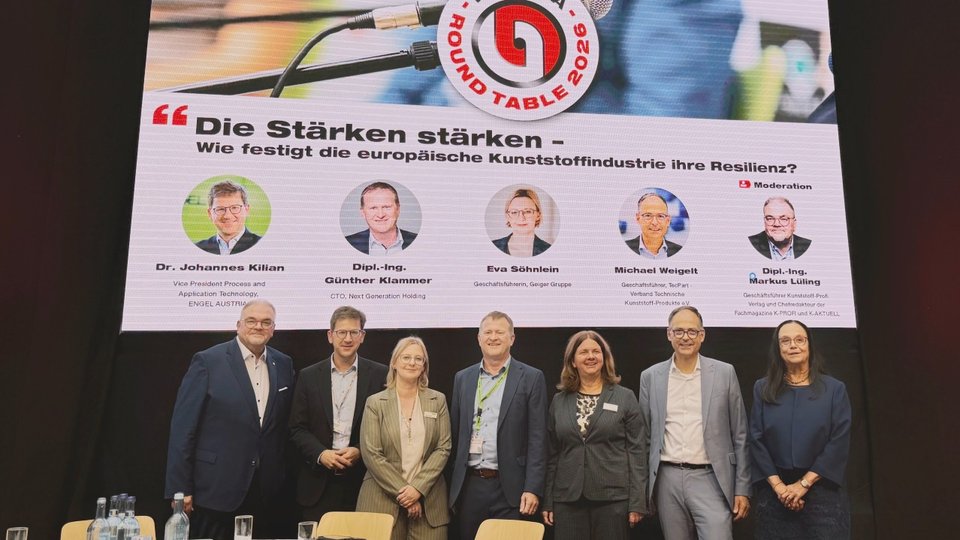
A round-table discussion at Fakuma 2026 examined how the European plastics industry can build on its existing strengths to improve resilience and support its economic future. Held on the second day of the trade fair, the panel addressed economic conditions, environmental requirements and social challenges affecting plastics-processing companies. The discussion, entitled "Building on Strengths – How Can the European Plastics Industry Enhance Its Resilience?", was moderated by Markus Lüling, managing director of Kunststoff-Profi Verlag and editor-in-chief of the trade magazines K-Profi and K-Aktuell.
The panel brought together Eva Söhnlein, managing director of the Geiger Group; Dr. Johannes Kilian, vice president of Process and Application Technology at Engel Austria; Günther Klammer, CTO at Next Generation Holding; and Michael Weigelt, managing director of TecPart, the Association for Technical Plastics Products. The participants identified common sense, insight, creativity, innovation and stronger involvement as important elements in developing a successful economic outlook for the sector.
Using industry platforms and digital tools
According to the panel, the European plastics industry already has substantial strengths in diversity, technology, recycling and integrated process chains. However, companies need to present these capabilities more clearly. Söhnlein stressed the importance of communicating individual corporate strengths through effective platforms, including trade fairs.
Kilian highlighted modern artificial intelligence tools as a resource that can support process improvements and help companies manage complexity. The discussion indicated that making practical use of existing platforms, expertise and digital tools could help processors improve their competitiveness without disregarding established industrial capabilities.
Increasing room for manoeuvre
The experts also called for companies to reconsider excessively narrow tolerances and oversizing as part of efforts to improve resilience and efficiency. Weigelt encouraged businesses to make greater use of the support, specialist knowledge and contacts available through industry associations.
He argued that active participation in associations and consultation processes could improve the industry's ability to reduce bureaucratic and regulatory barriers. Further regulations and directives should be avoided where they unnecessarily restrict companies' room for manoeuvre. At the same time, effective representation requires businesses to use the available opportunities for participation and co-determination.
Recycling remains a priority
The panel noted that overall plastics recycling rates remain below the desired levels, despite steady progress in expertise related to recycling processes and the use of recycled materials. The available volume of recyclates is still relatively low, while manufacturing products from recycled material is more expensive than production based on virgin raw materials.
Reservations about the quality and design of products made from recyclates also remain widespread. According to the participants, this situation is gradually improving, including through the targeted development of components designed specifically for recycled materials. Such product development can support more effective use of recyclates and address technical concerns associated with their application.
Skills shortages could constrain innovation
The experts called for greater enthusiasm for plastics and the plastics industry to be encouraged wherever possible. They identified the shortage of young talent, among both skilled workers and university students, as a barrier to innovation that requires urgent attention.
Klammer summarised how companies could build on their own capabilities: "Common sense, insight and creativity – each in its rightful place!"