Coffee packaging shifts towards recyclable mono-materials
Südpack identifies recyclable mono-material structures, flexible formats and premium print finishes as key responses to changing coffee markets and PPWR requirements. Its CarbonLite concept is based on PP and designed for processing on existing VFFS machines.
Rising green coffee prices, changing consumer habits, greater price sensitivity and the Packaging and Packaging Waste Regulation (PPWR) are reshaping the coffee industry. Packaging suppliers, roasters and packers must respond by improving production efficiency and brand presentation while reducing regulatory and operational risks. Against this background, Südpack has analysed the principal drivers and trends affecting packaging for ground coffee and whole beans. The family-owned film and packaging manufacturer draws on its extrusion and materials expertise, project experience and services to support the transition from conventional laminates to packaging concepts designed for recyclability. These solutions must preserve aroma, freshness and shelf life, remain compatible with production equipment and provide the visual and tactile qualities expected in the premium coffee segment.
The coffee market and changing consumption patterns
Coffee is one of the largest and most stable food markets worldwide. Europe currently accounts for around 30% of global coffee consumption. Its market value is estimated at approximately USD 56 billion in 2026, with an average annual growth rate exceeding 5%. Germany represents the largest share of the European market, with consumption of 456,000 metric tonnes and turnover of nearly EUR 9 billion in 2025.
At the same time, the industry is changing in terms of consumer groups, geographical markets, product categories and packaging sizes. Ground coffee remains a major segment, but whole beans are gaining popularity. Rising prices, volatile raw material markets, climate change and growing global demand are reinforcing the perception of coffee as a premium product. Nevertheless, it remains a widely consumed everyday product.
Major coffee roasters are increasingly looking beyond their traditional markets for growth. Some adapt their portfolios to regional preferences, while others offer broader coffee ranges, exotic blends or categories such as coffee concentrates, ready-to-drink products, functional coffee, collagen coffee and high-protein coffee.
Formats, print and premium positioning
One-kilogram packs of whole beans and traditional 500-gram vacuum packs for ground coffee remain standard formats, but smaller packs, including 250-gram formats, are becoming more common. Modified atmosphere packaging for ground coffee is also gaining importance in some segments.
The shift from ground coffee towards whole beans is particularly evident in Germany, where beans are currently the strongest-performing segment and sales have reached record levels. One in three households already owns a fully automatic coffee machine, reflecting consumers' interest in preparing higher-quality coffee at home.
High coffee prices and reduced purchasing power are making flexible packaging concepts, rapid design changes, short print runs, varied pack sizes and new price points important competitive factors. Packaging also increasingly supports brand positioning and the presentation of coffee as a premium product. High print quality, tactile lacquers and matt or gloss effects are used to reinforce this positioning.
Balancing recyclability and product protection
The PPWR is accelerating the transition from conventional laminates, both with and without aluminium, towards PP- or PE-based mono-material structures. Recycling streams for both polymers are already established in many European countries. Coffee roasters and packers must determine which films can run efficiently on existing machines at high throughput, provide the required product protection and reduce regulatory and business risks.
New packaging materials need barrier properties comparable to those of conventional aluminium laminates. These structures protect the characteristic aromas developed during roasting against oxygen, light and moisture, thereby contributing to the preservation of product quality.
CarbonLite PP-based packaging concept
Südpack's CarbonLite product family combines product protection and processing performance with design options in a structure developed for recyclability. The PP-based flow pack can enter established recycling streams in many European countries.
The mono-PP laminate can be processed on existing vertical form-fill-seal machines and provides high sealing performance and seal strength. It can incorporate barriers against oxygen, water vapour and ultraviolet radiation. According to Südpack, the material also offers high rigidity, puncture resistance and resistance to substances including oils. PP-based aroma protection valves can be heat-sealed into the pack to allow the coffee to degas after roasting.
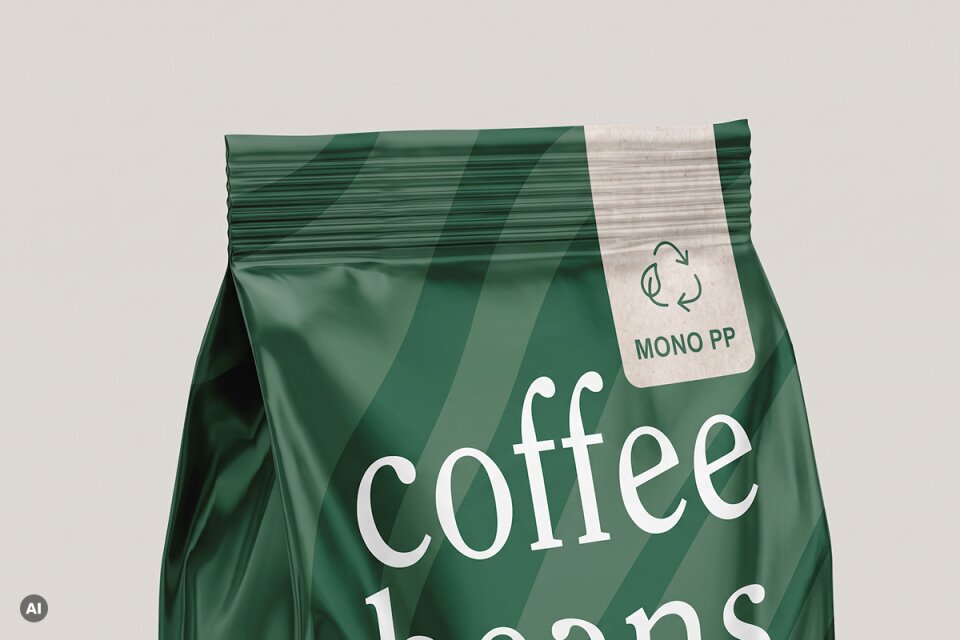
Alongside the PurePP film, Südpack offers a metallised version for producing metallic effects in the printed image. Both materials can be printed using flexographic, rotogravure or digital processes, depending on the application and customer requirements. Südpack's SPQ printing technology is another option. It uses a standardised seven-colour colour space and fixed process parameters to achieve consistent print results while reducing ink and solvent consumption.
Carbon footprint assessment and implementation
An internal screening by Südpack compared a conventional 100-μm PET/aluminium/PE laminate with CarbonLite PurePP film of the same thickness. The assessment indicated a 43% reduction in the overall carbon footprint. The calculation tool was developed in accordance with ISO 14040/44. The figures use a cradle-to-grave approach, exclude printing and the use phase, and account for end-of-life treatment using the German recycling mix.
Südpack supports producers throughout the development process, from the initial concept to final implementation. The objective is to reduce transition risks and ensure that new packaging structures can be integrated into existing production processes. The company also aims to provide greater flexibility, shorter time to market and packaging concepts prepared for future regulatory and market requirements.