Engel targets thin-wall packaging with e-motion 380
At Fakuma 2026, Engel will demonstrate the new e-motion 380 producing IML yoghurt cups in a six-cavity mould. The all-electric machine offers a dry cycle time as low as 1.2 seconds and injection speeds of up to 500 mm/s.
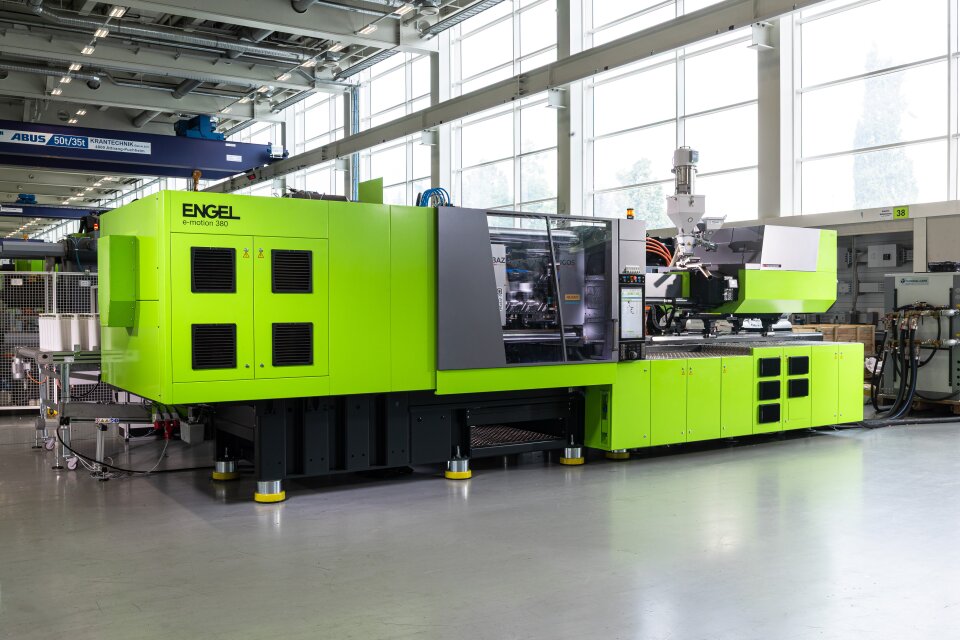
Engel will present the new generation of its e-motion 380 all-electric injection moulding machine at Fakuma 2026, using a thin-wall yoghurt cup application to demonstrate its suitability for high-volume food packaging. The machine has been developed for production environments in which fractions of a second in cycle time can affect unit costs and margins across annual volumes running into billions of parts. According to Engel, the e-motion 380 achieves a dry cycle time as low as 1.2 seconds, providing the basis for short cycles and increased output. The company will also use the live demonstration to show that all-electric machines can consume around 30 per cent less energy than comparable hybrid or hydraulic solutions. Engel positions this reduction in energy use as a means of lowering unit costs while maintaining the output and availability required for continuous packaging production.
High-volume thin-wall packaging has previously been dominated by high-performance hybrid and hydraulic machines. Engel intends to demonstrate that all-electric technology can reach comparable processing speeds while improving energy efficiency. The e-motion is also engineered for reliable 24/7 operation, as stable output without unplanned interruptions is a key requirement alongside cycle time and energy consumption.
Engel previously demonstrated all-electric technology for thin-wall applications at K, where it presented a thin-wall PET application based on injection compression moulding. With the enhanced e-motion series, the company is extending the technology to conventional thin-wall polypropylene applications, including dairy and other food packaging.
New clamping and injection units
The e-motion 380 will make its Fakuma debut as the first model in the new generation. It features developments in both the clamping and injection units and is described by Engel as the most powerful all-electric machine in its portfolio. The company plans to equip the entire e-motion series with the new clamping unit.
"We are demonstrating that all-electric technology can also meet the requirements of conventional thin-wall food packaging, while offering potential for efficiency gains," says Christoph Lhota, Vice President Medical and Packaging at Engel. "Equipped with a screw diameter of 70 mm, the new injection unit achieves injection speeds of up to 500 mm per second – a production-ready level of performance previously associated primarily with hybrid or hydraulic machines."
Premiere at Fakuma 2026: The e-motion 380 is the first machine in the new generation and, with its new injection unit, achieves injection speeds of up to 500 mm per second
Six-cavity IML yoghurt cup application
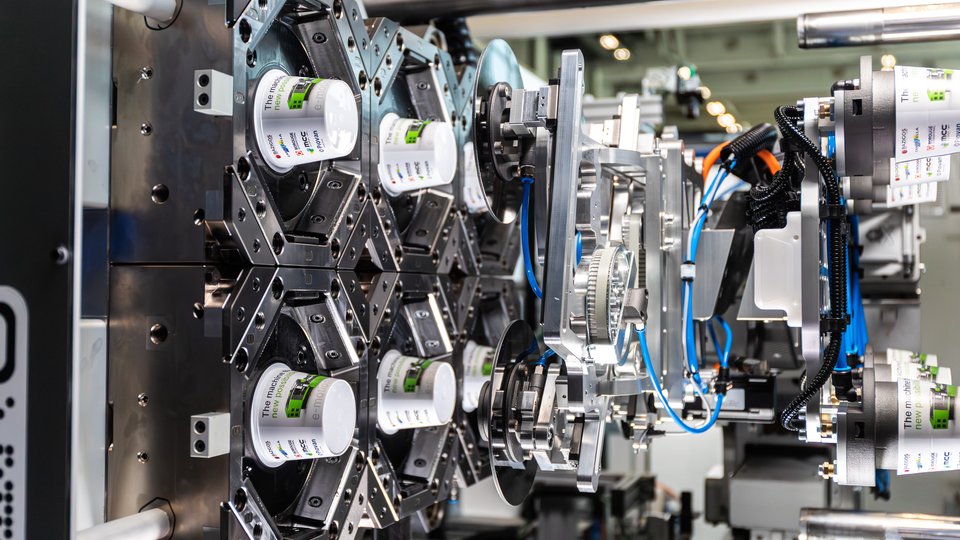
During the exhibition, the e-motion 380 will produce an in-mould labelled yoghurt cup in a six-cavity mould. The cup has a wall thickness of 0.28 mm, a flow-length-to-wall-thickness ratio of 370 and a finished weight of 6.33 g. These parameters place high demands on injection speed and on the stability of the overall injection moulding process.
When the mould opens, a side-entry robot removes the finished parts from both sides and inserts labels for the next cycle. The handling sequence requires high acceleration and deceleration rates to support the short cycle.
Partners across the production cell
The production cell combines equipment and materials from several specialist suppliers. Campetella provides the IML automation, Bazigos supplies the mould, MCC Verstraete provides the labels, Borouge International, formerly Borealis, supplies the material, and Piovan provides the material handling system.
Engel integrates the components and can assemble and test the complete production cell, including its automation, at its own facility at the customer's request.
"Close cooperation with specialist suppliers across the entire process chain is extremely important to us – this performance can only be achieved when every component works seamlessly together," concludes Christoph Lhota.
The demonstration will take place at Fakuma 2026 in Hall A5, Stand 5203.