Interview with Dr. Jürgen Hambrecht, Chairman of BASF
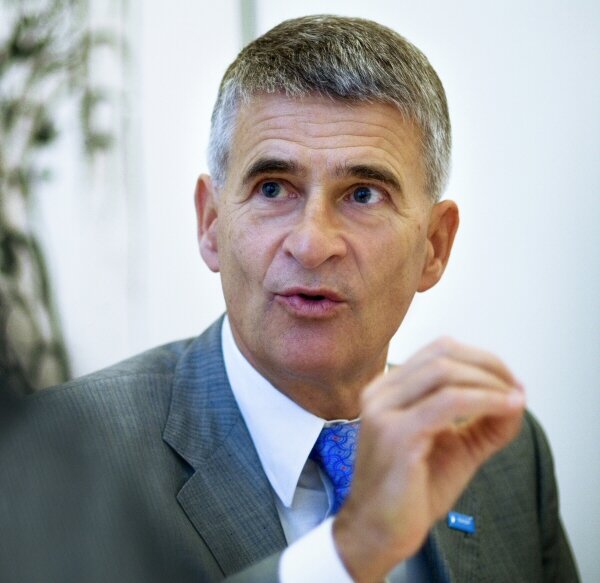
We publish an interview with Dr. Jürgen Hambrecht, Chairman of BASF. In this interview, BASF's CEO Jürgen Hambrecht discusses problems and solutions for the economic crisis. BASF is the world´s leading chemical company.
A year ago you were much more optimistic, although the problems of the financial sector were already generally known.
Dr. Jürgen Hambrecht: - I must confess, the scale of the downturn has taken me by surprise too. When I started at BASF in 1976, that was called a crisis year at the time. Since then, we have survived several crises: in 1992/3, after the German reunification boom ran out of steam, in 1997 in Asia, and in 2001 after the attacks on the United States. But in over 30 years with BASF, I’ve never seen such problems appear at the same time in America, Asia and Europe.
You’re now thinking about closing plants permanently and you’re cutting jobs in the United States and South Korea. How many of your 95,000 employees are you going to lay off altogether?
We will have to get rid of less efficient plants in Europe, America and even Asia. Under normal circumstances, these plants would have been replaced by new investments over the course of time. Now, we’re closing a lot of plants earlier than planned. I can’t say where and how many jobs will be lost; we’re still in a crisis. Because our company operates globally, we unfortunately can’t offer everyone who is no longer needed in one location a job somewhere else in the world.
In Germany, there’s the option of short-time working for a maximum of 18 months. Is this enough to avoid redundancies?
In the chemical industry, this option unfortunately has only limited use. In plants which don’t work around the clock and are started up and shut down several times a day, you could operate a four-day week if necessary. But a cracker …
In other words, a plant like the one here in Ludwigshafen where you break crude petroleum down into its constituents …
A cracker like this can’t be simply turned on and off. It has to run around the clock, seven days a week. Short-time working just isn’t an option here. This is why we may have to take more drastic measures.
Are you planning to cut German jobs?
I’m at the head of a transnational company, and I’m responsible for all our employees. Our employees in China or anywhere else are just as important to me as those in Germany.
In your Ludwigshafen plant, the biggest chemical site in the world, you can’t lay anyone off before the end of 2010. Do you regret having made this promise in the job security agreement for the site?
No, quite the reverse. Even agreements like this include clauses for emergencies. If these occur, you sit down together and try to find a reasonable solution together. The dialogue with our employees is constructive and ongoing. We’ll be talking about a possible follow-up agreement in the near future.
An investment in keeping your people happy?
It’s not a matter of keeping people happy, it’s about a shared goal: the success of our company. And if we’re working on drafting a new agreement, we will make sure that it reflects all the needs that we see in the future.
What are you talking about here? Early retirement clauses as in the past, or a reduction in working hours, like the one Bayer has just implemented?
It’s too early for details. But we’re proud of the flexibility and team spirit of our employees. In Ludwigshafen and Antwerp, people are currently moving from less busy plants to other plants, so that their colleagues there can clear their working time accounts.
What do you think about the German government’s measures?
The economic package was right, there’s no question about that. If the real economy is threatening to collapse completely, you have to do something. I think it’s good too that the government didn’t use all the options at its disposal and is waiting to see what effect their measures will have. Afterwards, you can then fine tune. Then, I’d like to see more support for research, for example.
That would certainly be as good as money in the bank for you.
I’m thinking primarily of smaller companies, which often cut back on research when things get tight. If companies could get a tax credit for their total research spending, that would help. The same goes for interest on loans. For many, the cap on tax deductions has become a major burden.
Wouldn’t it be better to skip the dividend payment, instead of asking for tax concessions?
We promised our shareholders that we would pay a dividend at the previous year’s level even in difficult times, and we stand by this. After all, the shareholders have suffered tremendous losses.
What worries you most about the current crisis?
The growth of protectionism. The crisis has shown how much we depend on each other. Look at Asia. Most people thought that the billions of people there would stabilize the region with their demand. But when the West stumbled, growth there fell so much that we’re even feeling it here. If more and more countries put up trade barriers, this will steepen the downward spiral. This mustn’t be allowed to happen. We’ve only ever got out of a recession through exporting.
You wanted to make BASF less vulnerable to economic cycles by making acquisitions. Now, the expensive new deals are particularly hard hit by the crisis. Has this strategy failed?
Not at all. The chemical industry is the ultimate cross-sector industry. We supply all the other industries, and naturally we‘re affected by their problems. BASF, with its diversified portfolio, is better positioned in a recession than any other company in the industry. We not only produce chemicals and plastics, we’re also involved in crop protection, nutrition, cosmetics, hygiene, and oil and gas.
But Bayer has long since overtaken BASF on the stock market. The difference in value is now €10 billion.
Bayer has pharmaceuticals first and foremost, and they’re significantly less cyclical. The picture used to be the other way around. We haven’t stopped being ambitious because of that.
Unfortunately, you also acquired Ciba just a few months ago. The Swiss chemical company is a candidate for restructuring.
That’s not true. Two of Ciba’s three lines of business are in excellent shape – plastics additives and pigments. Paper chemistry is a problem for both Ciba and us. We’re merging in order to make the business profitable again after serious restructuring.
You actually signed the contract on the very day that Lehman Brothers filed for bankruptcy.
Of course we saw that coming!
Since then, the world economy has gone downhill very quickly. At €3.8 billion, Ciba was very expensive even in September. Will you at least try and renegotiate the deal now?
We closed the deal on those terms, and we’ll honor our contract.
Your oil and gas subsidiary was always seen as a support for your business. But there are risks there too. Weren’t you worried that you could run out of natural gas during the recent tussle over gas between Russia and Ukraine?
No. Most of our gas comes via Belarus, much less through Ukraine. Our large natural gas storage facilities provide additional security.
Your Russian business partners have a pretty bad image.
It’s more a problem of perception. As far as Russia is concerned, the media coverage of the conflict was fairer on this occasion. Now, everyone has realized that Ukraine was drawing off some of the gas.
But Russia is using its primary commodities as political leverage.
We’ve always been supplied with gas, even in the most difficult times. Our relationship with Gazprom is an excellent one, and one reason is that our Russian partner owns almost half of the distribution company Wingas. We invested together from the start, including in 1993 – another recession. That’s when the big pipelines were built that we’re benefiting from today.
Agriculture was also always seen as crisis-proof. Now you’re still running into barriers with genetic engineering. You’ve been set back another year with the licensing of the genetically-modified potato Amflora.
That’s an extremely difficult situation. The European Food Safety Authority has already approved Amflora twice, and each time it’s been halted by the Commission. And in the whole area of genetically modified plants, we don’t have a single shred of evidence that any damage or injury is being caused to people or the environment. This has just been confirmed by Nobel laureate Christiane Nüsslein-Volhard. Amflora is really the safest thing you can come up with. Potatoes don’t propagate through pollen, and they don’t fly through the air on their own. If you can’t get that approved, what can you?
BASF has instituted legal proceedings. Why is the biggest chemical company in the world now in dispute with the E.U. Commission over a potato?
Ultimately, the question is, how are we going to feed a population which is going to grow towards nine billion over the next 30 years? Green biotechnology has a very important role to play here.
But Amflora isn’t meant to be eaten. This is about producing industrial starch.
That’s right. But for us, Amflora also opens the door to genetic engineering. I think that what we’re doing in Europe in this area is totally marginal.
What do you mean?
We have it easy in Europe. At present, food shortages play barely any role here. Worldwide, however, 20,000 people die every day from malnutrition, according to the World Health Organization. I think we’re losing respect for the poor people of the world.
And you believe that genetic engineering will solve the problem of hunger?
Another reason is that water is becoming an increasingly scarce resource. 70 per cent of water today is used in agriculture. This is why we need to develop plants that can grow in dry soil and produce higher yields. We can’t do this with conventional crop cultivation alone.
An interview was contained in Germany weekly “Die Zeit" and on the website www.basf.com.