New tech center for Herrmann Ultrasonics
In November the company opens in Katowice a laboratory for applications which can be ultrasonically welded.
Polish customers will now have a shorter drive: at the end of November 2013, German machine builder Herrmann Ultraschall opens a modern technical laboratory for applications which can be ultrasonically welded. Equipped with the new HiQ machine generation, customers can come for application consulting, basic training and service. Initial feasibility trials and material tests are possible in addition to detailed welding tests with tensile and tightness tests.
The welding of thermoplastic materials with ultrasonics is a fast and reliable joining method for a wide range of applications in the automotive, electronics and consumer industries. Good results with regard to strength, tightness and visual impression can be achieved if the plastic components are designed for ultrasonic welding from the start. It is here that Herrmann Ultraschall is helping out in the new laboratory, both with the initial consulting for new weld parts and with optimizing processes for existing applications.
Sales Engineer Marcin Tomczyk: "The key strength of Herrmann Ultraschall is in the project support it provides from the start. We have more than 50 years of experience and solve more than 1,500 applications per year. In Katowice I am now able to respond faster and more precisely to inquiries from Polish customers. I'm pleased about that."
Consulting from the start ensures good weld results
The great advantage of ultrasonic joining technology is the targeted energy input which enables an exactly defined and time-controlled melting and bonding process. However, the parts have to designed in such a way that the ultrasonic waves are focused in the joining area. The correct welding geometry on the injection-molded parts consists of points and edges in the joining area. These points or edges are called energy directors, and define the place of the first melt formation. The point contact at this place prevents a flat coupling of the components and an uncontrolled sonic transmission.
The ultrasonic provider should be involved very early on, to make sure part requirements for ultrasonics are met. This starts in the design phase of the component with the correct joint design, and also includes the choice of material and the final weld process optimization. Herrmann Ultraschall not only wants to provide its customers with a machine, but a complete solution for its application.
Ultrasonic applications for automotive and white goods are increasing
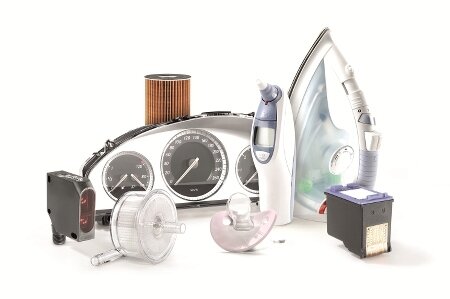
Lower energy consumption and short cycle times facilitate a high manufacturing speed. In the automotive industry, there are now more than 100 applications for ultrasonics, from instrument panels, to lights, to the vacuum actuator in the engine block. There are also many weld applications for ultrasonics in the area of electronics and household goods. With ultrasonics, thermoplastic materials can be welded, riveted, remolded, embedded, separated and also stamped. In a matter of milliseconds and without using additives, the ultrasonic waves create a very strong, gas and watertight bond that is visually impeccable. The low energy required means the parts are subject to very little thermal load. Hard, amorphous plastics such as PC, PS, SAN, ABS and PMMA have very favorable transmission characteristics for ultrasonic energy. Partially crystalline plastics like PA, PP, PE and POM are ideally welded in the immediate near field of the sonotrode. The welded parts can be processed immediately, allowing for ultrasonics to be integrated into automation lines without any problems.
More informations to be found on Herrmann Ultraschall website.