Rethinking Recycling: breakdown of glass-fiber-reinforced polyurethanes using enzymes
The German Plastics Center SKZ and RWTH Aachen University are developing a process that uses enzymes to break down glass-fibre-reinforced polyurethane thermosets and recover both the glass fibres and the resin for reuse in new composites.
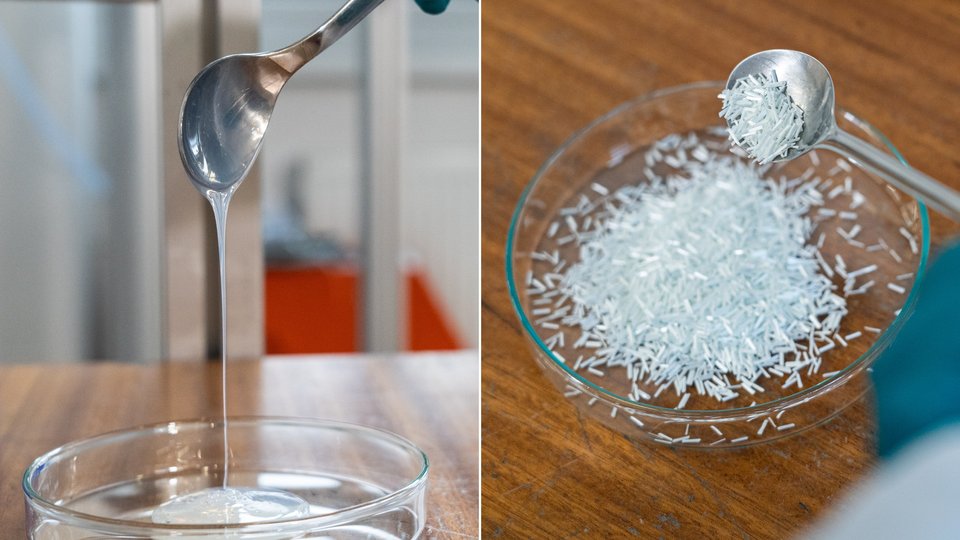
The German Plastics Center SKZ is cooperating with RWTH Aachen University on research into a new recycling route for glass-fibre-reinforced polyurethane composites. The approach uses special enzymes to selectively break down polyurethane thermosets, so that the raw materials used in composite manufacturing can be recovered. The project aims to enable gentle recycling of polyurethane composites without the use of harsh chemicals.
Fibre-reinforced composites are used in wind turbines, aircraft manufacturing and lightweight construction in the automotive sector. Their combination of high durability and good mechanical properties with low weight makes this class of materials essential for many industries. At the same time, the high durability of the thermoset matrix and the strong bond between the matrix and the fibres make recycling very difficult. For this reason, most composites are currently either incinerated or landfilled.
Enzymes as selective tools for polymer breakdown
To improve the sustainability of composites, SKZ and RWTH Aachen University are investigating a recycling approach based on enzymes. Enzymes are widespread in nature, where they catalyse specific reactions with high efficiency. This mechanism can also be used technologically to break down polymers selectively at defined sites without destroying the entire molecular structure. In this way, polymers can be broken down gently into building blocks that can be used to produce new polymers. Polyurethanes are suitable candidates for this approach, as their urethane groups, from which they take their name, have high potential for enzymatic cleavage.
Recovering raw materials of the same quality
The goal of the research project "EnzyReput" is to develop a process for breaking down glass-fibre-reinforced polyurethane thermosets with enzymes in such a way that the raw materials, namely glass fibres and polyurethane resin, can be recovered with constant quality. This should enable the production of a new composite with comparable mechanical properties. To this end, customised enzymes for the cleavage of urethane groups will be developed and tested. The project combines the experience of the Chair of Biotechnology at RWTH Aachen University in developing enzymes for polymer cleavage with SKZ's expertise in resin development and materials testing.
"The recycling of composites is still in its infancy. We are confident that this approach could represent an entirely new type of recycling", explains Dominik Uhl, Scientist in the Crosslinked Materials division at SKZ. "Unlike chemical recycling methods, enzymes allow us to use low temperatures, making this a very energy-efficient process. At the same time, we do not need aggressive chemicals to break down the polymers, which means we also protect the matrix, fibers and the environment."
Enzymes are to be used to recover the original raw materials, resin and glass fibres, from polyurethane composites. (Photo: Luca Hoffmanbeck, SKZ)
Extracting glass fibres from the matrix
A particular focus is on extracting the glass fibres, which are firmly anchored in the composite, from the matrix without causing mechanical or chemical damage, so that the fibres can be reused with consistent quality. The project therefore initially concentrates on short and long glass fibres. Unlike continuous fibres, they allow composite components to be ground into granulates without heavily damaging the fibres, which offers a number of advantages for recycling.
The "EnzyReput" project aims to further explore the potential of enzymes in polymer recycling and to lay the groundwork for composite recycling. The objective is to reduce the waste problem associated with composites and to lower the demand for resource-intensive virgin materials.
The "EnzyReput" research project (grant reference number RU 2607/4-1) is funded by the German Research Foundation (DFG).