A visit to Engel's customers
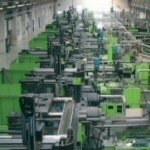
The large majority of TV sets manufactured in Europe come in housings produced by the privately owned firm of Jász Plasztik. Currently equipped with over 150 injection moulding machines, Jász Plasztik leads the field in Hungary - only 20 years after Lajos Kasza started it up in his garage at home. The 110 injection moulding machines from Engel have had an important part to play in this story.
Viewed historically, the success story of Jász-Plasztik Kft in Jászberény in eastern Hungary (about 80 km east of Budapest) is extremely short and yet highly remarkable. It began only a few years before the political changes of 1989, when Lajos Kasza, an agricultural machinery mechanic at the local agricultural production co-operative, recognized the potential of self -employment as a contract injection moulder.
As he had no money to buy an injection moulding machine - either a new or used one - he had to fall back on his own initiative and ingenuity. Together with his cousin, Janos Kasza, he built his own molding machine, modelling it on an Engel toggle-clamp machine dating from 1957 that he had seen in the local Lehel refrigerator factory.
Built from car components, agricultural machinery parts and other available materials, the prototype was completed within six months: a 200 tonne toggle clamp machine with a 400 cm3 injection unit, a plasticizing screwthe cousins had ground to shape themselves and a home-made relay control. After making a number of improvements to the prototype, they set about making a "series" of three machines.
From 1987 until well after the official founding of Jász-Plasztik Kft. on 1st May 1990, these machines were the economic mainstay of the firm. Working in the cellar of his home, Lajos Kasza was able to manufacture a variety of small PVC parts, such as furniture handles and tablecloth clips, and sell them at a profit.
- We invested our entire profit in 1990 in our first professional injection moulding machine, a used Kuasy 400 from the Lehel refrigerator factory - says Kasza, casting his mind back to those early days.
In that same year, another opportunity arose: a state-run enterprise in Tatabanja had to give up its business. Among its assets were several TOS injection moulding machines, which Kasza bought at a very fair price. Now equipped with eleven machines in a new production facility, Jász-Plasztik could manufacture parts of superior quality and was soon operating as a sub-contractor supplying parts for car and truck batteries. The battery parts were supplied mainly to the state-owned battery factory Unitechnika at Sülysáp (40 km east of Budapest) and to a manufacturer in Yugoslavia. Business with Unitechnica continued until 1994, when this stateowned enterprise ran into financial difficulties and was no longer able to pay for goods received.
Kasza hit upon the idea of taking over and rationalizing Unitechnika`s business in settlement of its outstanding debts. Indeed, from 1995 onwards, battery production contributed substantially to the economic growth of Jász- Plasztik as a whole, and profits were largely reinvested into the expansion of the company's plastics production facilities at Jászberény. Jász-Plasztik then acquired the entire grounds of the former agricultural production co-operative in Jászberény, permitting even further expansion of capacity.
Jász-Plasztik?s collaboration with Engel began in 1997, when Kasza bought five relatively new Engel injection moulding machines from a Slovakian plastics processor whose financial circumstances had obliged him to sell at a give-away price. Jász-Plasztik`s positive experience with these machines marked the beginning of what was to become a lasting partnership with Engel.
With the high standards of quality and performance offered by these new machines, Jász-Plasztik was able to meet the demands of the large electronics companies, such as Sony, Philips, Sharp and Samsung, that were setting up new production facilities for TV sets in Hungary and Slovakia at the same time as Jász-Plasztik was developing into a contract supplier of high-quality components.
Moreover, Jász-Plasztik`s existing contacts with the Lehel refrigerator factory, also located in Jászberény and now a member company of the Electrolux Group, stood it in very good stead for future business in the white goods market. Of the 153 injection moulding machines currently in service, as many as 110 are from Engel. Remarkably, half of them are large-capacity machines with clamping forces of 5,000 kN and over - one of them with a clamping force of 32,000 kN.
This development towards ever larger machine capacities directly reflects the evolution of TV technology and Jász-Plasztik?s growing specialization in this market segment of the market. Until a few years ago cathode ray sets with a 4:3 screen format and screen diagonals up to 28 inch (71 cm) were state-of-the-art.
Now they are being replaced by the new plasma and LCD technology, with the 16:9 screen format as the prevailing standard. As screen diagonals of between 30 and 63 inch are now technically feasible, the demand for correspondingly large housings is growing steadily.
The specific criteria governing this category of moulded part are not just the steadily increasing dimensions but also the steadily growing demands made on the surface finish, especially on that of the screen surround. Moreover, this surface finish is no longer produced by painting or surface coating in a downstream process but rather in just one, economically efficient, single-stage injection moulding process, in which the moulded part emerges from the machine complete with a high gloss surface - without flow lines or other blemishes.
These demands are being met by various methods, the most important one currently being the so-called variothermal mould cooling process. With this process, the high gloss surface of the cavity is rapidly heated immediately prior to injection of the melt and then not cooled until the cavity is filled. The heated surface blends the flow lines and other surface blemishes, resulting in a perfectly smooth and uniform gloss finish.
The process is also more efficient, as further downstream finishing is no longer required, and offers enormous potential for innovation in product design. But what sounds so simple is in fact a complex process technology that in practice has to find an economically viable compromise between the best possible surface finish and the shortest possible cycle time. This application is not just of interest to manufacturers of flatscreen TV sets but offers new design potential for a diversity of automotive components and household appliances.
Both Jász-Plasztik and Engel place the development of processes for the production of high gloss, blemish-free injection moulded parts high on their list of priorities. Yesterday a contract injection moulder, today an active technology partner in product development, Jász-Plasztik numbers among Europe?s leading processors - a remarkable accomplishment considering its short history and the economic constraints of the first few years.