Arburg Technology Days 2018
Arburg Technology Days 2018: Around 6,300 guests from 54 countries. Large groups from overseas: around 160 guests from the USA and around 100 from China. Largest groups from Europe: Around 200 guests from Switzerland, 185 from France, 130 guests from Poland.
All good things come in … three machines in a new design
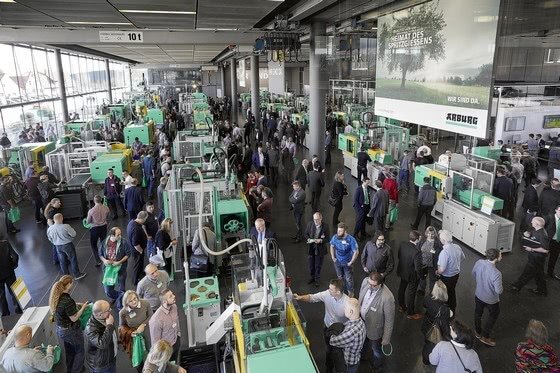
Following the hybrid Allrounder 1120 H and 920 H machines with clamping forces of 6,500 KN and 5,000 kN respectively, a third large machine is now available in the new design with the visionary Gestica control system: the "new look" hybrid Allrounder 820 H with a clamping force of 4,000 kN is on show for the first time at the Technology Days 2018. The three machines are on view in conjunction with two ambitious turnkey solutions, as well as a packaging application.
"As part of our unique event in Lossburg, we are showing the plastics world how the transition to the design and control system of our large Allrounders is progressing successively," explains Gerhard Böhm, Arburg Managing Director Sales. "Visitors to the Technology Days 2018 can see for themselves the benefits of the new design and 'smart' control system in terms of functionality, ergonomics and intuitive operation."
Design change extended
A prototype of the Allrounder 1120 H in the new design and featuring the new Gestica control system celebrated its world premiere at the K 2016 and is now production ready. In recognition of its outstanding design, the new large machine, which extends the clamping force range by 30 percent to 6,500 kN, was also awarded the internationally renowned "iF Design Award" on 9 March 2018. The market launch of the Allrounder 1120 H took place at the Fakuma 2017. For the first time ever, an Allrounder 920 H with a clamping force of 5,000 kN was presented in the new design and with the Gestica control system, which is now available for customers to purchase. A "new look" hybrid Allrounder 820 H with a clamping force of 4,000 kN is on display for the first time at the Technology Days 2018.
iF Award for the Allrounder in the new design
The design that won the "iF Design Award" is characterised not only by its pleasing aesthetics, modern colour scheme and design, but especially by even greater functionality and ergonomic efficiency, which facilitate set-up, operation and maintenance. Features include generous safety doors with linear guides without additional interference edges for easier mould changes and automation processes. Integrated LED light strips on the machine panelling and control system display the operating status extremely clearly.
As the control panel of the Gestica control system is height-adjustable and pivotable, meaning that the machine can be operated ergonomically. The fact that the clamping unit is also enclosed from above reduces dirt penetration.
Measures that significantly reduce the time and cost of maintenance include automatic supply to all the oil lubrication points. Moreover, the grease lubrication points converge at a central lubrication point outside the machine panelling.
"Smart" Gestica control system
The visionary Gestica control system reproduces the look and feel of smart mobile devices. It builds on the benefits of the Selogica control system, which sets the industry standard, but thanks to multi-touch technology, it can be operated more intuitively and efficiently using gestures. The 16:9 format, high-resolution full HD screen provides a brilliant image, improving readability, even in poor lighting conditions.
One highlight is the new "Easyslider" element, which allows the speed of movements to be controlled easily and precisely and displayed via variable-colour LED technology during set-up. Acceleration and deceleration can be controlled with a "swipe of the finger" along a bar at the edge of the screen.
The proven Selogica functionalities will be progressively integrated into the new control system generation. The Allrounder 1120 H features the Gestica control system as standard. All other machines converted to the new design are either equipped with the Gestica control system or the Selogica ND control system, i.e. the “new look” Selogica, which features a control panel design that is visually similar to that of the Gestica.
Exciting applications
At the Technology Days 2018, the hybrid Allrounder 1120 H is integrated into a sophisticated production cell that impressively demonstrates Arburg's expertise in the automation and turnkey sector. The exhibit produces the Arburg-design folding step stool in a fully automated process. The eight individual parts made from PP are produced on an eight-tonne family mould in one shot per cycle. Handling is performed by a linear Multilift V 40 robotic system. With the aid of a six-axis robot and an assembly station, the finished folding step stool is assembled within the injection moulding cycle. In this way, the 1,092-gram final product is completed "ready to use", in a cycle time of 60 seconds.
The hybrid Allrounder 920 H produces a 600-gram PBT housing for high-volume production at Arburg in a cycle time of around 80 seconds. Here as well, a Multilift V with 40 kilograms load-bearing capacity is used. In conjunction with a sophisticated sequence and gripper concept, integrated packaging in boxes is achieved without elaborate peripheral equipment: the robot system removes the individual parts and stores them at an interim station. As soon as seven housings are produced, they are transferred by the gripper as a single group, packed in a cardboard box and removed via a conveyor belt.
The premiere Allrounder 820 H machine with a clamping force of 4,000 kN produces PP screw caps examplarily. In a cycle time of around 12.7 seconds, 48 moulded parts are manufactured, each weighing 2.2 grams.
Efficiency Arena with focus on digital transformation
Under the slogan "for digitalisation", everything at the Efficiency Arena 2018 relates to digital transformation, efficient production and "Industrie 4.0 - powered by Arburg". The focus is on six new assistance packages that actively support the machine operator and is available for purchase from the Technology Days 2018 onwards. Demonstrations of the new Gestica control system and the Arburg ALS host computer system are also on show. "for connection" is the theme of the Interface Café. Here, visitors can obtain information from experts on the use of OPC UA and on Arburg's current development activities in relation to the Euromap interfaces. In the "for visions" area, Arburg provides a practical demonstration of the benefits of Augmented Reality (AR) and Virtual Reality (VR).
"At Arburg, digitalisation is a teamwork effort at the highest level," says Jürgen Boll, Arburg Managing Director Finance, Controlling and IT. "Together with specialists from Engineering, Sales & IT, we are driving the topic forward in a coordinated and purposeful manner." Heinz Gaub, Arburg Managing Director Technology & Engineering adds: "In our business processes, digitalisation relates, for example, to the technical machine configuration or working with a digital twin. Furthermore, we focus on the digitalisation of our products and services to enhance production efficiency even further for our customers. Practical examples of this are shown live and in colour in the Efficiency Arena."
Six new assistance packages
In the Efficiency Arena, six assistance packages which actively support operation of the machine using the Selogica or Gestica control systems are individually presented at a different station. The following six new assistance packages are available starting from the Technology Days 2018:
- "4.set-up" is an assistance package for guided set-up. Machine operators receive active support during set-up and parameter input, leaving them more time for productive tasks.
- "4.start-stop" facilitates production start-up, reduces the number of start-up parts and increases production capacity. This assistance package is predestined for sophisticated applications such as those involving multi-component or hot runner moulds.
- "4.optimisation" is designed to enhance part quality and reduce unit costs. Features for individual process and efficiency optimisation include injection during mould closing, dosage across cycles and extended mould locking.
- "4.production" gives experienced operators greater flexibility and freedom when programming functions. In particular, it facilitates work with special processes and complex mould technology.
- "4.monitoring" is the assistance package for detailed process and quality monitoring and seamless process documentation. It comprehensively monitors the system status and detects process deviations reliably and promptly.
- "4.service" makes it possible to offer customers remote assistance via online support, thus increasing machine availability. The new Arburg Remote Service ARS plays an integral part in this.
Even more assistance with everyday injection moulding tasks
Arburg is dealing with the topics of control system and host computer under the heading "for assistance" at two further stations in the Efficiency Arena.
The first station focuses on the new Gestica control system generation. All the familiar Selogica functionalities are being integrated into this on a step-by-step basis. Visitors can, for example, display which technical developments have taken place to date. These include functions such as logs, graphics, quality monitoring and maintenance as well as a new thematic navigation and the interface to the Arburg ALS host computer system. A mobile version of the Gestica control system are also be on show for the first time.
The second station shows the possibilities offered by the ALS host computer system for a digitally networked injection moulding production system. The focus here is on mobile applications, e.g. for maintenance tasks.
Experts provide information on interfaces and data exchange
Once again, Arburg paves the way in terms of communication: the Technology Days is playing host to a so-called Interface Café. Here, Arburg experts from Software Development and the Turnkey department are available to provide information on the data exchange between machines, robotic systems, peripheral equipment, moulds and workpieces. In face-to-face meetings, interested parties can find out more about the current state of the Euromap interfaces 77 (MES systems), 79 (robotic systems) and 82 (peripheral equipment) or the synchronisation of machines and robotic systems in turnkey systems. The basis for connectivity modules such as the ALS host computer system and the new ARS Arburg Remote Service is the OPC UA communication protocol, which Arburg has been using since 2010.
A glimpse into the future: Augmented and Virtual Reality
The "for visions" exhibition area offers a glimpse into the digital future. As well as assistance functions for machine operators and networking of the entire injection moulding production, digitalisation is also set to make advances in business processes and services. Also likely to be of interest in the future is the opportunity to work with a "digital twin" - a virtual simulation of a real machine.
Speaking of Augmented Reality (AR), the Technology Days 2018 is showing how service can be improved in the future using computer-assisted augmentation of reality with virtual additional information or objects. In the Virtual Reality (VR) area, visitors are given the opportunity to experience products at first hand, enabling them to gain an insight into complex relationships. Here, details of the clamping unit of the large Allrounder 1120 H machine and production of the folding step stool that cannot be seen in the real world are made visible in an interactive environment.
"Industrie 4.0 - powered by Arburg": Practical example of tension straps
In addition to the exhibits in the Efficiency Arena, a practical example of Industry 4.0 is presented, which involves the production of a variety of elastic tension straps. In the Customer Center, a turnkey system built around a vertical Allrounder 375 V demonstrates how customer requirements can be integrated into the running injection moulding process online. During the Technology Days 2018, visitors are able to select the variant of their choice on-screen. The production cell then produces the tension straps "on demand" in different versions and in high volumes, while maintaining economic efficiency. Thanks to an ingenious product and mould design, this is possible flexibly from shot-to-shot, without any conversion of the machine. In industrial practice, an application of this kind is ideal for cable assembly in the automotive industry, for example.
Application highlights
Arburg offers visitors to the Technology Days 2018 a complete overview of its range of machines, applications and processes for efficient plastic parts production - from high-volume items to one-off parts. Of the more than 50 exhibits, 34 Allrounders and one Freeformer can be seen "live" in the Customer Center alone. In addition, more machines will be on view in the Arburg Prototyping Center and in special exhibition areas spread throughout Arburg headquarters.
New large machines used in "live" production
About 15 applications are automated on the Technology Days - from Integralpicker to six-axis robot. The two largest machines in the new design and with the new Gestica control system demonstrate their potential for production-efficient plastic parts production in the context of two sophisticated turnkey solutions.
The hybrid Allrounder 920 H with a clamping force of 5,000 kN produces a 600-gram PBT GV housing in a cycle time of around 80 seconds. Thanks to a clever sequence and gripper concept and 40-kilogram load-bearing capacity, a Multilift V 40 robotic system plays a dual role in this application: it handles the components and stores them individually at an interim station. In the next step, the gripper removes seven housings as a complete group and sets them down in boxes. This enables integrated packaging.
The centrepiece of the turnkey system for ready-to-use folding step stools in the Arburg design is the new large hybrid Allrounder 1120 H machine with a clamping force of 6,500 kN. The eight individual PP parts of the 1,092-gram step stool are produced in an eight tonne family mould in a cycle time of around 65 seconds. A Multilift V 40 removes the individual parts and sets them down in an assembly station. A six-axis robot then works hand-in-hand with the linear robotic system to fit stoppers onto the feet and assemble the step stool ready for use.
Lightweight construction at a glance
At the Technology Days 2018, no fewer than five different processes and solutions for lightweight construction will be on show:
- Fibre Direct Compounding (FDC)
With FDC, long glass-fibre rovings are cut and fed directly into the liquid plastic melt via a side feeder. A hydraulic Allrounder 820 S with a clamping force of 4,000 kN produces a 140-gram high-volume part made from reinforced PP for the automotive industry in a cycle time of 36 seconds. - Profoam
With the Profoam physical foaming process, the single-phase mixture of polymer melt and process gas required for foaming can be generated on conventional machines with little additional technical effort. A hybrid Allrounder 630 H with a clamping force of 2,500 kN, equipped with a 5-litre granulate lock, produces two 180-gram back-up battery covers in 28 seconds. The 30 percent glass fibre-reinforced parts are lightweight and feature low distortion. - Mucell
As a partner of Trexel, Arburg offers turnkey production systems for physical foaming together with MuCell®, including license and the SCF dosing device for supplying gas in the supercritical state. A hydraulic Allrounder 520 S with a clamping force of 1,600 kN produces a 110-gram "Mini-Car" made from PC/ABS. The cycle time is 50 seconds. - Gas injection moulding technology (GIT)
The GIT process produces lightweight components by creating cavities. This involves introducing carbon dioxide into the cavity during injection, which reduces the amount of material used and shortens the cycle time. An electric Allrounder 570 A with a clamping force of 2,000 kN produces a 310-gram cooling water pipe in 46 seconds. - Filler-optimised lightweight construction material
An electric Allrounder 820 A with a clamping force of 4,000 kN demonstrates how part weight and distortion can be reduced by selecting an appropriately designed material. The machine processes PP filled with hollow glass spheres into stacking boxes weighing 393 grams in a cycle time of 35 seconds.
High-speed machines for packaging technology
The hybrid high-performance Allrounders of the Hidrive series are the perfect solution for high-speed applications in the packaging industry. As a typical application, a Packaging version of an Allrounder 630 H with a clamping force of 2,300 kN produces 20 disposable spoons from PS in a cycle time of 6.4 seconds.
Another packaging product is manufactured on an Allrounder 820 H with a clamping force of 4,000 kN. The machine in the new design with the new Gestica control system produces screw caps on a 48-cavity mould in a cycle time of 12.7 seconds.
Innovative LSR processing
Arburg is a pioneer in the processing of liquid silicone (LSR). Two technically interesting applications are being presented at the Technology Days:
An electric Allrounder 520 A with a clamping force of 1,500 kN produces four napkin rings in a faceted optical design from highly transparent LSR (Shore hardness 70 A) in a cycle time of 70 seconds. The prismatic contours give them a typical high-quality crystal look.
The second LSR machine is an electric Allrounder 470 A with a clamping force of 1,000 kN, which also uses a Shore hardness 70 A material to produce seals for domestic appliances in a cycle time of 45 seconds. The special feature here is that the LSR dosing system from Reinhardt Technik is integrated into the machine control system with a new Arburg OPC UA interface. This means that the LSR system can also be controlled directly via the Selogica control system and all associated process data can be exchanged.
Micro-injection moulding in the PIM process
An electric Allrounder 270 A with a clamping force of 350 kN, equipped with a size 5 micro-injection unit, demonstrates that the Arburg micro-production cell is also suitable for the production of small metal parts. In the powder injection moulding process (PIM), two nine-gram model railway insulators are produced in a cycle time of 18 seconds. In this case, the micro injection unit combines an 18 millimetre screw for melting the material with an 8-millimetre injection screw.
"Industrie 4.0 – powered by Arburg": practical example of a tension strap
A practical example of Industry 4.0 is presented, involving the production of a variety of elastic tension straps. In the Customer Center, a turnkey system built around a vertical Allrounder 375 V with a clamping force of 500 kN demonstrates how customer requirements can be integrated into the running injection moulding process online. Visitors to the Technology Days 2018 can select the variant of their choice on the screen. The production cell then produces the tension straps "on demand" in high volumes in different versions, while maintaining cost-effectiveness. Thanks to a clever product and mould design, this is a flexible process from shot to shot without any need to change the machine set-up. In industrial practice, an application of this kind is ideal for cable assembly in the automotive industry, for example
Industrial additive manufacturing
Visitors to the Technology Days 2018 can experience seven Freeformers "live" in one place - more than at any other trade fair worldwide. The exhibits use Arburg Plastic Freeforming (APF) to produce functional components from qualified materials. The processing of the PMMA is presented as a new development.
Seven Freeformers in one swoop
Visitors to the Technology Days 2018 can experience seven Freeformers in a single swoop - more than at any trade fair worldwide. The exhibits use Arburg Plastic Freeforming (APF) to produce functional components from qualified materials. As an innovation, the processing of the materials PMMA and SEBS (medically approved) are being presented. Moreover closure caps made from standard PP are on show, as well as parts made from PC, PA10, ABS and from two components.
"At the Technology Days, we are demonstrating the wide variety of functional components that can be produced from qualified original materials in an additive manufacturing process using the Freeformer," says Eberhard Lutz, Director Freeformer Sales. "Because we have been receiving highly positive feedback on the processing capabilities with standard PP since the premiere in autumn 2017, we have now begun using this semi-crystalline material at our Arburg Prototyping Center in order to produce sample parts for potential customers on the Freeformer."
Expansion of the material database
A total of seven Freeformers and numerous functional components are being used at the Technology Days 2018 to demonstrate that Arburg Plastic Freeforming (APF) is not only suitable for prototyping but also for the industrial additive manufacturing of functional components in particular.
The APF experts are continuously expanding the existing material database with new materials. In addition to amorphous standard granulates such as ABS, PA and PC, the material spectrum includes, for example, elastic TPU and semi-crystalline PP. The processing of PMMA and a medically approved SEBS with a hardness of 28 Shore A (Cawiton PR13576) is being presented for the first time at the Technology Days.
Other original materials that have been successfully processed on the Freeformer include ABS Terluran GP-35, PA10 XE 4010, PC Lexan 940 (approved for aerospace applications), PC-ABS Bayblend FR3021 (flame-proof), PLA Purasorb PL18 (approved for medical technology), PP Braskem CP 393 and TPU Elastollan C78A.
Open system for industrial additive manufacturing
One of the major advantages of the APF process is that Freeformer customers can use the open system to qualify their own original materials and optimise the freely programmable process parameters specifically for their respective application. All of this process data can be stored and analysed and designs can be optimised in a short time to produce prototypes and functional components quickly and economically using the Freeformer. The better the process is adjusted, the better the quality of the component. Mechanical stress tests show that adapted process control can achieve component densities of up to 95 percent and tensile strengths of up to 97 percent compared to injection moulding.
Specialist presentation by the Technical University in Munich
An external speaker from the Technical University of Munich, Andreas Schröffler is giving specialist presentation in German and English each day during the Technology Days 2018. He sheds light on how important component parameters can be specifically influenced by exploring of new build strategies and how this affects the build time, dimensional accuracy and surface quality of additively manufactured functional components.

Read more: