Dr Boy: automated over-moulding
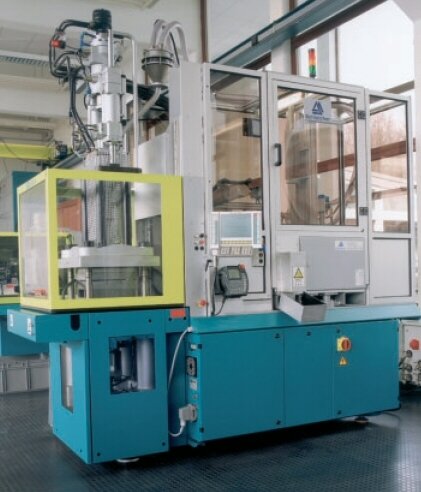
Dr BOY insert moulding machines with vertically arranged clamping units offer many advantages for an automation of the production process. In particular, the easy and space-saving integration of peripheral equipment and the possibility for rapid changeover are decisive factors.
For decades, the insert moulding machines from the manufacturer from Fernthal have set standards for those automated production cycles and are being successfully employed throughout the world by many customers.
There has been a tendency towards the automation of injection moulding machines for quite some time in the plastic-processing industry. However, the requirements do not stop at that. Integrated automation concepts should, if at all possible, take over the complete processing of the moulded parts, which is the very claim the new, modular design meets entirely. A look at this design will reveal how the production process works in practice.
One of two main elements of the modular line is the insert moulding machine BOY 55 VV with a clamping force of 550 kN. The fixed lower platen for secure positioning of the inserted parts is very favourable for such lines. Thus the parts, which are very often individually formed, can be easily picked up, transported, and deposited again. Generous distances between tie bars of 360 x 335 mm allow the production of relatively large moulded parts, or the use of moulds with many cavities.
The other key element of the line is the precision robot. Due to the great moveability of a six-axis robot, many modular processing stations can be arranged within the cell. At least just as important as the moveability is the long range of the robot. The design must be such that all positions can be securely reached and that, furthermore, quick access to the densely arranged processing stations is enabled.Modern swan-neck robots excel with a very high performance regarding precision and speed. The accuracy of positioning is two hundredths of a millimetre, thus guaranteeing reliable and continuous operation of the line.
Unlike the standard components insert moulding machine and robot which, so to speak, are the heart of the injection moulding cell, the injection mould and the downstream processing stations naturally have to be individually designed, to accommodate the parts.
Here, all processing stations relevant to the article are on a quick- change unit which - similar to the injection mould – can be easily lifted off the machine after disconnecting a few plug-type connectors. The robot hand is disassembled together with the modular processing cell and remains with the unit.
Already when planning the modular automation line, processing and cycle times are of great significance, meaning that the complete processing cycle of the parts should, preferably, not be longer than the cycle times for the insert moulding. Thus, maximum output is ensured.
The same is true for optimum changeover times: Due to the modular design, a changeover can be effected in a very short time, with the mould and the automation module being changed. In general, the robot remains on the machine frame and is thus available for other applications. This means that basically, endless production possibilities exist with just one machine. The maximum size of the parts is determined by the clamping force and the available size of the mould for the insert moulding machine. Especially the compact dimensions of all three insert moulding machines (BOY 22 VV, BOY 35 VV, and BOY 55 VV), the fixed lower platen, as well as generous space for peripheral equipment on the machine frame offer optimum integration facilities for downstream automation.
Taking a look at the beginnings of automation, you will find that the production of serial parts without corres - ponding automation very often was a strenuous and monotonous affair. One at a time, the parts were manually inserted into the injection moulding machine and then over moulded by the machine upon the push of a button. Subsequently, the parts had to be taken out, sometimes sorted, and separated from the sprue in a cumbersome way.
A first remedy were the so-called sliding and rotary tables. While the inserted parts were over-moulded at one station, industrious hands could place blanks/inserts into the other lower mould halves. After each cycle, the next lower mould half was pushed or pivoted into the machine.
Thus, some time was saved in feeding the machine; however, the time needed for demoulding and sorting / processing of the parts remained. To this day, manual sliding and rotary tables are used, especially for smaller batches or very simple parts, provided that the space needed to mount such tables on the machine is available.
Due to the parts being ever more complex, as well as a continuously growing number of integrated operational steps, automation with rotary tables reaches its limits ever more quickly.
Thus, the performance of rotary tables is mostly restricted to the insertion of parts, transport, and demoulding resp. transfer to other processing machines independent of the injection moulding machine.
Further operational steps are carried out by peripheral equipment, which requires extra space and, more important, entails a significant increase in processing time. In this case six-axis robots operating within a cell are a great advantage.
As a subsequent developmental step to make the work more easy, linear and swan-neck robots were employed. Accurate and rapid feeding of the blanks / inserts, their demoulding and transfer simplified the work process, dueto the use of robot technology. However, this initial generation of robots was rather inflexible. For example, many robots and their range were relatively hard to adapt to the respective application and necessary movements.
Besides the programming, which still has to be done today, former robots often had to be repositioned for varying tasks, to guarantee that the mould, the injection moulding machine, and downstream processing stations would cooperate without trouble. Many times automation cells were designed and used for just one specific application. After the entire order had been produced the automation cell, together with the robot, was stowed away pending the next order. As this was not really effective, a way had to be found to make robot technology available on a larger scale for other applications, too.
The solution is the separation of robot and automation cell. If, when setting up the injection moulding machine, the mould has to be changed and the automation adapted, a modular design ensures that only the cell has to be detached from the machine frame and exchanged for another modular unit. The position of modern six-axis robots can be retained without change.
All that has to be done is enter the programming steps pertaining to the application into the control, and serial production can start right away. Due to an ideal, fixed position of the robot on the frame of the injection moulding machine, the mounting of a new automation cell and its integration in the programme cycle of the travelling movement will be simplified significantly.
At several exhibitions the BOY 55 VV demonstrated how such lines work in practice. This insert moulding machine from the specialist for injection moulding machines with clamping forces up to 1000kN fully automatically overmoulded hexagon socket screw keys of varios sizes.
Based on Dr Boy informations