Engel at Fakuma 2011
"More colours. More integration. More energy efficiency." – this is the motto chosen by Engel Austria in for this year's presentation of system solution competency at Fakuma from 18th to 22nd October in Friedrichshafen/Germany.
With five production cells at our own trade fair booth and five additional machines at partner booths, Engel will be demonstrating efficient and economic production of premium quality moulded parts based on solutions tailored for a variety of applications.
More colours. More Integration." – These two statements stand for maximum process integration, multiple-component technology and for insert-placing methods or surface decoration in Engel's trade-fair exhibits. In Friedrichshafen, Engel will be showing its full hand of efficiency-boosting and process-optimising approaches: from the use of innovative technologies, machines and mould concepts, through automation, to reducing energy and material consumption in production.
"More energy efficiency": from hydraulic machines with energy-saving servohydraulics, through hybrid machines, to fully electric high-performance machines, Engel will be presenting future-orientated drive concepts at Fakuma, each of which is tailored to meet the specific needs of the automotive, teletronics, medical, technical moulding, and packaging industries.
The vision of a vehicle interior without buttons and switches is becoming increasingly tangible. At the Engel trade fair booth in Hall 5 visitors to the fair can take a seat in the automotive cockpit of the future. Various control functions can be activated via the centre console in the simulation cell. All you need to do is to lightly touch one of the functional elements below the completely closed surface. Thanks to Engel clearmelt technology and the integration of a capacitive foil via in-mould labelling, vehicle controls will be just as elegant as smartphone controls in the future. At the same time, Engel's clearmelt technology opens up a totally new degree of freedom to interior stylists.
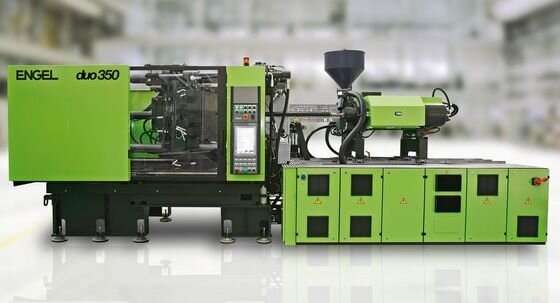
At Fakuma, an Engel duo 350 injection moulding machine equipped with the servohydraulic Engel ecodrive will be producing piano black centre consoles. This is the first showing of this new machine size, which brings the power of the duo large-scale machines – maximum power on a small footprint – to the lower clamping force class.
Thanks to reversing plate technology, the thermoplastic centre console top carrier made of ABS-PC is injected while the pre-moulded part created in the previous cycle is overmoulded with polyurethane in the second half of the mould. This process is based on the Engel combi M method, but with a polyurethane system connected to the mould instead of a second injection unit. The capacitive foil is insert-placed into the mould before injecting the first component. Two Engel viper 20 and Engel viper 40 type linear robots take care of component and part handling.
In the Engel clearmelt process, the layer of PUR fulfils multiple functions at the same time. The primary task is that of protecting the part's class A surface against chemical and mechanical exposure. The coating's excellent degree of glossiness and the 3-D effect that it creates, thus adding value to the part's appearance, are important side effects.
Engel is presenting this exhibit in cooperation with system partners. The mould maker is Schöfer from Schwertberg/Austria; Hennecke from Sankt Augustin/Germany is the exclusive project partner for polyurethane technology; the function foils are supplied by plastic electronic in Linz/Austria, with Magna Exterior & Interior Systems from Munich/Germany supporting the processing technology side of the project.
It goes without saying that this exhibit, too, is characterised by its extremely energy-efficient operational approach. Engel pioneers energy-efficient drive technology and has set another milestone in the form of the servohydraulic Engel ecodrive, which is available for all of the hydraulic machines in Engel's product portfolio. Depending on the machine type and application, machines equipped with Engel ecodrive can save up to 70 percent energy compared with legacy, hydraulic machines, thus achieving consumption values that can compete with fully electric machines. The key to this impressive level of energy efficiency lies in reducing loss energy. While the machine is idle, during cooling phases for example, no energy is consumed. On top of this, ecodrive reduces the oil cooling overhead. Typically, the electrical energy component that is not delivered to the individual machine movements as kinetic energy is converted to heat and dissipated by the hydraulic oil. The oil temperature is thus an important indicator of a machine's energy efficiency.
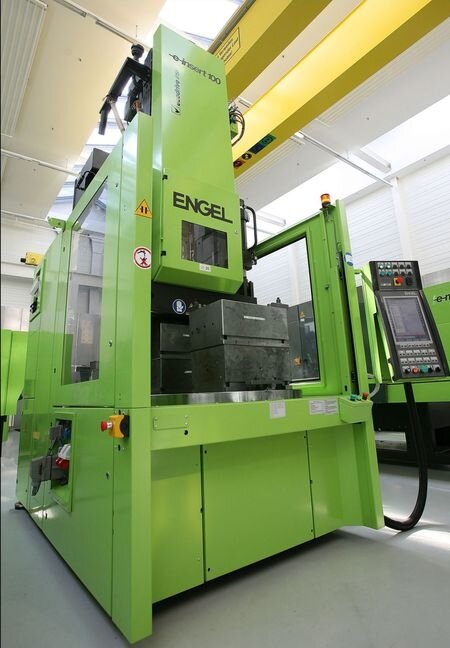
For injection moulders in the telecommunications and electronics industries, Engel will be exhibiting an Engel e-insert machine at Fakuma, the electrified variant of the vertical Engel insert machine with a servoelectric rotary table and fully electric injection unit. The clamping process and ejection both rely on the servohydraulic Engel ecodrive.
Sensor housings for control electronics made of fibreglass reinforced polyamide with metal insert-place parts will be produced on an Engel e-insert 310V/100 using a 4 -cavity mould - this is an application that requires the utmost precision. The requirement is fulfilled on the one hand by the electrical injection unit, which guarantees an extremely high level of precision in insert-place part overmoulding, while the servo-electrically driven rotary table at the same time ensures excellent positioning accuracy and ultra-short rotation times.
The Engel e-insert machine was presented for the first time at K 2010. But since then, two new software tools have been introduced to reduce the cycle time. The control unit calculates the required rotary table acceleration and braking ramps from the speed and other parameters, taking the mould weight into consideration, to optimally adjust the rotation time to match the current operating state and mould weight. At the same time, a specially developed control concept takes care of automatic positioning optimisation.
Automation is another highlight of this production cell. The sensor housings are taken off by a Stäubli six-axis robot whose control unit is fully integrated into the Engel injection moulding machine's CC 200 control unit without needing a Euromap 67 interface. This sets the Engel solution apart from the many other suppliers whose understanding of integrating multiple-axis industrial robots is that of simply mirroring the robot's user interface on the injection moulding machine's display, without removing the need for the users to familiarise themselves with the two different control approaches. The Engel product developer's primary goal is thus: if you can operate the injection moulding machine, you can operate the robot, too.
To allow for simple and fast programming and control of the robot, despite the complexity of the overall system, the control unit offers the users different user levels, from a simple view, to a fully object-oriented visualisation of the sequence. The industrial robot is programmed with the familiar and simple graphical instructions supported by the CC 200 control unit. The additional movement instructions for the multiple-axis robot integrate seamlessly with the graphical user interface.
From the point of view of the CC 200 control unit on the injection moulding machine, it really doesn't matter whether the machine cooperates with a linear device or a multiple-axis industrial robot. The control concept is identical for the two robot types. Besides ease of control and programming, the fact that the machine and the robot share data storage is another advantage of control unit integration which both improves efficiency and ensures a greater degree of process reliability.
The Engel Business Unit medical exhibit is also equipped with an integrated Stäubli type TX 90 six-axis robot. Disposable hollow needles for insulin pens are produced on a fully electric Engel e-motion 200/100 T injection moulding machine in a highly-automated process. The single-step manufacturing process is an innovation compared with legacy multiple step methods, which first manufacture the needle holder in an injection moulding step and then glue in the hollow needles. To save a complete step, as well as adhesive, the Engel solution uses a multiple-axis robot to remove the needles from the magazine and insert them into the 3-cavity pilot mould by Zahoransky, where they are overmoulded with polypropylene, before being taken off again by the multiple-axis robot.
The fully electric Engel e-motion injection moulding machine series is predestined for applications in clean rooms with encapsulated drives, sealed toggle, smooth surfaces and an encapsulated barrel.
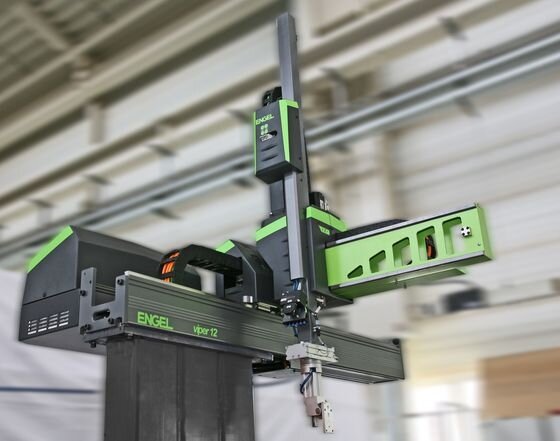
An exhibit by the Engel technical moulding business unit just goes to prove that automation doesn't necessarily involve using more space. An Engel victory 330H/200V/120 combi will be producing bottle openers in two-component injection moulding with in-mould labelling and insert technology. An Engel viper 12 type linear robot insert-places both the metal part and the decorative foil into the mould - manufactured by FKT. The basic body of the bottle opener is first injected in polycarbonate. In a second step, the edge is reinforced with TPE to achieve a better grip.
Thanks to the Engel victory machines' tie-bar-less design, the robot can reach into the mould cavity from both sides, thus supporting automation on a very tight footprint. Both the robot and the magazine for the metal inserts and foils are inside the machine's safety guarding.
The tie-bar-less machine design enables smaller injection moulding machines to be deployed than the mould size would normally dictate, which also cuts back on the space requirement. Moulds are relatively large in multi-component applications in particular, and comparatively low clamping force is required on account of the rather small part surfaces projected. Where a clamping unit operates without tie-bars, the mould can project beyond the edges of the mould fixing platens.
The Engel packaging exhibit also achieves maximum integration. A fully electric Engel e-motion 740H310W/180 T combi is used to produce a lid for a newly-developed ice-cream container in two-component injection moulding with in-mould labelling and thin-wall technology. The Engel system partners for this exhibit are H. Müller in Conthey/Switzerland, the leading manufacturer of moulds and automation solutions for IML applications, and the Weidenhammer Packaging Group with its head offices in Hockenheim/Germany, the manufacturer of the ice-cream container.
Fully electric injection moulding machines like the Engel e-motion continue to make inroads into the packaging industry, especially in the field of high-performance and quick running applications. Cycle times of less than 5 seconds and injection speeds of 450 mm per second are now feasible – this is a performance class that was previously the domain of energy-intensive accu machines. Thanks to continuous ongoing development, the Engel e-motion machines combine maximum precision with ultra-short cycle times and minimal energy consumption.
The now complete series of Engel viper robots will not just be on show with the other exhibits, but as stand-alone machines. Representing the new generation of Engel linear devices, an Engel viper 12 will be taking the trip to Friedrichshafen - this is the fastest robot in its load bearing class in international comparisons. The viper robots impress with a high load bearing capacity, excellent positioning accuracy, and highly dynamic action. Thanks to intelligent software such as vibration control, or mass identification, the robots reduce their structure-borne vibration, even with longer axis dimensions, and optimise their movements and dynamic values to achieve better efficiency. What this means is: shortest cycle times and maximum productivity with low energy consumption.
Viper robots are not just deployed on Engel injection moulding machines. More and more plastics processors are ordering Engel viper robots for third-party injection moulding machines, or to replace legacy equipment with the aim of improving productivity in manufacturing. Five sizes with nominal load bearing capacities of between 6 and 60 kg are available.