Future of injection molding
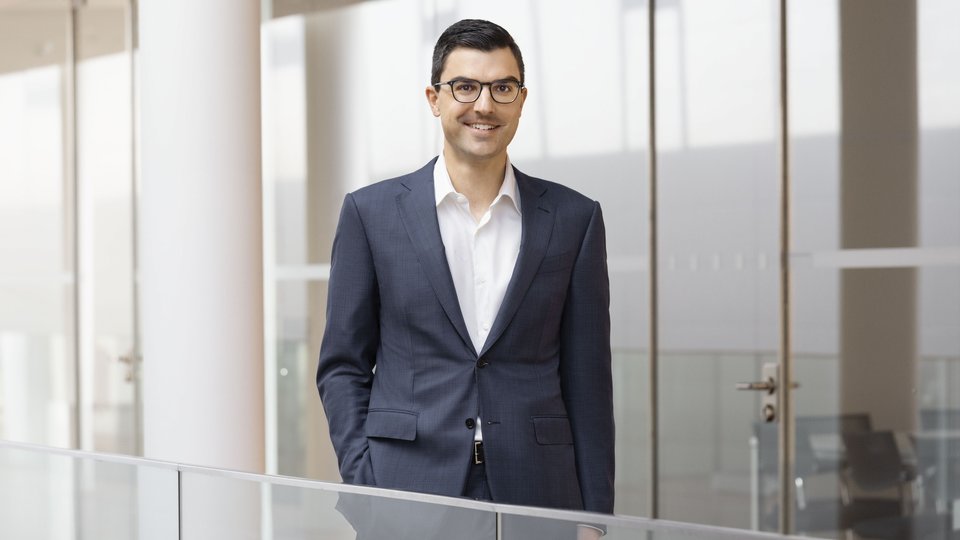
Interview with Dr. Stefan Engleder, CEO of Engel Group.
The rapid development of digital technologies has widely opened the gate to the era of the so-called Industry 4.0. What impact does digitalization have on the injection molding machine industry and how has it changed the approach to injection molding processes?
Digitalization is radically changing our production methods. This is comparable with the transformation in the automotive industry. Vehicles will be autonomous in the future, and injection molding machines will self-control and self-optimize themselves independently.
Digitalization is already a decisive competitive factor today. Industrial production processes are becoming increasingly complex. But digitalization can help to manage and control them in an easy and safe way. Digital solutions make it possible to leverage the full potential of injection molding machines and optimize production processes on the basis of the generated data. As a result, quality, productivity and efficiency are rising significantly. Digitalization is the prerequisite for sustainability. We will only be able to achieve the given CO2 reduction targets if we consistently take the opportunities offered by digitalization.
But these are still the beginnings of advanced digitalization and, generally speaking, the level of maturity in terms of the digitalization of injection molding processes is still heterogeneous.
That's right. If we look at the massive potential that digitalization opens up, we are still at the beginning of this development and the differences in how production processes are being digitalized in the enterprise are substantial. On the one hand, this is due to the fact that, just like with capital expenditure on new machines and production units, digitalization projects are also precisely adapted to individual requirements. The focus is always on the concrete added value for the user. On the other hand, we also see some companies still struggling with the decision to invest in digital solutions, even though the benefits are obvious. We would be happy to see more trust in the new solutions here. What it will take is a change in the mindset. We are actively pushing for people to leverage the opportunities that digitalization opens up and to gear their injection molding production facilities for future requirements with a view to competitiveness, but above all to sustainability. A wide range of both field-proven and new digital solutions is available for all maturity levels.
Well, let's say what doors digitalization opens – what specific opportunities it makes available.
As previously mentioned, digitalization helps us to leverage the full potential of the injection molding machine or systems solution, and to make production more efficient and avoid rejects by doing so.
For example, sim link, the interface for exchanging data between the simulation program and the injection molding machine, has already helped us to lay down the tracks for a sustainable manufacturing process, and for recycling later on, during the development of the product. The iQ weight control smart assistance system, to cite another example, makes it possible to use recycled material even in processes for which virgin material was previously unavoidable.
On top of this, the lack of qualified personnel is also driving our clients to invest in digital solutions. It's all about supporting production personnel and ensuring a consistently high product quality, even if skilled personnel is not available on every shift.
As injection molding processes become increasingly digitalized, the volume of data is increasing. Data contains a lot of information but this is often not recognizable at first glance. How does using this information support processes optimization?
This definitely is one of the greatest challenges, extracting information from the increasing volume of data to support both process and production optimization and troubleshooting. Data scientists are trained precisely for this task. However, only very few processors employ their own data experts. This is why ENGEL now offers this expertise as a service following the addition of our new "analytics" package in our performance.boost process optimization service. We have built up personnel resources for this. Our data scientists have years of injection molding experience on top of well-founded data analytics training. They understand the injection molding machine and the processing technologies, and that is precisely the major advantage of performance.boost analytics compared with other service offerings on the market.
Our data scientists systematically analyze the available data for each specific use case, visually process the results and develop concrete recommendations for action. For example, to increase production efficiency or reduce the reject rate. Depending on the application and customer requirements, the production and process data as well as data from quality assurance deliver the raw data, which is collected over a longer period of time. The analysis allows insights into the root causes of rejects, for example, reveals gradual quality changes and enables long-term trend statements.
Online support, remote service, augmented reality – the functions are now already widely used. What are your achievements in this area?
Digitalization is one focus of ENGEL's development work. Every year, we invest tens of millions in digitalization. There have been massive changes, particularly in the Service Division, in recent years. Numerous newly installed injection molding machines are already online, and more are coming online all the time. The rising number of digital applications will automatically cause machine connectivity to grow. Covid-19 has accelerated this development. After all online support and remote maintenance are key to ensuring productivity and delivery capability, even in a crisis.
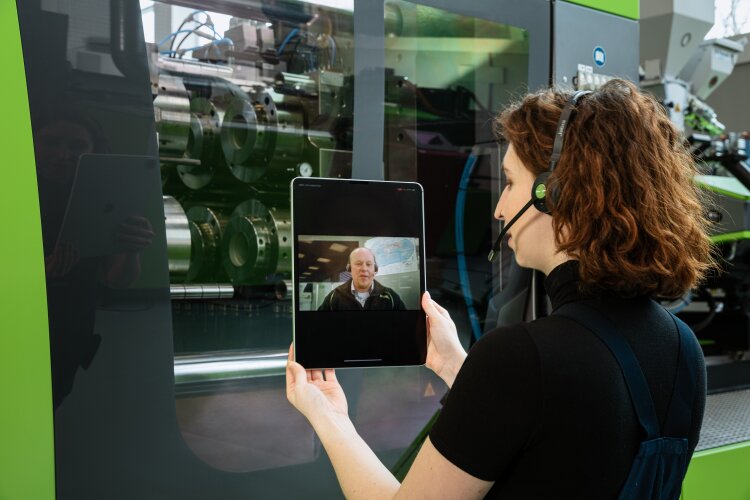
During the pandemic, when on-site service calls were not possible to the usual extent, our experience with video telephony as a component of our online support was excellent. Our new e-connect.expert view offering grew from this. Where the ENGEL service technician in classic online support has access to the injection molding machine's control interface in real-time, the new web application relies on video to provide additional information on the status of the machine components and the injection molding machine's environment. Some three quarters of all urgent service cases can be resolved remotely in this way. Troubleshooting times are reduced by 70 percent.
Video telephony is supported on both smartphones and tablets and using augmented reality (AR) glasses. The only pre-requisite is an internet connection.
Some of ENGEL's customers have already started working with AR glasses, and there is a general interest in the new technology. The advantage that AR glasses offer is that both hands remain free to work on the machine. Besides this, additional information supporting the collaborative work can be displayed in the form of text, animated objects or short video sequences.
We are also seeing the rapid development of AI. This is particularly noticeable in the social sphere, although we often see side-effects of this development as well. But let's stay with our business. What is the role of AI for injection molding processes?
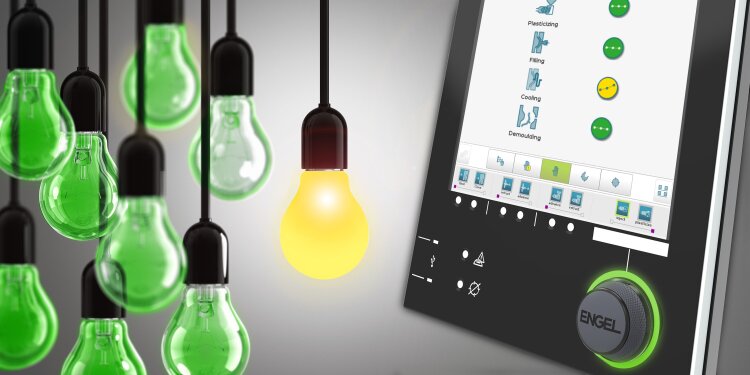
Artificial intelligence is also opening up new opportunities in injection molding. The first application for the injection molding machine is iQ process observer by ENGEL, which sees us move further towards the self-controlling injection molding machine. We collect anonymized and generalized data from analyses provided by customers who explicitly gave us their approval for this. Accordingly, we can draw on the accumulated experience of a broad installed base for the further development of iQ process observer and for artificial intelligence training. Our customers are benefitting from the continual improvement of the software.
Finally, I would ask you to play the role of a visionalist. What will the injection molding technology sector look like in 20 to 30 years?
The processes will be smart and transparent. In this way, we can ensure the extremely economical use of energy and raw materials and keep plastics in circulation.
Until then, the main thing is to network the companies in the plastics industry even more closely along the entire value chain.
Applications such as ENGEL e-connect.24 for remote maintenance and online support, are primarily implemented on vertical platforms today. What vertical means here is digital mapping of a system or production cell within a single stage of the value chain. This "digital twin" describes the system and its behavior based on data and lays the foundation for optimization.
Through a transition to horizontal platforms, which is being actively promoted by ENGEL and other companies in the plastics industry, we can network these applications along the entire value chain and exchange information and data across enterprise boundaries. This benefits the circular economy and we will no longer have to downcycle materials, but can focus on genuine recycling or even upcycling. For example, a digital watermark applied invisibly to packaging enables targeted sorting of plastic waste, resulting in single grade, high-quality recycling. The watermark identifies the material, the packaging manufacturer and the processing method. The data is available to all participants and users of the horizontal platforms in order to be able to control and tune the recycling process, and the processing of the recycled materials downstream, for maximum resource efficiency. In this way, we are shaping a sustainable plastics industry in collaboration with our customers and partners.
Jacek Leszczyński
Read more:
