Interview with Bernhard Hantmann
from Ball Packaging Europe
We publish an interview with Bernhard Hantmann from Ball Packaging Europe. He is the Sales Director Central and Eastern Europe. Ball Packaging Europe is one of the leading beverage can producers in Europe.
Introduce please the Ball Packaging Europe company.
Bernhard Hantmann: - Ball Packaging Europe is one of the leading beverage can producers in Europe with currently 2,600 employees. Twelve production plants are situated in close proximity to clients in Poland, Germany, France, the Netherlands, Serbia and the United Kingdom.
The range of products and services provided by Ball Packaging Europe comprises two-piece beverage cans made of aluminium and tinplate for beer, carbonated soft drinks, energy drinks, mineral water, fruit juices, coffee, wine drinks and other beverages. Ball Packaging Europe is a wholly-owned subsidiary of Ball Corporation, a supplier of high-quality metal packaging products for beverage, food and household products customers, and of aerospace and other technologies and services, primarily for the U.S. government.
Ball Corporation and its subsidiaries employ more than 14,000 people worldwide and reported 2009 sales of 7.3 billion US dollars. In the Technical Centre of Ball Packaging Europe, the research & development centre in Germany, scientists and engineers work constantly to enhance product features and production processes and to develop innovations to tap new product segments. Excellent facilities are available to our customers and our specialists for all activities: state-of-the-art laboratory equipment as well as test filling, sterilisation and pasteurisation units.
You inform that Ball Packaging Europe, as the leading producer of beverage cans in Europe, delivers products for the aeronautical and space industry as well as the state-of-the-art solutions for the American government. It is very interesting, so please tell us more about what these projects consist in and what their characteristic features are.
Ball Aerospace is a wholly-owned subsidiary of Ball Corporation, with its headquarter in the USA. In 2009 Ball Aerospace achieved sales of $689 million (which represents about 10 % of the total turnover of Ball Corporation). In 1956, the "Ball Brothers Research Corporation" was formed and it is now known as "Ball Aerospace & Technologies Corp." From 1962 to 1975, the Orbiting Solar Observatory (abbreviated OSO) was the name of a series of nine satellites built by Ball Aerospace for NASA to study the sun. From there the fledgling aerospace company’s product portfolio developed rapidly both in breadth and depth.
Today the areas in which Ball Aerospace does business are extremely complex: These range from "Space Science & Exploration" - i.e. innovative satellite systems and components for the exploration of outer space which are already being used in numerous NASA projects and civilian satellites. Then there is instrument and sensor technology which supplies the US meteorological and oceanographic authorities with valuable data about changes in the atmosphere and the environment and finally antennas and tactical camera systems for US military defence customers.
Ball Aerospace has seven sites in the USA, where numerous technological advances are made for highly sensitive optical instruments and sophisticated cryogenic systems and services are offered in data exploitation and RF solutions to support critical missions for U.S. agencies. And the list of success stories for the aerospace innovator is long.
For instance, the aerospace company’s engineers successfully built the instrument that corrected the blurry vision of the Hubble Space Telescope when it was launched in 1990, built the first instrument – HiRISE – to return high-resolution images of the surface of Mars, and provided NASA with the space vehicle that intercepted a comet - Tempel 1 for the Deep Impact-Mission.
Concern is the second largest European producer of beverage cans. What are the capacities of your plants and which of them: those from Germany, France, Great Britain, the Netherlands, Poland or Serbia have the largest production?
The total production capacity of our European plants is currently nearly 18 billion cans per year. The largest production capacity has our plant in Bierne, France, with 3 production lines for steel cans.
In France we also have 2 plants with 3 manufacturing lines for alu in La Ciotat. Our Polish plant in Radomsko has 2 production lines for aluminium cans. In Germany Ball has 3 plants with altogether 5 production lines for steel cans and 2 lines for aluminium cans. Last not least in Serbia we have a plant with currently one line for aluminium cans, we will add an additional line next year. We also have 2 production facilities that only produce can ends with which the cans are closed (one in UK , the other in Germany)
The Ball Packaging concern has existed for several decades. Please tell us what events were at that time the most important ones from the company's point of view and which may be called milestones in development of the concern?
The Ball company was founded by five brothers in the 19th century in the US: The five founding Ball brothers started the company in 1880 in Buffalo, New York. Two of the brothers, Frank and Edmund, borrowed $200 from their Uncle George, a minister, to go into business selling wood-jacketed tin containers to hold paint, varnishes and kerosene. Since its founding, Ball has grown from a small producer of wooden-jacketed tin cans to an international manufacturing company. In Europe the packaging company Schmalbach was founded in 1898 in Braunschweig, Germany.
The company started to produce metal packaging for vegetables. This company also grew to an international leading packaging company named Schmalbach-Lubeca. It was the first European company that started to develop beverage cans in 1935 – and introduced the first beer cans on the German market in 1951.
In 2002 Ball Corporation acquired Schmalbach-Lubeca AG, the German-based metal beverage company, and created Ball Packaging Europe, boosting Ball’s beverage can sales by more than $1 billion. Today Ball is the largest producer of beverage cans in the world; in North America, Ball is the largest producer of aerosol cans and the second-largest producer of food cans.
Certainly, as the market potentate in your industry you have to set the trend of its development also in technological terms. Which achievements of the company in the field of e.g. production or decoration of packagings brought the concern the greatest recognition?
Our Ball Resealable End was revolutionary for the beverage can industry because for the first time we succeeded in finding a marketable solution that doesn’t change the classic shape of the can with its logistic and ecological advantages.
Reclosability offers our customers new marketing opportunities and more convenience for the consumers. Until today, Ball Packging Europe is the only can maker who offers this resealable can on the market. In 2009, the Ball Resealable End was awarded with various prices including the “Can of the Year Award” and the “Best in Metal Award”. Other international awards for this innovation followed, such as the IMDA Technical Award 2010 and AmeriStar Award 2010.
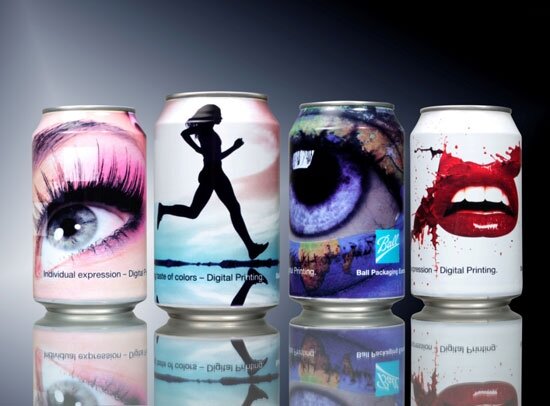
Reproducing custom designs in unprecedented quality, digital printing follows the resealable closure as a second game-changing technology able to unlock new markets for beverages cans. Ball Packaging Europe is the only company which brought digital printing for beverage cans to market maturity. A digital print head applies images straight onto the can surface at resolutions up to 600 dpi. The images pass directly from computer to production line without any need to make up a printing plate. This is not just a time saver; it means every container can be printed at top quality with a different design. With these two revolutionary and many other innovations Ball Packaging Europe is the leading beverage can producer in terms of innovation.
As we have already mentioned, Ball Packaging Europe is one of the largest global producers of metal and plastic cans for the beverage and food industries. Which industry: that related to metal packaging or that related to plastics packaging is more demanding and difficult to be served, from your company's point of view?
Ball Corporation announced in June 2010 that it has entered into an agreement to sell its plastic packaging, Americas, business to Amcor Limited. The plastics division was Ball’s smallest business. It accounted for less than 9 percent ($635 million) of Ball’s 2009 sales of $7.3 billion. Ball believes the plastics business is better positioned to grow as part of a larger plastic packaging company. Since the plastic business has been sold, Ball’s packaging business – which is more than 90 percent of total sales – is entirely metal cans, aluminum and steel, for beverages, foods and household products.
In addition, Ball Packaging Europe conducts the successful activity in the Polish market. Please tell us about operation of your Polish plants.
Since 1995 Ball Packaging Europe has a beverage can plant in Radomsko with 2 production lines and about 170 employees. Aluminium cans with many different sizes: 25cl, 33cl, 50cl,– mainly for beer, but also for Carbonated Soft Drinks (CSD) and Energy Drinks.
The cans we produce in Radomsko are mainly sold in the Polish market but we supply also markets in Central and Eastern Europe (Belarus, Ukraine, Estonia, Czech, Slovakia, Lithuania, Hungary, Romania , Russia,Serbia, Germany and Austria).
Ball Packaging Europe is the most innovative company on the can market offering its customers many non standard products. Special features are for example “Embossed cans” with a three dimensional surface, the advertising slogan is “you can feel the difference”, makes the can a premium packaging.
- small 25cl slim cans - most dynamic segment, sold mostly for energy drink producers, as well as CSDs 56,8cl - pint size, quite new for Polish consumers, focused on Polish emigrants coming from Uk where the size is widely used and very popular.
- undertab printing for promotional activities - used widely to promote the product with consumer contests, prizes etc in order to create additional value of the product.
Also, Ball Packaging Europe’s activities in the Polish market includes its responsibility for the environment. The company (then Schmalbach-Lubeca) was the main initiator of the Recal Foundation when it was set up in 1995.
The Recal Foundation promotes environmental education and the concept of recycling, in particular amongst children and adolescents. The Recal Foundation environment programmes have gained several awards, for example from the Polish Minister for the Environment and the from the national environmental organisation (NFOSiGW).
Ball Packaging Europe was presented with the Eagle Award by Rzeczpospolita in May 2003. In addition Ball Packaging Europe founded the Recan organisation which task is not education but to physically collect used beverage cans and to return them to the recycling process.
What made Poland a country in which Ball located its production plants? Poland is one of only six countries where the concern's plants are located, so there must have been some specific reasons for interest in our country?
Ball Packaging Europe entered the Polish market 1995, its production facility started operation in Radomsko and can look back on an unparalleled track record. In order to keep pace with continuous market growth, we installed a second production line in 1999 in Radomsko and have tripled our output volume since the plant was opened. Parallel to this the number of jobs rose.
As canned products became more available, more popular and enrichment of Polish society has been observed, Polish consumers have been year by year increasing its demand for canned products. After years of being a minor package the can became the most preferred package for many drink groups eg. beer and energy drinks. About 4.3 billion cans were sold in total on the Polish market in 2009 that was about 3 % more than in the previous year – a relatively low growth rate compared to previous years with growth rates of up to 30 %.
In 2009 the per capita consumption of beverage cans in Poland was 104 – more than twice as high as 5 years before. The biggest share is contributed by the beer segment with 90 cans per head. Hence the beverage can share in beer packaging has risen to 47%. Also, in the case of soft and energy drinks, it is mainly young Poles who choose cans. Particularly small cans for a quick refreshment ensured, as compared with the previous year, a growth of 14 % in the case of carbonated soft drinks and 58 % in the case of energy drinks. The can wins points in Poland thanks to its many advantages: easy to handle, light to transport and simple to store. And as it is considered trendy and modern, creative design possibilities are forever setting new and more exciting images on the sales shelves.
What is the future of Poland in terms of the concern's development in the nearest years? How is this part of production located in Poland to develop?
So far Poland was, with growth rates of up to 30 %, the most dynamic market in eastern Europe for Ball Packaging Europe. And there is a good chance that – despite the global economic crisis – it will remain that way also in the future.
The affluence of the population is constantly increasing and consumer confidence is extremely favourable – particularly for the beverage can. Overall, therefore, Poland is a market which, thanks to its growth, provides a lot of potential and prospects - and will remain one of the most important markets for Ball Packaging Europe.
Does the Polish metal packaging market differ in any terms from metal packaging markets in other European countries where Ball Packaging is present?
It is more dynamic than other European markets. Especially young consumers are open for innovation and new products. For example the 56,8cl can - a pint size, quite new for Polish consumers, focused on Polish emigrants coming from Uk where the size is widely used and very popular.
Producers of various types of packaging tend to convince that their packagings, e.g. those made of plastic are more ecological, less expensive than packagings made of other materials. What are the advantages which you, as renowned producers of cans, could attribute to cans?
The can is the most recycled drinks pack in the world. Every can is 100% recyclable and can be recycled infinitely with no loss of quality. The beverage can is a highly efficient & economic package to produce, fill and distribute. The can is a lightweight, convenient and unbreakable pack that protects the product perfectly. It is the only beverage packaging which is absolutely tight against light and oxygen. Therefore a beverage in a can has a longer shelf live.
The years 2008 and 2009 are the times of crisis. From the company's point of view, was this collapse visible both in its European and Polish markets or was it possible to avoid recession?
The European beverages can market was stable in times of crisis. We did not witness a substantial decrease of sales, however, the market was flat and is now returning to growth. In Poland the growth was slower than in previous years – however the prospects in Poland are again very promising.
Thank You for the interview