Maplan show energy efficiency and compact solutions
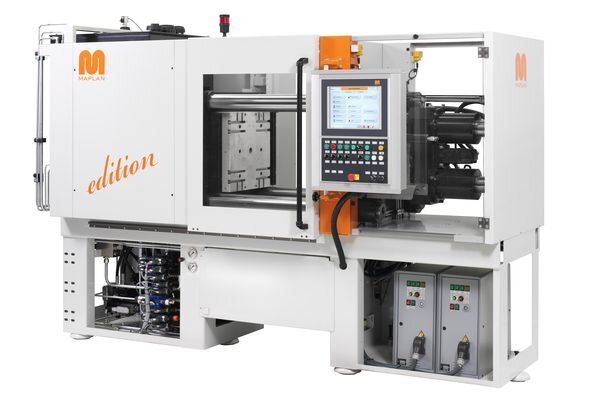
Maplan presents their three latest compact and energy-efficient developments.
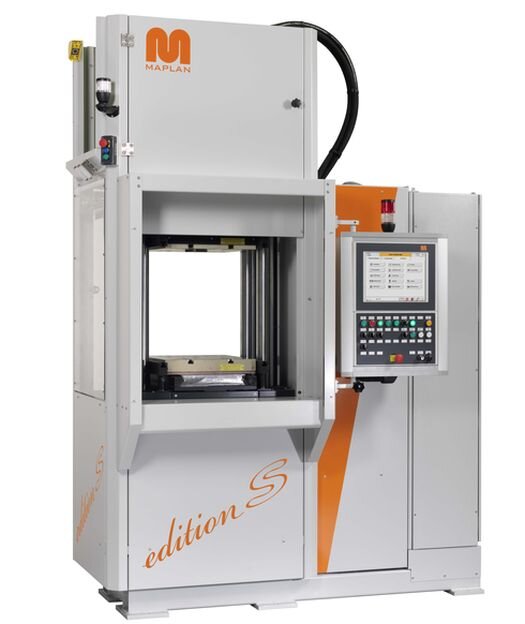
Maplan’s new “technical highlight” is, according to technical division manager Rudolf Eisenhuber, the vertical elastomer injection-moulding machine MTF400/100edition that injects from top and is equipped with a Cool Drive II.
The vertical edition-series now comprises a total of seven models: 100, 160, 250, 320, 400, 650, 800 tons clamp force for the “edition” and “editionS” designs respectively. A new addition to the range is the 3.200 kN machine. The other two exhibits not only show corner vulcanisation with rubber and possible corner over moulding with TPE, but also the future potential for the automation of elastomer applications, as Eisenhuber states.
Maplan’s innovation has earned them a very high regard in the elastomer industry along with their ability to follow a trend in elastomer processing: “Especially in the case of automotive work we can acknowledge the increasing importance of TPE and an increase in TPE applications in general. With energy-efficient and compact solutions as standard – we try to do both worlds justice and to set new standards for injection moulding and vulcanisation,” explains Rudolf Eisenhuber.
Vertical machines with high repeatability
The MTF400/100editionS, exhibited in Nuremberg, illustrates what the elastomer experts from Austria are all about. A high-precision FIFO-injection unit with a shot volume of 400ccm guarantees outstanding shot precision and a consistent L/D – ratio. The very short nozzle ensures maximum injection pressure directly at the tool. Furthermore, it is cooled, so nozzle retract is not required. The retractable plasticising unit simplifies every change of material. With a footprint of only 2.3m² and a clamping surface that has been increased by 20%, the footprint-optimised ‘edition’ series offers high performance coupled with low space requirements. However, the emphasis is on energy-efficiency.
The servo-hydraulic CoolDrive II, already standard equipment of the ‘editionS’ version, enables energy savings of up to 70% when compared to conventional machine drives. Even the noise level of this drive concept sets new standards. The energy saving versions of DCI tempering devices guarantee the optimum temperature control of the tool throughout the cycle. The machine is also equipped with the unique process optimisation system Cure² that drastically decreases the heating time during the process. Cure² analyses and optimises all relevant process parameters for the operator: tool tempering, cold-runner temperature, plasticising cylinder temperature, dynamic pressure, holding pressure and screw speed. This results in a consistent part quality. The new machine controller PC5000touch V3 will be presented with new features in Nuremberg.
“We’re proud of our controller, not just because of the Cure² interface. In general, the controller is very transparent and easy to use. New features include: multi-media support, a new online diagnosis, a cleaning function and an additional statistics function. This allows an optimum diagnosis. Our latest version unites precision with high repeatability and makes a machine from Maplan absolutely reliable,” explains Rudolf Eisenhuber.
All that remains to mention is the application: a part will be produced out of photo-luminescent elastomer. The raw material by Beele Engineering, Aalten (NL) has an afterglow time of several hours. Such raw materials are interesting for safety elements, fast orientation and other design aspects.
Automation of elastomer machines as illustrated by the horizontal 200 to edition.
The exhibit of a MHF400/200edition with a six-axis robot addresses the theme of automation. Rudolf Eisenhuber concedes that generally, six-axis robots are rarely used for the processing of elastomers: “With the further increase in the number of cavities and in complexity, this issue becomes more interesting. In any case, there is great potential in the automation of elastomer processing. For me, this is another contribution to the consolidation of Europe as manufacturing base.”
Like the first exhibit, the MHF400/200edition is also equipped with the latest PC500touch V3 controller with Cure²-interface. It employs a high precision FIFO injection unit that is arranged horizontally, which results in a footprint of 3.6m² without demoulding devices. It produces wristbands out of silicone rubber. The cold-runner tool is provided by RO-RA Aviation Systems from Schörfing am Attersee (A). The tool is equipped with an actively controlled double valve gate cool-runner with two cavities.
A six-axis Fanuc M710iC/50E with removal grippers by RO-RA is employed as extraction robot. The manufacturing cell works fully automated, flash less and requires no rework.
Corner-vulcanisation and -over moulding ‘state-of-the-art’
As third exhibit Maplan shows a MTTF100/40C with C-frame construction. This is a vertical elastomer machine that injects and clamps from top. The tie-bar-less C-frame excels through its strong construction. Maplan C-frame machines offer advantages in ergonomics and handling: they allow the operator free access to the mould mounting area.
Machines of this type are mainly used for corner-vulcanisation, glass overmoulding, sealing elements, moulded parts, end caps and 2k-components. As an alternative to vulcanisation, there is also a TPE version, in the shape of an injection unit for thermoplastic resin, available. This compact system at the DTK 2012 “requires” a footprint of only 1.3m². It is state-of-the-art technology with regards to energy-efficient drive technology (CoolDrive II), as well as to control technology.
However, the highlight is clearly the keyword “corner vulcanisation” and its application. As finished products, the corner jointing of extruded profile result in, for example, window sealings for the car industry or window manufacturers. At the DTK 2012 Maplan produces a door profile. Profile production requires ergonomics, free accessibility and freely configurable additional movements. Again, the Maplan FIFO injection unit with a shot volume of 100ccm sets new standards when it comes to performance and precision.