Two examples of pioneering mould technology
In essence, a cost-efficient, high-performance injection moulding solution involves an effective combination of machine and mould.
Arburg, together with its co-operation partners Zahoransky and Foboha, presents two interesting examples of such combinations in the field of multi-component injection moul-ding on two large two-component Allrounders.
Arburg, together with the mouldmaking division of the Zahoransky Group, demonstrates a completely new and innovative mould technology. This involves a two-component version of an electric Allrounder 720 A with a clamping force of 3,200 kN and two injection units, one size 800 (horizontal) and one size 290 (vertical). Twelve toothbrush bodies made from PP with moulded-on TPE elements will be produced per cycle. The parts will be demoulded with the mould closed and removed by a pneumatic removal device from Barth. The cycle time for production of the twelve toothbrush bodies is around 20 seconds. The proportionate weight of the two components is 10 grams for the TPE portion and 6.15 grams for the PP portion.
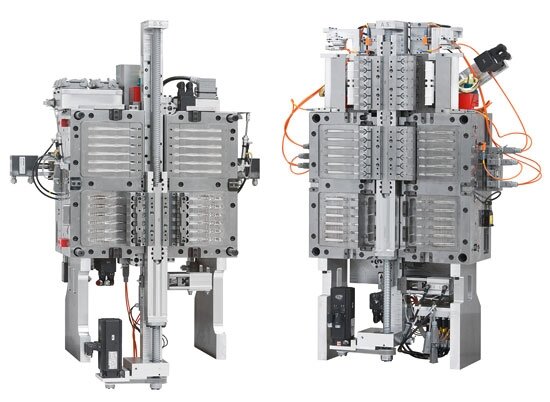
The SCPS technology complements the mould systems used to date for multi-component injection moulding, such as rotating or stack-turning mould technology. The acronym stands for Servo Cavity Positioning System. Until now, the problem with these technologies was that the moulds needed to be very large. As a consequence, these large moulds necessitated machines with a correspondingly high clamping force, even though the products them¬selves did not require this.
With its SCPS technology, Zahoransky has deve¬loped a system that does not use the conventional rotating, interchangeable variants. The 12-cavity mould features special moulded part carriers on the ejector side, which are rolled vertically from station to station via a spindle drive.
Sequence: similar to a paternoster system
When the mould opens, the continuous system engages the part carriers in the cavities and transfers the preforms to the subsequent station. The preforms are injected at the first station. After opening of the mould, the preforms are transported into the final injection position by the moulded part carriers. Once the second component has been injected, the moulded part carrier carries the finished article to the removal position and removal takes place automati¬cally with the mould closed. The next injection takes place simultaneously. The empty moulded part carrier is transported back to the first station by means of a second spindle drive.
The main advantage: greater cost-efficiency
The principle advantage of the SCPS technology is that the moulds are only marginally larger than standard moulds. This means that they can also be used on standard machines with the optimum clamping force for the parts, without requiring any additional equipment. The innovative mould tech¬nology means that the investment costs for the machines remain reasonable because it is no longer necessary to use oversized machines as a result of the mould sizes. Likewise, there is no need to en¬large the clamping platens or installation dimensions. All movements in the mould, including those of core pulls and needle shut-off nozzles, are driven servo-electrically, making them independent of the machine technology. In turn, this means that there are no restrictions with regard to simultaneous machine movements, ensuring optimised cycle times. Finally, the application of force in the mould is absolutely central, which results in high-quality parts.
“Cube mould” on Allrounder machines
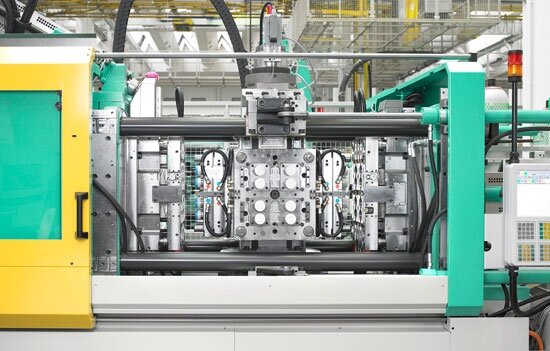
In cooperation with its partner Foboha, Arburg will demonstrate cube mould technology on an innovative solution for a continuous, high-speed production process. A hydraulic two-component Allrounder 630 S with a clamping force of 2,500 kN and size 1300 and 400 injection units will be used at the fair to produce caps for water bottles.
The smaller of the two injection units is mounted on the moving mounting platen. The sliding unit for the central section of the cube mould operates indepen¬dently in the machine base. This allows mould opening to be adjusted flexibly, enhancing process reliability and optimising cycle times through inde¬pendent machine movements.
The Foboha mould used has eight cavities on each of its four sides. This means that it can complete 32 individual production steps simultaneously. It moves to four stations in succession.
The preform is produ¬ced in the first station and cooled in the second after the mould has been rotated through 90 degrees by a servo-electrically driven movement. A further 90-degree rotation brings the preforms to the third station, where the second component is injected. In the fourth station, which is reached through the final 90-degree rotation, the finished parts are demoulded free-falling by means of core pulls with the mould closed, allowing the injection moulding process to continue. Eight preforms and eight water bottle caps are produced during each cycle.
Selogica controls all processes
The Selogica machine control system ensures the smooth, effective programming of all combined injection moulding and handling processes. All mould functions are fully integrated in the Selogica system and can be flexibly programmed in the same way as additional machine axes. The movement sequences are perfectly coordinated and comprehensively synchronised through the individual selection of start conditions. The injection units are combined in a central sequence, enabling the operator to maintain direct control of all processing parameters. This renders complex processes transparent, while simply and reliably ensuring smooth production thanks to a clear and intuitive human/machine dialogue.
Innovative technology with attractive benefits
The sophisticated Foboha stack-turning technology has significant advantages, particularly with regard to cycle-time reductions. Not only can multi-component parts be produced rapidly at a high quality level, they can also be demoulded during the running produc¬tion cycle. Highly complex parts can be produced on a single machine. Because injection is performed simultaneously into two parting lines, cube mould technology permits production at half the clamping force and with twice the number of cavities. This brings considerable time and cost benefits, particu¬larly during high-volume production.
Optimum machine-mould combinations: Arburg also has excellent cooperation partners in this sector. Close cooperation means that innovative solutions are created on a regular basis, which are precisely tailored to the customer’s specific application in terms of performance, quality and economic efficiency.