Vertical competence - proven for many years
The German Witte Automotive Group manufactures in its Czech production plants in Nejdek and Ostrov large quantities of mechatronic lock modules for passenger car doors and trunk lids. To make these components, Witte has been relying on Wittmann Battenfeld injection molding machines with vertical rotary table clamping units for more than 15 years.
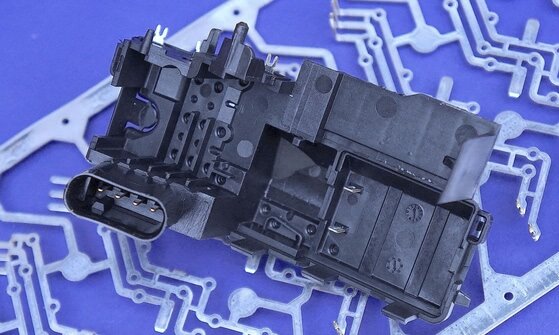
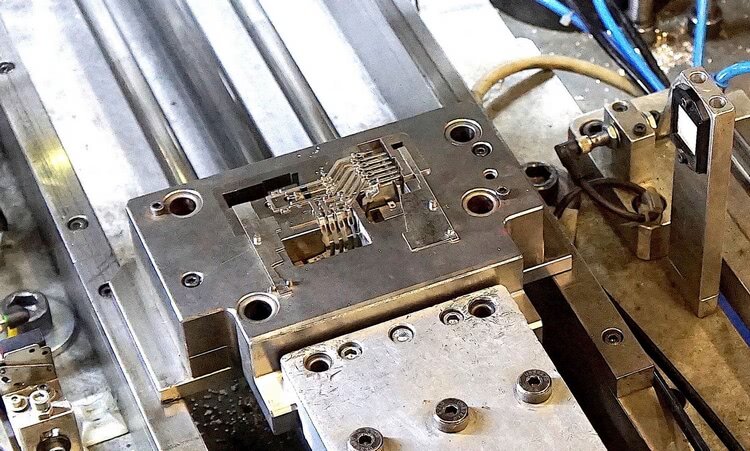
The German Witte Automotive Group manufactures in its Czech production plants in Nejdek and Ostrov large quantities of mechatronic lock modules for passenger car doors and trunk lids. The housings of the electromechanical drive units are metal/plastic hybrid parts. They consist of a conductor track structure formed as a stamped and bent part, which is covered with plastic on both sides of the housing in the injection molding process. To make these components, Witte has been relying on Wittmann Battenfeld injection molding machines with vertical rotary table clamping units for more than 15 years.
A tour of the Witte Automotive production plant in Nejdek near Karlovy Vary in North-Western Czechia is an impressive experience even for insiders of the industry. Especially during shift changes, when the paths of hundreds of workers arriving and leaving cross each other. Their total number is more than 2000. A large proportion of the workforce is employed in the assembly of many different mechatronic components for closing and locking of cars. But the product range of the Witte Automotive Group goes far beyond door handles, since it also includes restraining bars, internal door operating units, keys and locks, closing aids, door-stays, door brakes and motorized door drives.
The range for engine hoods and trunk lids is similarly diversified. In addition to the electromechanical locking units, it includes electrical drives and grip rails with integrated lighting and sensor switches. To improve pedestrian safety, components for the "active" engine hood concept are manufactured as well. Here, pyrotechnical components ensure that in the event of a collision the engine hood is raised to provide a softer crumple zone at the front.
Witte / Nejdek, however, not only assembles an impressive, diversified range of safety-relevant motor vehicle components, but also makes a large proportion of the parts in-house, especially in the injection molding department, where some 400 workers manufacture them in 4 shifts with currently 51 machines ranging from 50 to 650 tons in clamping force. The production plant receives vigorous support from the 70 staff members of the company’s own mold-making shop.
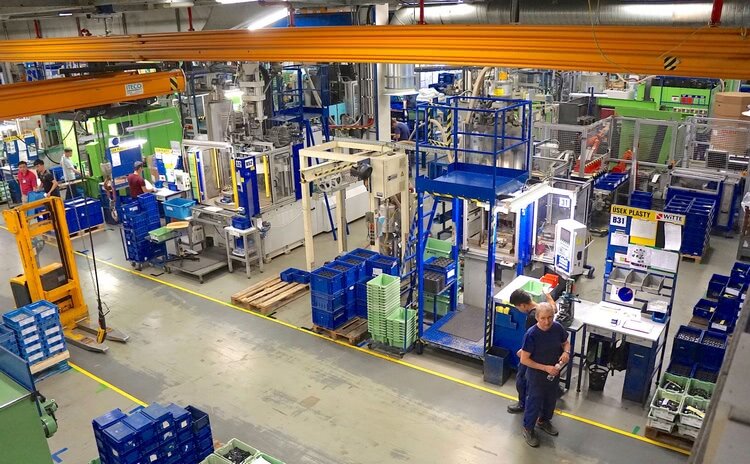
Vertical machines for assembly injection molding
Since electrical drives and an electronic control are the state of the art in closing and locking systems, virtually every one of the door closing and locking devices produced has a housing component with embedded electrical conductors. These are inserted into the mold of the overmolding machine either manually (for simple, mostly flat and therefore solid structures), or passed on by robots fully automatically and directly from a progressive cutting and stamping machine (in the case of three-dimensional multiple-track structures formed in several steps, which are difficult to handle manually). To provide ergonomically favorable conditions for this type of work, primarily injection molding machines with vertical injection units are used for this purpose. They make up about a quarter of the total machinery stock, ranging from simple 1-station clamping units for manual operation to 2-station rotary table machines in various sizes and automation levels. The majority comes from Wittmann and is partly combined with Wittmann robots and material handling technology.
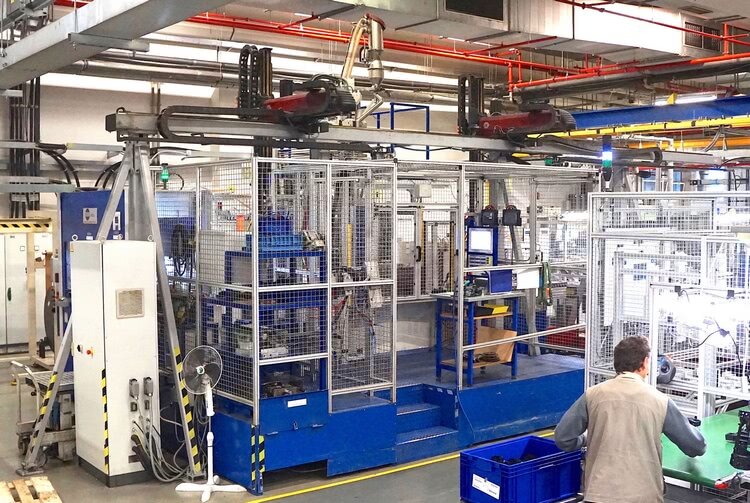
Appreciated by machine operators
Since Witte Automotive is the sole supplier for a number of lock modules, reliability is right at the top of its list of priorities for production equipment. Kamil Hušek, the company’s project leader for injection molding systems, comments: "Eight of our twelve Wittmann Battenfeld machines in operation have a vertical clamping unit. The oldest one is a Battenfeld VM-50 R and was built in 2002. It has been producing parts for more than 15 years in combination with a robot for insert feeding and parts removal without showing any decline in reliability or increase in maintenance expenses. In our newer machines, which we operate mainly as fully automatic production cells with two- to four-cavity molds, our workers on the production floor appreciate above all the excellent control system integration of robots and machines. For example in the event of a production interruption, resetting all robots to their defined starting positions is not necessary to resume automatic operation. In most cases, it is sufficient to simply press the cycle key. This is an advantage not to be underestimated, above all in shift work, when expert staff cannot always be called in for "trouble-shooting" immediately."
Fast-response core pull ensures smooth embedding of conductors
Embedding and overmolding of conductor tracks involves more than just insertion and fixing of metal parts with subsequent injection of plastic material. To insulate the conductor tracks right up to the plug contact and protect them against moisture, they must be completely sheathed. Kamil Hušek explains: "For centering the metal conductors inside the mold we use groups of mobile fixing pins which can be moved forward and backward similar to ejector pins. The pins wedge in the metal parts from both sides when the mold closes. Towards the end of the injection process, the pins are retracted during changeover from injection to holding pressure via the core pull function, and then the holes left behind by the pins are filled. This must be carried out very fast and reliably every time. The Battenfeld machine control system ensures this."
Efficiency goals achieved
In conversation with the Wittmann Battenfeld CZ Managing Director Ing. Michal Slaba and Ing. Miroslav Tureček, Sales Manager injection molding machines, Kamil Hušek sums up: “The excellent reliability of Battenfeld injection molding machines combined with Wittmann automation expertise delivers consistent good parts quality at low unit costs. The high repeatability from one shot to the next allows continuous production within narrow tolerances and minimizes the possible scrap rate."
The positive experience with the vertical machines convinced those responsible at Witte Automotive that the acquisition of standard machines from Wittmann Battenfeld would be a good investment, too. So it is not surprising that at both the Nejdek facility and its sister plant in Ostrov some 25 km away hybrid MacroPower machines with 2-platen clamping units have been installed as well.
Source: Wittmann Group
Read more: