High quality of low tonnage NPM injection moulding machine
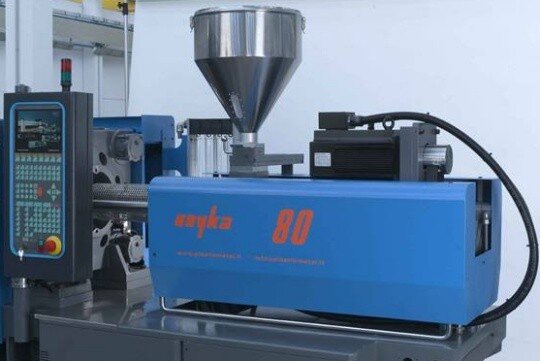
After one year of market-introduction, it is always increasing the widespread success that low tonnage NPM injection moulding machines are scoring. The rationalization of the technical features has allowed us to increase remarkably the industrialization grade and to increase the production levels, also achieving a quality-price relation, that has been considered unforeseeable till nowadays.
he injection moulding machines still maintain their features of solidity and compactness, features that are peculiar to NPM`s way of producing, and that are based on the five points reliable toggle in fusion and bronze bushes and on the pump with variable capacity and radial piston.
Cast platens assure high structural rigidity and allow for good-sized guides on tie bars. The moving platen, supported by sliding blocks, makes it possible to use the heaviest moulds, maintaining maximum parallelism and precision on movement.
Adjustment of mould thickness is effected via a hydraulic motor with central crown gear transmission. Other features include:
- automatic programmable multiple point lubrication and oil recovery,
- control of clamping and opening movements with fully programmable speed and pressure profiles actuated through a proportional distributor,
- position detection by means of absolute linear transducer, and software computation of the various speed ramp values to allow for fast and precise movements that protect and safeguard the mould.
The hydraulic plate ejector is integrated into the rear portion of the moving platen, and allows precision movements even in the presence of unbalanced loads, thanks to the specially sized guides.
There are independent speed, pressure and position values for the ejection and retraction movements and for the different ejection cycles. The rational integration of peripherals in the mould area is assured by a particularly unencumbered drop-out area, accessible on three sides.
The movement of the unit and the injection phase are actuated using two hydraulic cylinders for each movement. That assures both a perfect alignment of the injection unit with the mould, and the subsequent balanced application of injection force, while also leaving sufficient clearance around the plasticising screw to facilitate routine and special maintenance actions.
The plasticising barrel, irrespective of the screw diameter, has a constant L/D ratio and is able to assure optimal plasticising even using standard screws.
The hopper base temperature is controlled by a close-loop thermoregulation and displayed on the video interface. Rotation of the screw is actuated by a hydraulic motor, with an inverter-controlled electric motor, that is available upon request.
Both the speed and pressure of the injection phase are adjustable, by profiles as well as by individual values, and actuated through a closed-loop servo-distribution unit.
A high-dynamic response MOOG servo-valve is also available on request.
The system is based on a variable-displacement radial piston pump with closed loop control of pressure and flow rate. This allows a rapid response to the pressure and flow rate variations required by the process cycle.
The temperature of the hydraulic oil is displayed and electronically controlled, allowing for additional savings on the cooling system. A delivery side filter with electronic clogging detection protects all the hydraulic components of the machine.
On request, the machine can be equipped with a second pump for overlapping the ejection and radial movements. The display monitor is ergonomically positioned along side the fixed platen, and has a swivel base to ensure sufficient clearance for operations in the nozzle area.
Temperature, pressure, speed, time and positions values are set up, displayed and processed in real time by the industrial PC incorporated in the unit. The system software includes a full array of graphical displays, quantity control features and production-statistic functions, all ms The fusion planes makes possible a big structural rigidity.
A USB storage device imbedded in the system allows for virtually unlimited archiving ( 80,000 moulds programs ). Simplified direct-access controls on the main application screens allow for quick start up of the production cycle, while a comprehensive set of sub-menus can be used to optimally fine tune all the parameter settings. A remote access facility is also provided, that can be used for data collection as well as for the modem remote technical support service.