Mocom develops TPV for two-component PA12 applications
Mocom has introduced Alfater XL A70I 4PA1210, a TPV designed for direct overmolding onto unreinforced and fiber-reinforced PA12. The material is intended for hard-soft components requiring adhesion, sealing performance and coolant resistance.
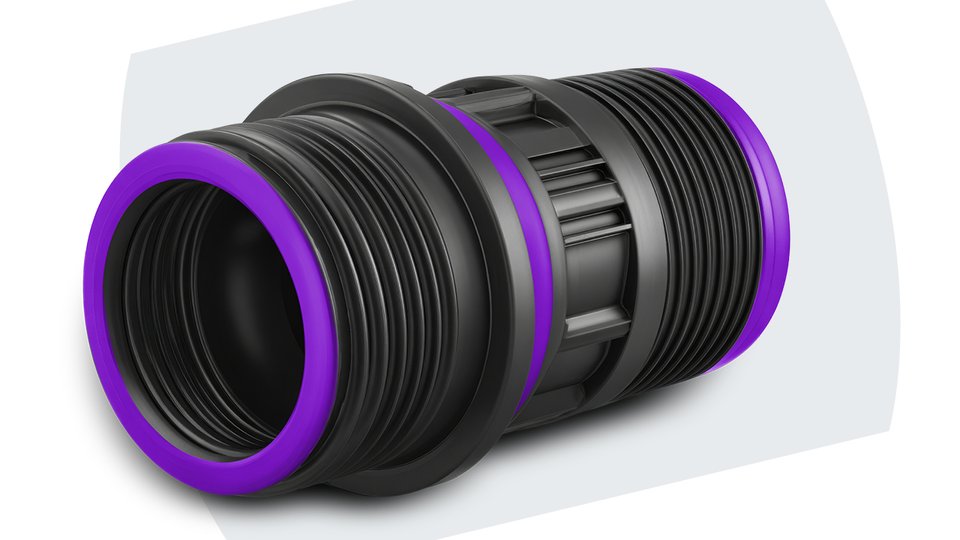
Material selection in engineered plastic components affects functionality, manufacturing reliability and cost efficiency. This also applies to two-component applications that combine hard and soft materials. In seals, hose connectors, quick-connect systems, tactile elements and other functional soft components, a key technical challenge is obtaining a reliable bond between a PA12 part and an elastomer. "Integrating functions, in other words, combining property profiles to meet different technical requirements in a single product, and potentially simplifying the process help optimize the cost of the complete component," explains Dr. Stefan Zepnik, Director Technical Service Center at Mocom.
PA12 is used in demanding applications across the automotive, electrical and electronics, and sports and leisure sectors. As plastics are integrated more extensively into technically demanding products, requirements for material combinations are also increasing. In PA12-based parts, elastomers are often overmolded to provide sealing, flexibility or tactile properties. The selection of the soft component influences both the performance of the finished part and the manufacturing process. Relevant requirements include reliable adhesion between hard and soft components, stable and cost-effective processing, long-term performance and, increasingly, recyclability.
Processing challenges with silicone and TPU
Silicones and thermoplastic polyurethanes have traditionally been used as soft components in many two-component PA12 applications. Although both material groups offer established properties, they can create specific processing challenges.
When silicone is used as the soft component, vulcanization may add manufacturing stages or extend cycle times in two-component injection molding. It also significantly restricts recyclability. Silicone and PA12 have very limited inherent compatibility, so bonding agents, pretreatment or mechanical anchoring may be required, depending on the application.
Using TPU as the soft component can also impose particular requirements on two-component processing. These include careful process control due to the material's sensitivity to moisture and potential issues involving demolding and mold design. Depending on the application, additional measures may also be needed to obtain reliable adhesion between TPU and PA12.
"Good sealing performance, adhesion to PA12-GF30, and very good coolant resistance (water/glycol) defined the requirements for developing the new material," says Zepnik.
TPV designed for adhesion to PA12
Mocom has expanded its portfolio with Alfater XL A70I 4PA1210, a thermoplastic vulcanizate developed specifically for adhesion to PA12. The material is optimized for use with unreinforced, glass fiber-reinforced and carbon fiber-reinforced PA12, enabling technical hard-soft combinations.
The TPV is intended for direct two-component overmolding onto PA12, without the additional application of primer or adhesive systems. According to Mocom, it does not require special mold coatings or mold designs of the type that may be necessary in some TPU applications.
Compared with silicone-based solutions, processing does not require complex mold technology, specific mold temperature control, separate vulcanization or post-treatment. Eliminating the primer or adhesive system also removes a processing step.
Long-term mechanical and sealing properties
Alfater XL A70I 4PA1210 has a Shore A hardness of 70 and low compression set, including under long-term loading. These properties are intended for components requiring durable sealing performance and stable mechanical characteristics.
The material maintains a stable property profile after heat aging and after exposure to water/glycol coolant. Following 1,000 hours at 100°C, Shore hardness changes only slightly, while tensile strength and elongation at break remain at high levels.
Applications in automotive, electronics and sports equipment
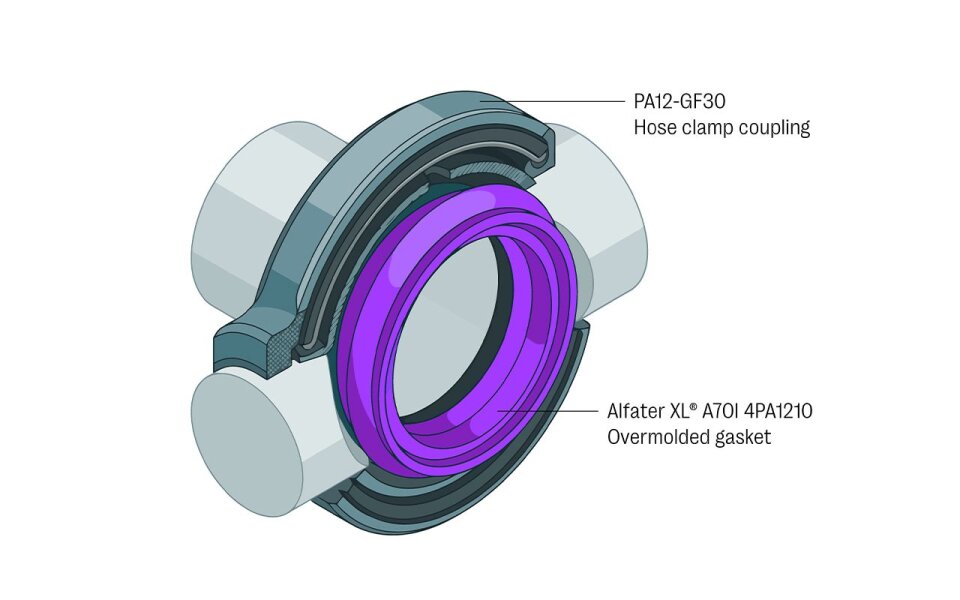
Potential uses for the material include bicycle components and automotive seals, hose connectors and quick-connect systems. "With these new multi-material solutions, we offer one-stop solutions, such as WIC PA12 paired with a soft component optimized for adhesion to PA12," says Zepnik. "This expands our portfolio of compounds for automotive battery-electric vehicle applications to include cooling circuits with seals and connectors, as well as multilayer coolant hoses."
Further applications in the electrical and electronics sector include connectors, housings and switches. Combining the TPV with newly developed lightweight WIC PA12 compounds is also intended for demanding two-component products, including robust lightweight sports and leisure applications such as ski bindings.
According to Mocom, the low moisture absorption, high impact strength and low density of WIC PA12 help retain mechanical properties and dimensional stability under changing climatic conditions and at low temperatures. The material combination is intended to provide engineers and designers with additional options when developing two-component PA12 parts.