Sidel launches the EvoDECO Next labelling system
EvoDECO Next applies partial roll-fed labels to PET bottles. According to Sidel, the system can reduce label area by up to 75% while maintaining industrial production performance.
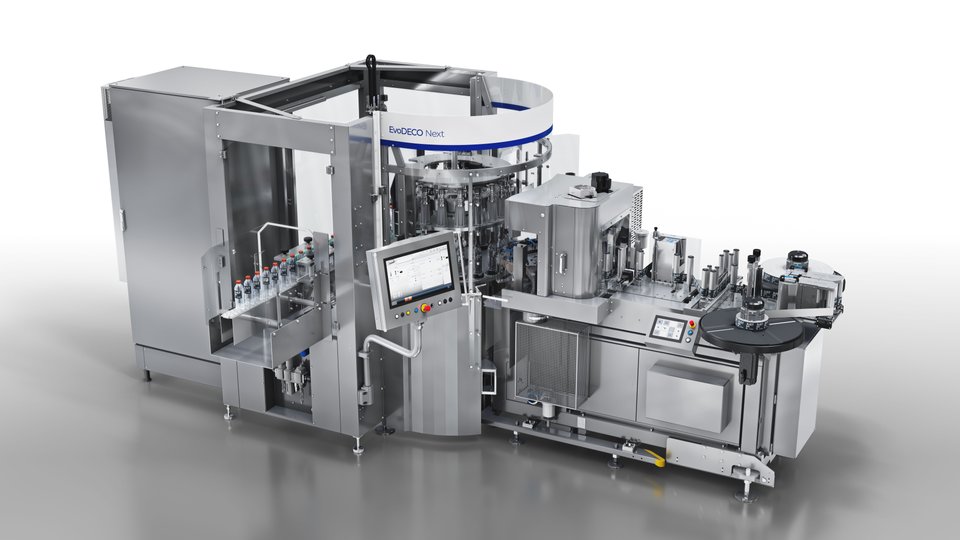
Sidel has launched EvoDECO Next, a new-generation roll-fed labelling solution that combines high production performance with greater decoration flexibility and lower material consumption. The use of partial labels on a roll-fed platform is intended to enable beverage producers to reduce the amount of labelling material while exposing a larger area of the bottle. This makes it possible to use the shape of the transparent PET container and the product itself as elements of visual identity, without limiting the robustness required for industrial production.
"EvoDECO Next redefines the possibilities of roll-fed labelling. Producers no longer have to choose between industrial performance, material savings and striking decoration. By introducing partial labels in a simplified roll-fed architecture, we can help customers reduce material consumption, create new branding opportunities and maintain the performance required on their production lines," said Anne Philippe Lafon, Product Manager in Sidel's labelling product division.
Responding to the evolution of PET packaging
PET packaging is evolving towards greater material efficiency and a circular economy, while brands remain under pressure to differentiate products on retail shelves. Most industry measures to reduce weight have so far focused on the bottle itself, from the neck through the body to the base. EvoDECO Next extends this approach to decoration, treating the label as another packaging component that can be optimised.
Roll-fed labelling, traditionally associated with wrap-around decoration, can also be used for smaller partial labels with EvoDECO Next. Exposing a larger part of the bottle allows the shape of the transparent PET container and its contents to form part of the product's visual identity. According to the manufacturer, the solution can provide a premium appearance while reducing the amount of labelling material.
Smaller label area
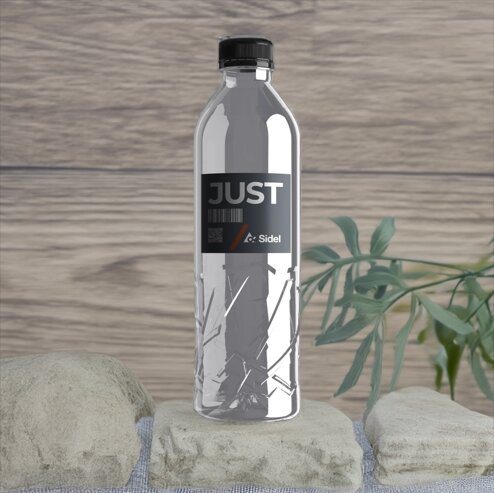
According to Sidel, depending on the selected design, partial labelling can reduce label area by up to 75% compared with a conventional wrap-around label. The maximum figure applies to the 90-degree partial label configuration presented by the company. In the 180-degree configuration, the label area is reduced by 50%.
In high-volume production, reducing the label area can result in significant savings. In one example provided by Sidel, switching from a wrap-around label to a 90-degree partial label reduced BOPP film consumption by 208.4 tonnes per year, lowered the related CO2 emissions by 346 tonnes and generated raw material savings of approximately EUR 723,000 per year.
This approach also forms part of Sidel's JUST label concept, which combines sustainability, branding, a lower total cost of ownership and simpler technology. The exposed part of the bottle becomes an intentional design element, allowing producers to reduce material consumption while maintaining a distinctive product appearance on the shelf.
Integrated technology for efficient production
EvoDECO Next was designed as an integrated platform, rather than an existing roll-fed machine adapted for shorter labels. Its architecture includes Cutter 2.0, Smart Buffer and Smart Camera modules, as well as components that support rapid configuration changes. The feeding, cutting, transfer and control systems were developed to operate in a coordinated manner.
The partial labelling function is based on a new cutting system positioned directly on the transfer drum. The rotary cutting device handles shorter labels using two blades, enabling faster cutting at high speed.
The Smart Buffer module is intended to minimise the effect of reel changes on production speed. Its compact design requires no additional space or changes to the standard film path. It also enables material splicing at rated speed, supporting overall production performance.
The Smart Camera module enables label management without registration marks. Eliminating conventional marks and the quiet zone increases flexibility in terms of raw materials and labels, while creating further opportunities for material savings. Dedicated software provides self-correction, improved automatic homing and extended diagnostics.
New rapid format-change parts are intended to increase machine autonomy and process reliability. The optimised sliding surface and air-knife system were designed to limit cross-contamination with adhesive and reduce label stress. According to Sidel, this can increase machine autonomy by up to five times while reducing unplanned downtime.
Automatic reel management
EvoDECO Next can be connected to CoboREEL, Sidel's automatic reel management solution. The system reduces the need for operator intervention, provides integrated traceability and increases production autonomy by handling up to 18 reels.
Across the entire labelling station, Sidel has also simplified key components to accelerate format changes, facilitate maintenance and provide consistently long uptime.
EvoDECO Next draws on Sidel's 50 years of experience in labelling. Since the platform was launched, the company has sold more than 330 EvoDECO machines, while over 5,000 Sidel labellers have been installed worldwide. The new solution extends packaging optimisation beyond PET bottle design to include labelling material consumption, decoration options and the organisation of the production process.