Wittmann to show PCR planter molding at Fakuma 2026
Wittmann Group will present a production cell for stackable planters made from recycled polypropylene at Fakuma 2026. The live application combines Cellmould foam injection molding, inline thermography and compact automation.
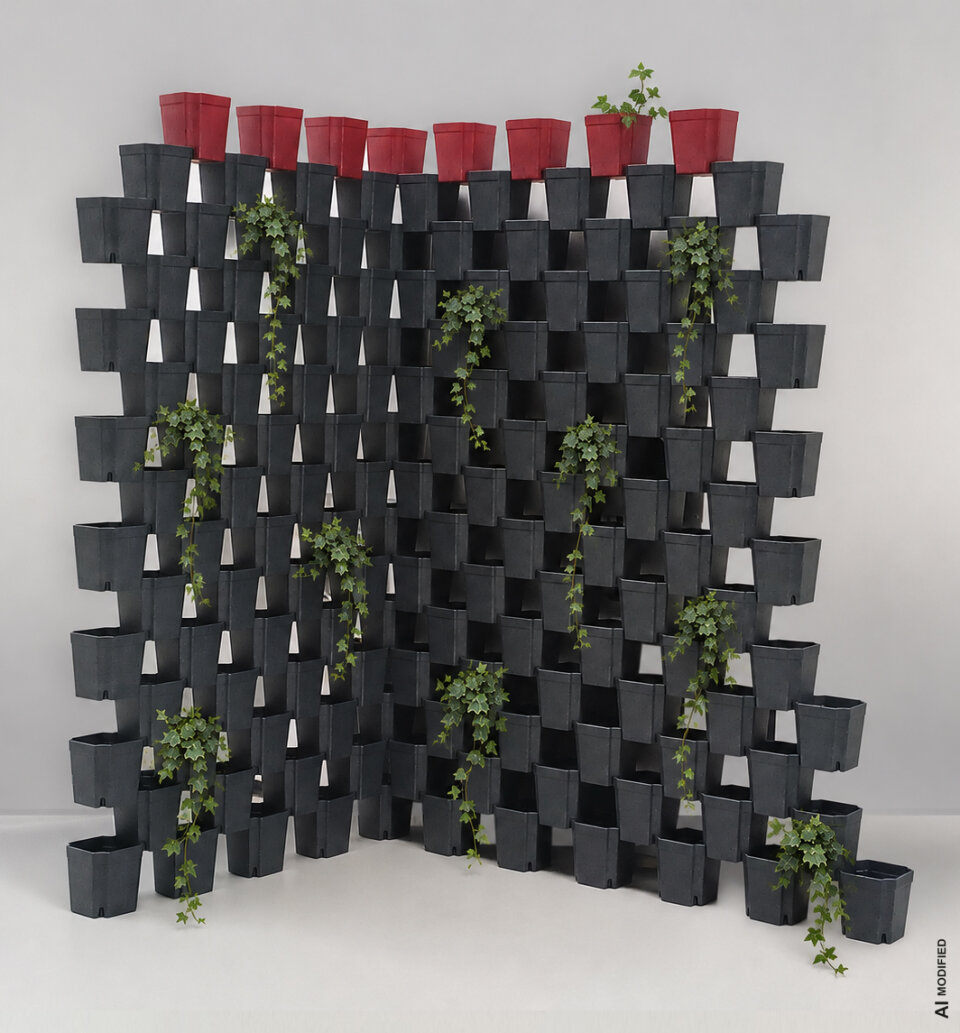
Wittmann Group will demonstrate a live injection molding application at Fakuma 2026, held from 12 to 16 October in Friedrichshafen, Germany, focused on combining sustainability with cost efficiency. Under the motto "Smart choices, smart savings", the company will produce stackable planters made of post-consumer recycled material at its booth. The production cell is designed to reduce space requirements, energy use and material consumption, factors which contribute directly to lower unit costs. The application uses lightweight, material-saving and energy-efficient processing, with recycled polypropylene derived from post-consumer waste collections. According to the company, these features are intended to support circular economy applications while keeping the process economically viable. Wittmann will present the system in hall B1, booth 1204.
Cellmould foam injection molding with recycled PP
The application will run on a SmartPower injection molding machine with 300 tons of clamping force. The machine will operate with a mold supplied by Schicktanz and with Wittmann Cellmould foam injection molding technology. The processed material will be a recycled polypropylene from Borouge, derived from post-consumer waste collections. The low carbon footprint of the planters is attributed by Wittmann to the fossil-free source of the raw material, the high energy efficiency of the servo-hydraulic SmartPower machine and the physical foaming of the melt using Cellmould technology.
In the Cellmould process, nitrogen gas is injected into the plastic melt during plasticizing and enters the cavity together with the injected melt. This generates a micro-cellular foam structure inside the molded part. The process reduces raw material demand and part weight. Wittmann also states that, in many cases, parts produced by foam injection molding can show better mechanical attributes than compact-design parts. Since foam injection molding requires a lower injection pressure than compact injection molding, clamping force can also be reduced, with lower energy consumption as a further effect.
Ease of use was another objective in the development of Cellmould. The entire process can be operated via the B8X control system of the injection molding machine. This keeps users within the familiar control environment and supports intuitive operation.
Processing PCR material in foam injection molding
Wittmann reports that extensive test series demonstrated recycled plastic materials can be processed with Cellmould just as efficiently and stably as virgin material. At Fakuma 2026, the production of the planters is intended to show the precision and dimensional stability achievable when processing recycled PP. Forming accuracy is important for this application because the planters must be stacked safely when used to build vertical gardening elements. Geometrical deviations would quickly lead to rejects.
According to Wittmann, the expansion of the nitrogen-containing melt inside the cavity supports reliable filling even in geometrically demanding molds with very small wall thickness areas and undercuts. For physical foaming, the company has developed a special plasticizing unit. The patented Cellmould 3-zone screw is produced in-house for all applications. It is suitable for a wide range of plastic materials and is designed to provide reproducible part quality, including with polymers that are difficult to homogenize. The individual screw zones can be exchanged independently, which simplifies maintenance and reduces related costs.
For stacking the planters safely, they must be molded with a precise geometry. Wittmann achieves this by using Cellmould foam injection molding technology
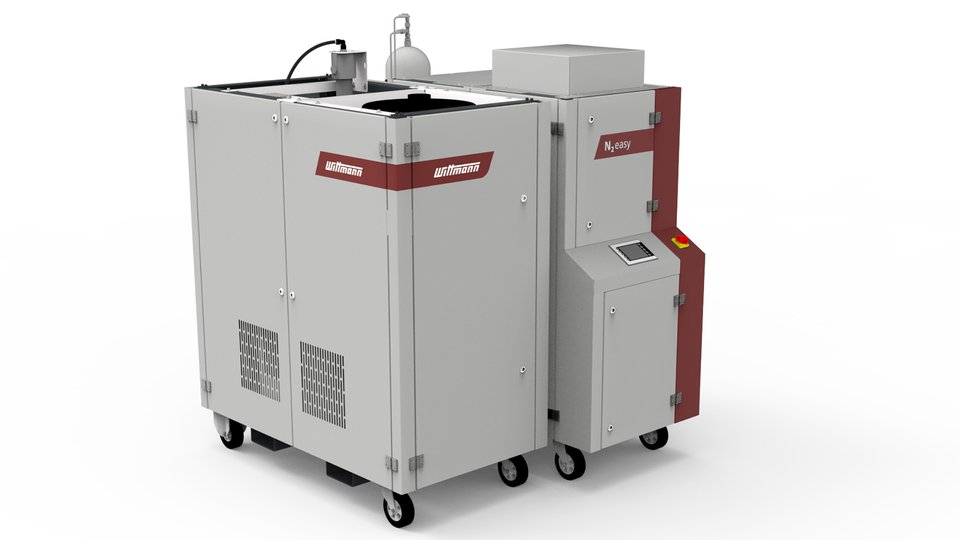
A further contribution to reducing carbon dioxide emissions comes from N2easy. Wittmann’s nitrogen generators, developed and manufactured in-house, draw nitrogen from ambient air and can supply several consumers simultaneously as required. The company states that N2easy pays off from a daily nitrogen consumption of just one gas bottle. In this way, the system replaces nitrogen logistics based on road transport.
Inline thermography and compact automation
The planters will be demolded by a WX142 linear robot from Wittmann and transferred to a fully automatic 100 per cent quality inspection station. Good parts will then be deposited on the conveyor belt. Quality inspection will be performed by inline thermography, which converts the infrared radiation emitted by the parts into thermal images.
Thermography has long been used for manual quality checks, but modern camera and image processing technology now enables thermographic part inspection to be integrated inline. In this production cell, the infrared camera is mounted on the robot’s Z-axis beam. The software compares each captured image with a stored reference image. Parts deviating from target specifications are sorted out via a quality switch. The thermal image shows the condition of surface homogeneity and internal structures, providing a basis for assessing the quality of the foaming process.
The automation system will be shown in the FlexCell primus configuration, in which the robot, conveyor belt and protective enclosure form a single integrated unit. Wittmann’s FlexCell automation cells are based on a standardized concept while remaining flexible. Inside the cell, all automation components have fixed positions and are safely enclosed. The cells are modular and extendable.
Because the cells dock directly to the injection molding machine and allow production while the machine guard door is open, the automation unit can be positioned very close to the mold. This reduces the space required for the complete work cell. The FlexCell automation cells are available in three versions. In the Primus model presented at the fair, the protective housing is mounted above the conveyor belt and requires no separate floor space. Together with the conveyor belt, it can be pushed to one side, enabling access to the mold area at any time.
Due to their standardized design, the FlexCell automation cells offer short delivery times and a favorable price-to-performance ratio, according to Wittmann. They are compatible with injection molding machines from all manufacturers and can be retrofitted to existing production equipment.
Read more: