Arburg automates two-component domino production
At Fakuma 2026, Arburg will present a turnkey cell based on an Allrounder More 2000. The system produces 32 two-coloured ABS dominoes per cycle and automates box preparation, assembly and output of complete game sets.
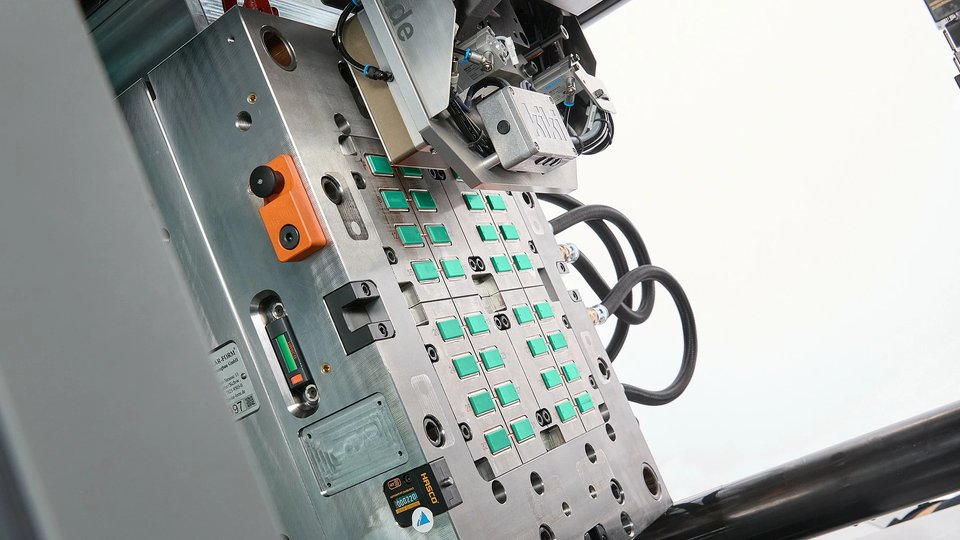
At Fakuma 2026, Arburg will present a further-developed turnkey solution centred on an Allrounder More 2000 at Hall A3, Stand 3101. The two-component injection moulding machine uses a 32-cavity hot runner mould from Polarform and Hasco to produce two-coloured dominoes. A new element of the system is an autonomous upstream automation cell that pre-assembles the boxes before they are fed into the injection moulding cell. A collaborative robot subsequently fills and closes each box, completing the ready-to-use game set and handling its output. Arburg is responsible for the design, implementation and delivery of the complete turnkey system as general contractor. Developed with Polarform and Hasco, the exhibit combines multi-component injection moulding, mould and hot runner technology, robotic part removal, box preparation, set assembly and packaging in one production concept.
A 32-cavity mould for different two-component parts
The Allrounder More 2000 has a clamping force of 2,000 kN and is equipped with a size 400 horizontal injection unit and a size 170 vertical injection unit. The 32-cavity Polarform mould incorporates hot runner technology and standard parts from Hasco. Additive manufacturing of the hot runner system enables interlaced runners, reducing space requirements and allowing either smaller mould dimensions or a higher number of cavities. The machine produces 32 two-coloured ABS dominoes in a cycle time of approximately 60 seconds.
Unlike conventional two-component applications, the mould does not open and rotate before the second component is added. The required mould movement is instead generated by a two-stage core pull concept. First, the vertical injection unit forms the front of each domino from light grey ABS. With the mould closed, two hydraulic cylinders retract the cores and the individual number pins, creating space in the cavities for the second component.
The horizontal injection unit then injects mint-green ABS, which forms the back of the dominoes and fills the indentations on their front surfaces. The process produces the 28 number-pair combinations from 0:0 to 6:6 required for a complete domino set, together with four additional pieces bearing the partners' logos.
Automated assembly of complete game sets
Within the production cell, a Multilift V 30 removes the finished moulded parts and places them on a conveyor belt. The vertical robotic system has a load capacity of 30 kg, uses a complex gripper supplied by Kiki and is fully integrated into the Gestica control system.
An autonomous automation cell pre-assembles and folds the boxes before feeding them to the injection moulding process. A mobile, autonomously operating cobot works at a table outside the safety fence. A camera system integrated into its gripper detects the exact position of a box and lid placed anywhere on the table and supplies the coordinates required for gripping.
The cobot progressively removes eight dominoes from the conveyor belt, stacks them in four layers inside the box and fits the lid. Machine operators then hand the completed sets to trade fair visitors.
Human-robot collaboration is protected by a light barrier, while the work area is divided into three zones. When the entire area is clear, the cobot operates at a defined optimum speed. If the light barrier is breached in the central zone, the robot automatically slows down. In the critical inner zone, it stops as soon as contact occurs. Mounted on a mobile trolley, this stand-alone unit can be deployed as end-of-line automation on different systems.
Modular machine configuration
Machines in the Allrounder More series provide space for larger moulds, turning units, media connections and a usable ejector stroke. Their standard configuration includes a dynamic electric toggle clamping unit with energy-efficient, liquid-cooled servomotors and two electric injection units. Clamping forces of 1,600 or 2,000 kN are available.
The modular design and features intended to simplify operation and maintenance allow the machines to be configured for specific customer and market requirements. According to Arburg, the platform supports common multi-component applications and can be combined with other processes, including liquid silicone injection moulding.
Read more: