Interview with Christophe de Margerie, Total’s Chairman and Chief Executive Officer
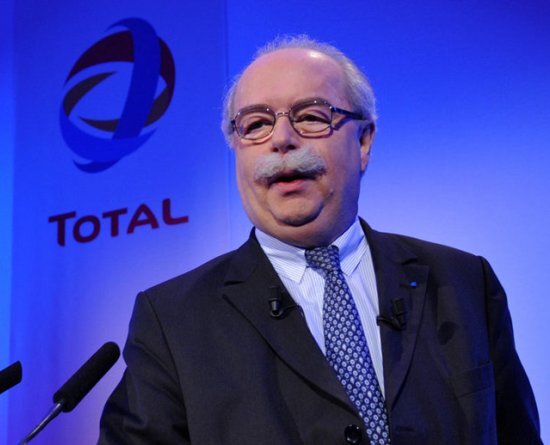
We publish an interview with Christophe de Margerie, Total’s Chairman and Chief Executive Officer. Total Petrochemicals is one of the world's leading petrochemicals companies, produces mainly polymers, which are used to make a host of plastic products that are indispensable to daily life in today’s world. to daily life in today’s world.
The crisis peaked in 2009. Looking back, what’s your take on this out-of-the-ordinary year?
In some ways, 2009 turned out just the way we expected: we had based our budget on oil at $60 a barrel and Brent averaged $61 for the full year.
However, I have to admit that we didn’t see the rest coming at all, especially the weak euro and the slide in natural gas prices. We had also hoped that refining margins would improve. When the bottom dropped out of oil prices in early 2009, it had a positive impact for a time - unfortunately it didn’t last long.
Refining margins then collapsed. On the other hand, petrochemicals and specialty chemicals held up pretty well. They were impacted by the crisis, but our teams worked extremely hard to cut costs and position themselves so that they would be shielded from the decline in demand. So our overall performance was a bit better than we expected.
How is 2010 shaping up?
First I’d like to say a word about the recession in the United States, which began in 2007, long before September 2008 and the Lehman Brothers bankruptcy. Lehman’s fall accelerated the crisis and we experienced the full brunt of its impact at the end of he year, when oil prices in turn collapsed. As soon as that happened, we weighed our trategic options for maintaining both a policy of relatively intensive capital expenditure - about €13 billion - and paying a stable dividend. We achieved both those ojectives in 2009.
2010 is a transition year, a bit better than 2009. The year got off to an even btter start than we projected, thanks to higher crude oil prices and a lower euro. The price of oil averaged $76 in the first quarter, compared to $60 last year.
On top of that, refining margins firmed up at the beginning of the year and were also higher than we were expecting. However, we aren’t sure that it will last and we remain quite cautious. The problem is actually structural: demand is declining, so we don’t see refining margins stabilizing at a satisfactory level in the short term - at least not until after the industry has adjusted.
Both specialty chemicals and petrochemicals are also doing fairly well as the recovery takes hold.
So you’re optimistic?
We haven’t seen the end of the crisis. There are still sectors at risk of a bubble. So we must remain, not conservative, but very attentive to and very strict about our cost and cash flow management, to ensure that we don’t have to change our capital expenditure plan if the economy relapses or takes longer than expected to recover.
We want to be able to keep doing the kind of major transactions we finalized in January, which brought us a billion barrels of potential reserves. I’m referring to our acquisition of interests in the Halfaya field in Iraq and the Ahnet field in Algeria, as well as the joint venture with Chesapeake, an American company specializing in Texas shale gas.
Our goal is to acquire reserves, not companies, because the market is still expensive. And I’m delighted that our switch to a business model that places more emphasis on partnerships and sustainable development has begun to pay off.
Speaking of the shift in your business model, has it led to any organizational changes?
Yes. We’re creating a new senior executives’ group this year, known for now as the G60. Our environment has changed dramatically: the East-West balance of power has shifted, the concept of OECD versus non-OECD countries is no longer the same, and the focus on the environment has sparked broad awareness. In this new world, we have to work differently.
The Management Committee is no longer adequate as the sole communication conduit between the Executive Committee and all the other senior executives, much less the rest of Total.
The new group comprises 60 senior executives, who sit on the Management Committees of our different businesses or, at the corporate level, work in Corporate Affairs and Finance. Its role is to reflect, in smaller groups, on a wide range of topics, such as our social license to operate, how to adjust our business model in a changing world, access to reserves, the concept of partnership, and alternative energies. The G60 will not set strategy; its job will be to support and then cascade it.
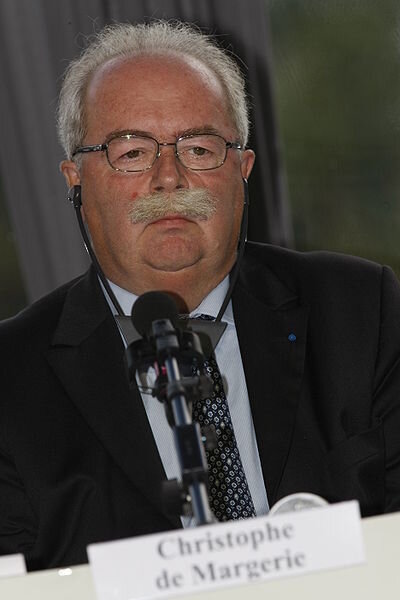
Is this new group a way of implementing Total’s cornerstone behaviors at the senior executive level?
Absolutely. Our cornerstone behaviors are boldness, listening, cross-functionality and mutual support. We call them the Total Attitude. These behaviors have become a real business model for us, which we apply across the board, and I’m convinced they’re what we need to stand out from the crowd.
Many people in France are skeptical about this kind of approach, but I’m struck by the fact that young people and non-French nationals have totally embraced the model. They consider it the way of the future. It’s not having the best seismic acquisition that will differentiate us - though, of course, we will have the best. It’s listening to others and treating producing countries like full-fledged partners, while helping them build schools, train local personnel and promote research.
Is cultivating personal relationships useful now that calls for tenders are becoming the norm and the awarding of blocks is an increasingly rigid process?
The way calls for tenders are currently organized is a mistake and I don’t think we’ll be able to continue doing it the way we do now. We saw that this year in Iraq. Some people criticized us, saying that we were being greedy when we refused to accept the financial terms and conditions imposed.
They thought we were being a typically arrogant major oil company. But I’m not backing down - it makes perfect sense to reject compensation of less than $2 per barrel when the price of oil is $80 and the capital expenditure involved is enormous. We’re talking about pretty complex fields and we’re the ones who have to carry the costs.
What’s your baseline price for making an investment decision and does it vary by project type?
We base all our assumptions on the same environment, namely the price of oil and gas, bearing in mind that we estimate them five to ten years forward, in line with the planned start date of the projects.
On the other hand, we don’t use the same terms of reference for all our projects. We use two very different yardsticks: one is the internal rate of return, or immediate return, and the other is value creation, which involves cash and long-term return.
The reason for that is we have projects that seem very lucrative but bring in little cash, because they’re short plateau. And with long-plateau projects, such as LNG or shale gas, you can have lower rates of return but greater value creation. They balance each other, so you need a mix of the two in your project portfolio.
What sort of oil and gas prices are you counting on for new capital projects?
Our budgets are based on a medium-term price of $80 for a barrel of oil and about $60 for a barrel of oil equivalent for gas. Keep in mind that during this transition period, we’re making sure that our projects will still be viable with oil at $60.
What are you relying more on organic gowth or acquisitions to drive cntinued growth?
Exploration remains our priority for growing Total. It’s the foundation of value added in a company like ours.
But you can only add 700 to 750 million barrels of resources a year through exploration, which isn’t enough to replace our reserves. We currently produce roughly 850 million barrels annually and we have to replace that every year, bearing in mind that our fields’ natural rate of decline is about 5%.
That’s why we make acquisitions. But there’s a big difference between acquiring 25% of Chesapeake’s Barnett Shale assets in Texas and acquiring a 25% stake in Chesapeake. We must be cautious and make sure that the payoff for our acquisitions is in line with our organic growth.
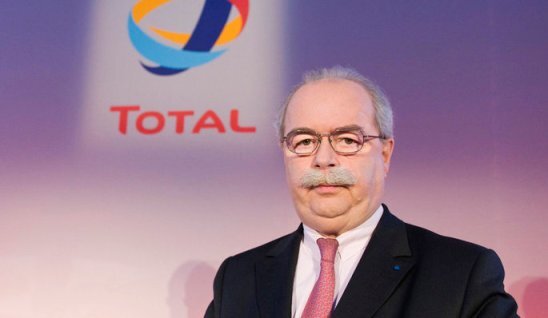
When it comes to acquisitions, are there some approaches that interest you more than others?
Exploration We’re increasingly inclined toward partnerships. For example, in marketing, we combined our retail network with Erg’s in Italy. It was a very profitable deal for both companies: the partnership made both of us more competitive and helped us achieve critical mass.
In exploration and production, acquisitions can involve either so-called conventional resources, our core business, or they can be made to learn about unconventional resources, as in the case of Chesapeake and shale gas.
Expanding our existing capabilities is still very important, but we don’t see anything wrong with learning from others. I’m not embarrassed to admit that in a few specific areas, some companies have more skills than we do. We have to partner with them to gain knowledge and expertise.
In the Gulf of Mexico, for example, we signed an agreement with Cobalt. It has demonstrated expertise in exploring that part of the world, but needs our deep offshore experience to develop its fields. This has the potential to be a win-win partnership. To penetrate new markets or develop new resources, you have to know how to work in partnership with others and drop the arrogant attitude oil majors are sometimes prone to.
I’d like to get back to refining for a second. You have announced that you want to scale back your refining capacity in Europe. Does refining still have a future ? What’s its outlook at Total?
As long as the growth in energy demand remains based on oil, especially for transportation applications, refining will be necessary. We never said we were pulling out of refining; we simply said that it had to be adjusted to demand. Today there is a real overcapacity problem, in both Europe and the United States.
We must also supply the market with the products it wants, in particular more diesel fuel, and products that meet environmental specifications. That’s why we upgraded the Gonfreville, Antwerp and Leuna refineries.
It’s also important to understand that our decision to invest in a project like the Jubail refinery in Saudi Arabia is not an example of offshoring. We’re not serving the same market and the Jubail refinery’s production is intended chiefly for Asian markets, not France.
Let’s wind things up by talking about your ongoing image problem in France. Is it really a problem, since it doesn’t stop you from making money?
The goal of a company is not just to make money. It’s to make enough money to grow profitably. It’s healthy for a company to be able to manage its future. In France, we’re regularly attacked for our earnings.
But posting a profit of €8 billion means nothing in and of itself and it’s not enough when you’re investing more than €13 billion annually. If we don’t earn more, we’ll have to change our strategy and scale back our operations. This message is starting to get through, but that’s not how we envision the future.
That said and in answer to your question, I think that changing the company’s image is worth the trouble. First, because nearly 100,000 people work at Total and are proud of it. Yet the negative image society reflects back to them still stings - even though our image isn’t nearly as black as it is sometimes painted.
We’re not having any problem hiring right now in France. In addition, a recent survey found that when the French are asked which company projects the best image of France abroad, we rank second. That surprised everyone - except for us here at Total.