Wittmann introduced an energy rating standard developed for dry air dryers
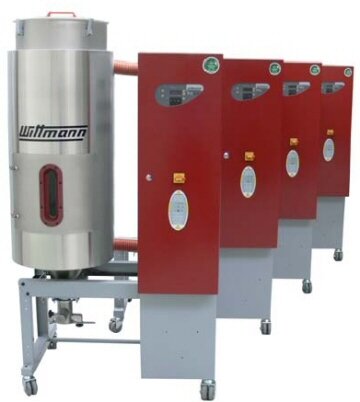
Many resin dryer manufacturers promote their units as being highly efficient and offering energy savings of 50% or more. However, when asked "How much energy does the dryer consume?" or "What is the basis of the energy savings?" there is often little data to support their claims. What the industry really needs is a standard test protocol for measuring dryer energy consumption. In the spring of 2008 Wittmann introduced exactly that.
Wittmann introduced an energy rating standard developed for dry air dryers which clearly defines the ambient conditions and the specific parameters for energy measurement. Basically, the test is performed with the dryer connected to a drying silo filled with resin to provide a true measure of airflow as mass per unit time, in order to determine the standardized energy consumption and arrive at a rating value.
All Wittmann compact dryers are now subject to an energy rating test under controlled conditions and the results displayed on a green energy rating sticker affixed to each dryer. However, only some other manufacturers offer any type of energy rating and test procedures vary, making any valid comparisons difficult at best.
Because of the number of inquiries about resin dryer efficiency, Wittmann has contacted EUROMAP (Europe`s association for plastics and rubber machinery manufactures) to offer their energy rating measurement protocol as the template for establishing a European rating standard.
Wittmann`s energy rating standard will allow processors to make their own comparison between different dryer manufacturers and dryer designs, capacities and energy saving features. The energy rating test provides not only actual energy consumption but some interesting results as up to 40% of the energy consumption can be reduced by simple investigation when selecting an energy efficient dryer. Wittmann`s Drymax dryers have been shown to offer both energy efficiency and excellent drying results without any disadvantages.
For example, the difference in dew point behavior can be determined under precisely defined and controlled ambient conditions during testing. Some dryers are unable to perform under typical summer conditions and cannot keep up as shown by the dew point class - a four scale rating of the ability to achieve a specific dew point. Other dryers fail and perform only like hot air dryers.
There was only one type of dryer tested that came close to the low energy consumption offered by Wittmann Drymax dryers but resulted in an insufficient dew point where the resin would absorb moisture. In this case, the dryer achieves low energy consumption but at the expense of dew point performance. The energy rating test was also performed on a honeycomb type dryer from a manufacturer with over 10 years experience in wheel technology. The result was a big surprise in terms of the higher energy consumption as the technology was thought to offer big energy savings.
The Wittmann Drymax ER60 incorporating Wittmann`s segment wheel technology provided a welcome result. Compared to the honeycomb wheel dryer, the differences in the construction detail were evident by the lower energy rating. Higher energy efficiency resulted from the use of desiccant beds versus the desiccant surface inside the honeycomb wheel. The constant dew point and the compact construction offered good performance under the extreme drying demands.
Based on a specified set of rating values it is possible to calculate the energy consumption for the actual resin drying beginning with the resin during the heat-up phase where the energy is dependent on the resin type, fill-in temperature and drying temperature. The heat-up energy can be determined independently of the drying equipment. With the typical fill-in temperature and drying temperature we can determine some important heat-up energy.
The total energy consumed for drying resin consists of the heat-up energy for the resin and the basic load of the dryer. In this example, we will compare the results for drying 60 lbs. of ABS per hour with a Drymax D60 versus a honeycomb wheel dryer.
The Honeycomb Dryer had the following energy consumption: Basic Load 2.4 kW + Heat up the resin 60 lbs./hr. * 9.0 kWh/1,000 lbs. = 2.94 kW or 0.049 kWh per lb of ABS.
The honeycomb dryer in fact required 70% more energy for the same drying demand! Thus, it is important to look at the real energy consumption and not only the 50% energy savings claim as suggested by many advertisements.
Wittmann invites processors interested in determining the energy rating for their specific resin dryer to bring it to their test facility in Groß-Umstadt near Frankfurt/M (Germany). The laboratory is equipped to measure the individual energy rating so the user can accurately determine the total energy savings between dryers.
Wittmann is the only manufacturer offering plastic processors worldwide a complete range of innovative robot automation and injection molding machine technology, along with auxiliary equipment for material conveying, blending, drying, granulating, heating and cooling - for individual work cells to fully integrated system solutions. Products include sprue pickers, robots, end-of-arm-tooling (EOATs), degators and complete automation work cells; injection molding machines, fully integrated materials handling systems with dryers, blenders, vacuum loaders and receivers, railcar unloaders, silos, pumps, central filters, tilt tables and surge hoppers; granulators; water flow regulators and mold temperature controllers.