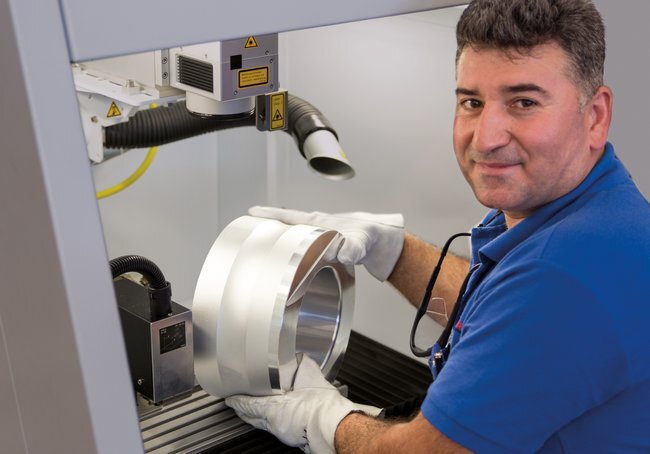
Large sonotrodes: pushing the limits
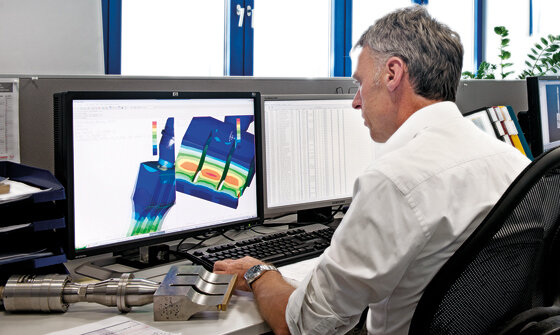
Three-dimensional joining of large parts is often difficult to implement. A particular challenge is posed by the need to transfer the optimum vibration energy in such a way that it can be reproduced at each point of the weld geometry. Optimum means that the oscillatory motion of the sonotrode, referred to as amplitude, is available in sufficient magnitude, including in difficult three-dimensional joint contours or very large joining parts. A perfect weld tool is now being developed by means of the finite element method (FEM). With this, the vibrating behavior is simulated on a computer with the aim of coming as close as possible to reality. In this process, particular attention has to be paid to undesirable secondary resonances (e.g. bending vibrations). With improvement of the algorithms and adjustment of the boundary conditions, the simulations become better and better, and agree even more closely with the end result. Most of the technical difficulties can thus already be solved in the simulation model – removing the need for elaborate and cost-intensive adaptation of the sonotrode.
As well as the simulation, the precise surveying of the sonotrode is also a decisive success factor. All natural frequencies (modes) with their typical vibration forms are surveyed by means of laser scanning vibrometers. This allows direct adjustment in accordance with the simulation. In oscillating condition, the amplitude is highly accurately checked at all the points that are relevant for the weld – it is not rare for this to include 50 different measuring points. The process demands in-depth knowledge of ultrasonic acoustics.
Another step in technical progress is the new software functions of the fully digital generators, which make it possible to run complex sonotrode geometries. The acoustic input signals of large-sized sonotrodes can be optimally adjusted. A precondition of this is that the ultrasonic converter converts these high-frequency electrical signals into mechanical vibration with no quality losses.
Surgical instrument handle: three-dimensional surface with height difference
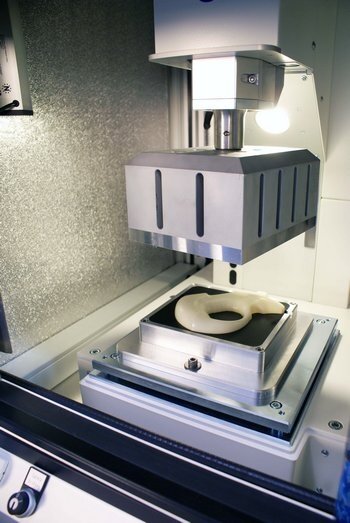
A weld tool is being developed for an American medical customer, to join the battery-operated handle of a liposuction instrument. This was presented for the first time at Medica 2015. Difficulties were posed by the size of the plastic handle and by the complex surface, with height differences of up to 12 mm in the joining area. Mapping the negative of the component contour on the weld tool, with a surface of 220 mm × 180 mm, and causing it to oscillate evenly is a masterpiece of vibration technology.
Wristbands: sealed edge trim
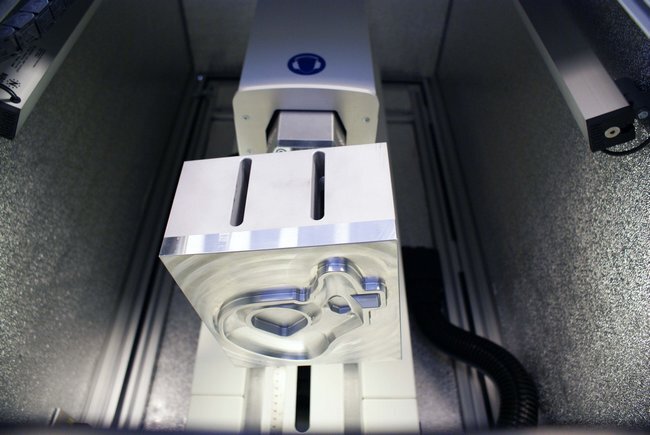
Here, two process steps are replaced: welding and cutting. Two velour-like nonwoven materials with gel pad inserts are welded together by ultrasonics, and at the same time the edge is trimmed, bordering the leading edge. The weld tool is designed and produced with a lot of development work as a square block sonotrode with an edge length of 220 mm. For reasons of wear and tear the sonotrode is not made of titanium but of hardened steel. Its production is complicated: with several slits on both sides and a weight of 45 kg. The hardening process must follow a precise temperature profile so that the structural change does not have a negative effect on the vibration parameters.
)
Overflow tank: watertightness is a must
For the joining of an overflow tank for a cooktop extractor fan, the customer had an in-depth look at alternative joining methods. Adhesive is too expensive as a consumable and takes too long to harden. In vibration welding, there are the disadvantages of high acquisition costs and possible generation of particles. Hot plate welding is not economical because of the long cycle time. With ultrasonic welding, the size of the two tank halves and the wall thickness is a challenge. The customer chose the ultrasonic weld process and followed Herrmann Ultrasonics’s recommendation for the realization of the joint geometry: an optimized tongue and groove design. With a two-part fixture, self-positioning and centering of the parts to each other is possible. A round sonotrode, produced from aluminum round material with a diameter of 260 mm, proved to have the optimal tool geometry.